
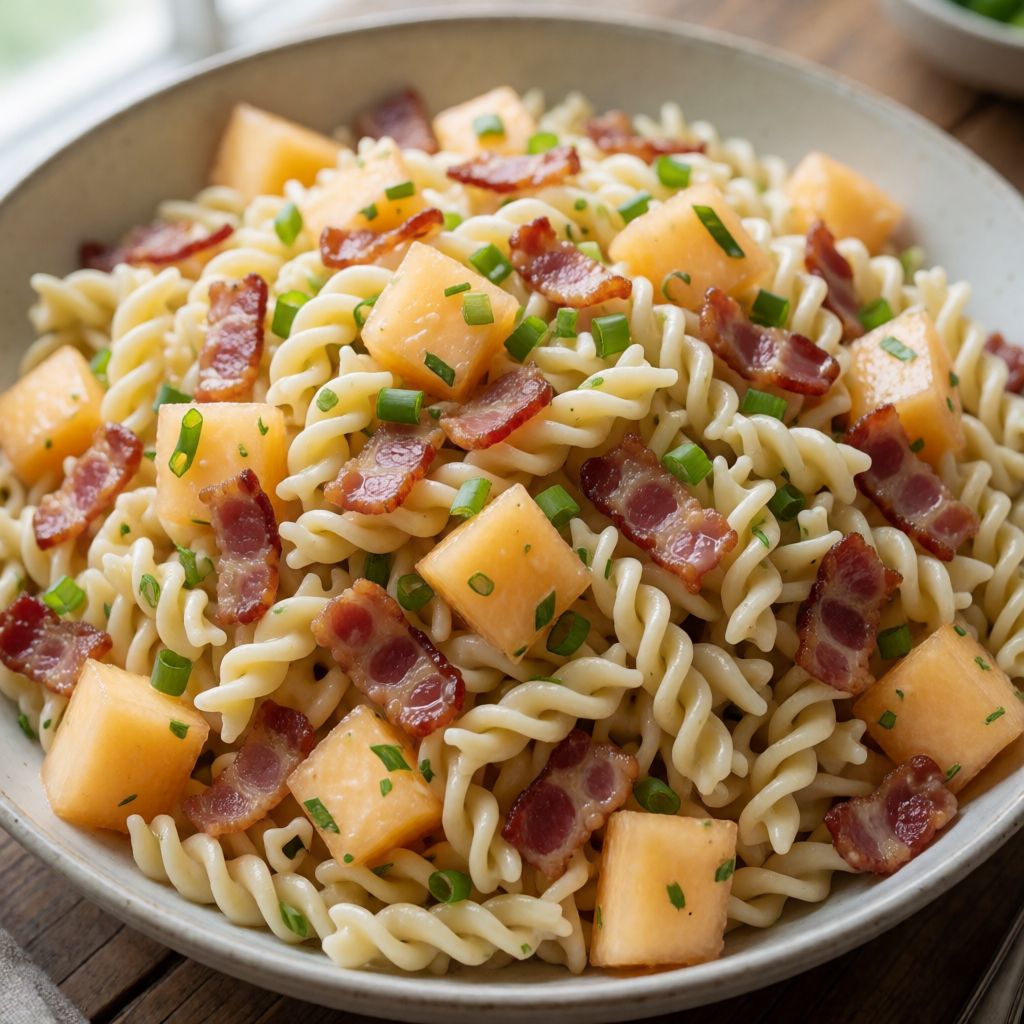
 AI photo
Pasta Salad with Melon and Bacon
A fresh pasta salad combining sweet melon, crisp bacon and a zesty lemon dressing with mint.
Labels are worked out automatically from the ingredients and can be wrong. Check the packaging if it matters to you.
Ingredients
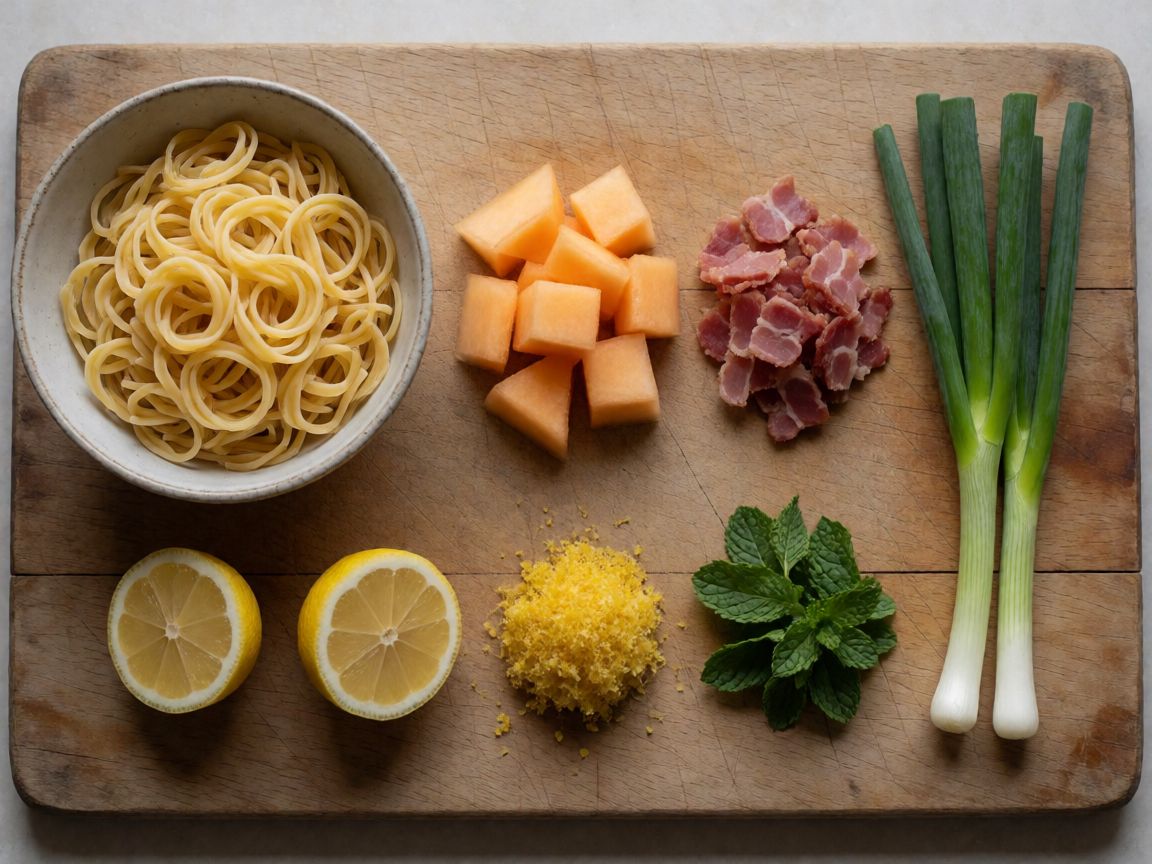
- 350 g Pasta
- 300 g Melon
- 50 g Bacon
- 4 pcs Spring onion
- 1/2 pcs Lemon for juice
- 1/2 pcs Lemon for zest
- Olive oil to taste
- Salt to taste
- Black pepper to taste
- Mint a few leaves









Steps
Peel the melon: cut it in half, then into wedges, remove the skin and dice the flesh.
Cut the lemon in half and squeeze the juice into a glass.
Take the lemon zest and finely chop half of it together with olive oil, salt, pepper and mint.
Wash and trim the spring onions. Slice the green part and fry it in a pan with oil, lemon juice and bacon.
Add 80 grams of diced melon to the dressing.
Put a pot of water on the heat, salt it and cook the pasta.
Drain the pasta al dente, 1-2 minutes before the time stated on the packet.
Put the pasta in a bowl, add the white part of the onion, the rest of the melon, the bacon and the dressing.
Add the lemon zest emulsion.
Season with salt and pepper. Chill in the fridge before serving.
30 min
This is a dish built on a contradiction, and the contradiction is the whole point. Melon is sweet and watery, bacon is salty and fat, and the thing that makes them sit together instead of just taking turns in your mouth is lemon — juice cutting through the fat, zest sitting on top of it with a bitter perfume the juice doesn't have. Pasta is the quiet one here: a carrier, not a flavour, which is exactly its job.
What decides whether this works isn't the pasta and it isn't the melon on its own — it's temperature management. You're taking a hot, salty, rendered-fat element (bacon fried with onion and lemon juice) and marrying it to raw, cold, sweet fruit, then cooling the whole thing down together so the flavours actually merge rather than just lying next to each other on the plate. Skip the chill and you've got a warm bacon salad with some fruit garnish — not wrong, just not this.
Some say melon and pasta together is a stunt, a "fusion" gimmick. No — because this is just the Italian habit of pairing melon with cured pork (think prosciutto e melone) pushed one step further: swap prosciutto for bacon that gets actually cooked, catch the rendered fat in a pan instead of leaving it raw on the plate, and use that fat as the base of a dressing. The logic hasn't changed, only the form.
The real skill move is splitting the melon in two: 80g goes into the hot pan to soften and release juice into the dressing — it half-dissolves, it becomes sauce. The rest stays raw and diced, so you get melon as both a liquid and a solid in the same forkful. That's not decoration, that's structure.
Pasta: 350g dried, any short-to-medium shape that holds a dressing in its curves rather than sliding off it — think shells, fusilli, penne. The "1-2 minutes before the packet time" instruction isn't fussiness, it's physics: pasta keeps cooking from residual heat as it drains and while it sits waiting to be dressed, and this dish asks it to then go cold in the fridge, which firms it up further. Pull it too soft and thirty minutes in the fridge turns it to paste. A wide pan of boiling salted water stands in fine for a pot — just don't crowd it, or the pasta clumps and cooks unevenly.
Melon: 300g, ripe enough that it gives slightly under the thumb near the stalk end — that's where the sugar concentrates first. Cantaloupe or a similar orange-fleshed melon gives you both sweetness and colour against the pasta; a green honeydew works but is milder, so taste and maybe add a touch more lemon juice to compensate. Underripe melon here is a real problem, not a minor one — it has texture but no juice to feed into that dressing, and the dish needs that juice.
Bacon: just 50g, which tells you it's there for salt, smoke and rendered fat, not bulk — this isn't a bacon salad, bacon is the seasoning. Streaky bacon renders more fat than back bacon and that fat is doing dressing-work, so streaky is the better pick. No bacon in the house? Pancetta or a few lardons do the identical job — salty, fatty, crisps up in a dry pan.
Spring onion, 4 of them, used in two different states — proof that one vegetable can do two jobs. The green tops go into the hot pan with the bacon and lemon juice, wilting down and taking on smoke; the white bulbs go in raw at the end, for the sharp bite that the cooked half has lost. Don't fry the whites with the greens — you'd lose the crunch that's the whole reason for keeping them separate.
Lemon, split the same way — juice into the pan to deglaze the bacon fat and stop it tasting purely greasy, zest kept apart and chopped fine into its own little emulsion with oil, mint, salt and pepper. Zest and juice taste different because they are different: zest carries the aromatic oils from the skin, juice carries acid and sugar. Treating them as interchangeable — "just use lemon" — is the myth to drop here; keep them apart and you get two separate lifts instead of one blurred one.
Olive oil: use something with no strong flavour of its own, since its job is to carry the mint and zest, not compete with them — a basic light olive oil or any neutral vegetable oil does this fine. Save a peppery extra virgin for drizzling at the table if you want, but don't cook the onions in it; strong olive oil turns bitter under heat and you'd taste that bitterness sitting on top of the bacon.
Mint, a few leaves, chopped into the zest-and-oil mix — it's doing what mint does with melon in every cuisine that pairs them, cutting the sugar with something green and sharp so the sweetness doesn't sit flat on the tongue. No mint, no disaster — basil gives a similar green lift, just a different direction.
The thirty-minute chill at the end isn't padding, it's an ingredient in itself — patience, doing the work that no amount of extra seasoning can do. Cold is what lets the bacon fat set just slightly, the pasta firm up, and the melon juice soak into the gaps instead of sitting as a puddle at the bottom of the bowl. Serve it straight from the pan and you'll taste separate things; give it the half hour and you taste one dish.