
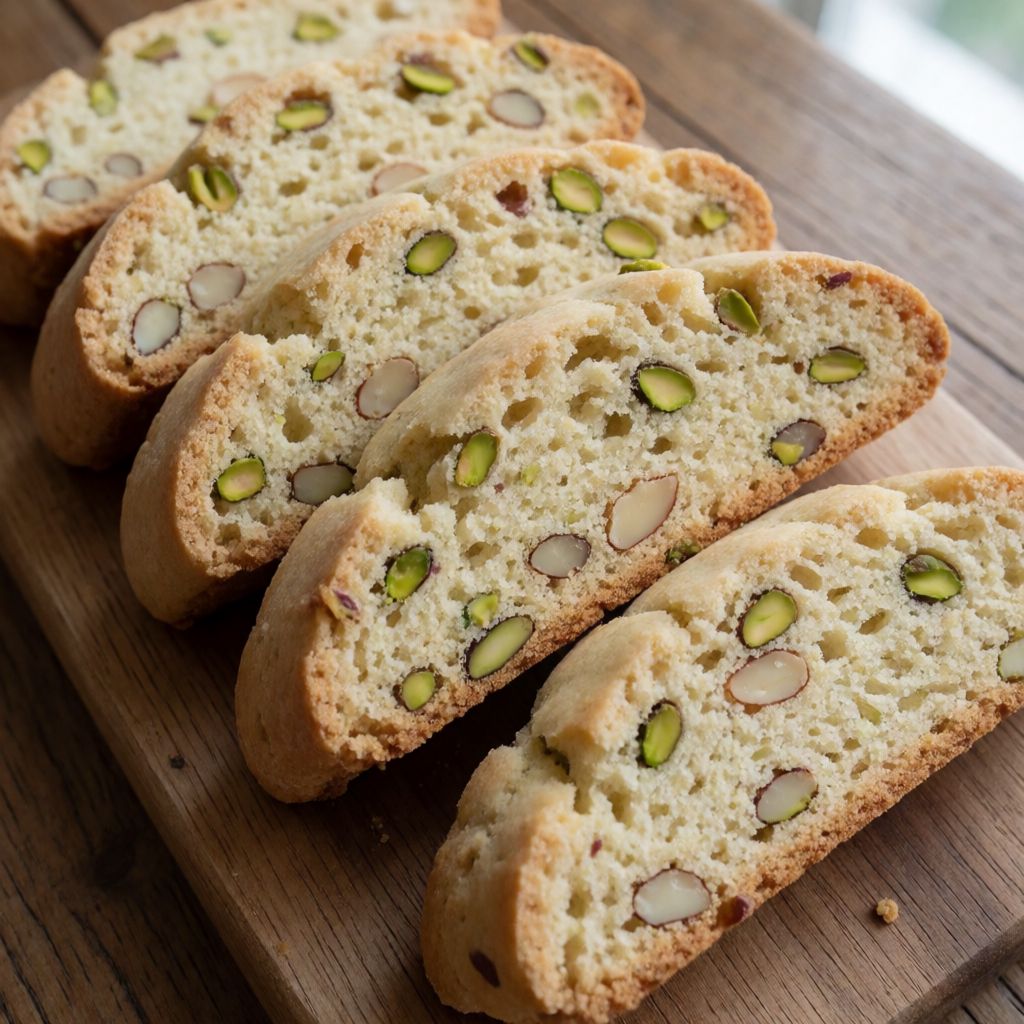
 AI photo
Savoury Cantucci
Savoury Italian-style biscotti made with parmesan, pistachios and almonds, baked twice until crisp.
Labels are worked out automatically from the ingredients and can be wrong. Check the packaging if it matters to you.
Ingredients
- 250 g Plain flour
- 70 g Parmesan
- 2 pcs Eggs
- 50 g Pistachios
- 70 g Almonds
- 1 tsp Baking powder
- 7 g Salt






Steps
In a large bowl, mix all the dry ingredients: sifted flour, baking powder, salt and parmesan.
Pile the mixture into a mound, make a well in the centre and pour in the beaten eggs.
Knead the dough by hand until it becomes soft and smooth.
Add the pistachios and almonds, distributing them evenly throughout the dough.
Knead the dough, wrap it in cling film and chill it in the refrigerator.
30 minShape the dough into a long log about 5 cm thick.
Place it on a baking tray lined with baking paper and bake in an oven preheated to 180°C.
30 minLet it cool, then cut into diagonal slices about 1-1.5 cm thick.
Place the cantucci on the baking tray and bake at 180°C, turning them over after 5 minutes.
Check that the biscuits are golden and crisp, then let them cool before serving.
What you're making here is the Tuscan twice-baked biscuit stripped of its sugar and dressed in parmesan — the same mechanism as a sweet cantuccio, pointed at a cheeseboard instead of a glass of Vin Santo. The double bake is the whole trick: you bake a log once to set its shape and cook the inside through, then you slice it and bake the slices again to drive the last moisture out of each cut face. That second bake is what makes a cantuccio a cantuccio and not just a hard bread roll — it's drying, not browning, that you're after.
What decides whether this works is patience in two places people skip. First, you let the log cool properly before you touch a knife to it. Cut it hot and the crumb is still full of trapped steam — it tears, crumbles, gives you ragged slices instead of clean ones. Second, you turn the slices halfway through the second bake. Skip that and the face touching the tray dries and colours while the top stays pale and slightly soft — not wrong exactly, just uneven, and uneven means some biscuits snap clean and others bend. You want them all to snap.
Some say cantucci have to be almond-and-aniseed, sweet, for dunking in dessert wine — no, because the thing that makes a cantuccio a cantuccio isn't the flavouring, it's the construction: a low-moisture egg dough, baked twice, dried rather than risen. Swap the sugar for parmesan and the almonds for a mixed handful of nuts and the mechanism doesn't notice. This is a legitimate biscuit, not a shortcut version of a 'real' one.
Flour here is just structure, not flavour, so plain flour is the right call — you're not trying to build a big open crumb that needs strong gluten, you're building a dense dough that has to slice clean. If all you have is bread flour, it'll still work, just knead a touch less so you don't toughen it.
Parmesan is doing two jobs at once: salt and savoury depth, and a bit of dry protein that firms the dough as it bakes. The criterion for a substitute is hard, dry, low-moisture, strongly flavoured cheese — Grana Padano or an aged pecorino both qualify (cut the added salt a little if you use pecorino, it's saltier). A mature hard cheddar will get you most of the way there in a British kitchen, though it won't taste the same — it's waxier and milder, so expect a gentler result, not a worse one.
The eggs are the only liquid and the only fat in this dough — there's no butter or oil to soften things. That matters because it's the egg quantity that controls how wet the dough is, and a wetter dough is a dough that spreads instead of holding its shape as a log on the tray. If your eggs run large, you may need a spoonful more flour to bring the dough back to 'soft and smooth' rather than sticky.
Pistachios and almonds split the job between them — pistachio for colour and a softer bite, almond for the harder crunch that gives cantucci their backbone. The rule for substitution is simple: any nut hard enough that biting it doesn't feel like biting nothing — hazelnuts or walnuts work, pine nuts are too soft and will just disappear into the crumb. Keep roughly the same total weight so the ratio of dough to nut stays the one the recipe was built around.
Baking powder and salt are small in quantity but not optional. The baking powder isn't there to make this rise like bread — it just lifts the crumb slightly so the slice isn't dense all the way through, which also helps the second bake dry it evenly rather than just baking a brick. The salt in a savoury version is pulling weight the sugar does in the sweet one — it's not a seasoning afterthought, it's balancing the parmesan.
On a domestic hob and an ordinary fan oven, watch the biscuits in the second bake rather than trusting the clock blindly — fan ovens run hotter and drier than the dial suggests, which is exactly the kind of thing that speeds up a drying bake. Golden and firm to a light press is your cue, not a number. And once they're cooled and hard, these have nothing to do with tea and milk — serve them with a cheese board at the end of a Sunday roast, or alongside soup, where their saltiness and crunch are doing real work rather than competing with sugar.