
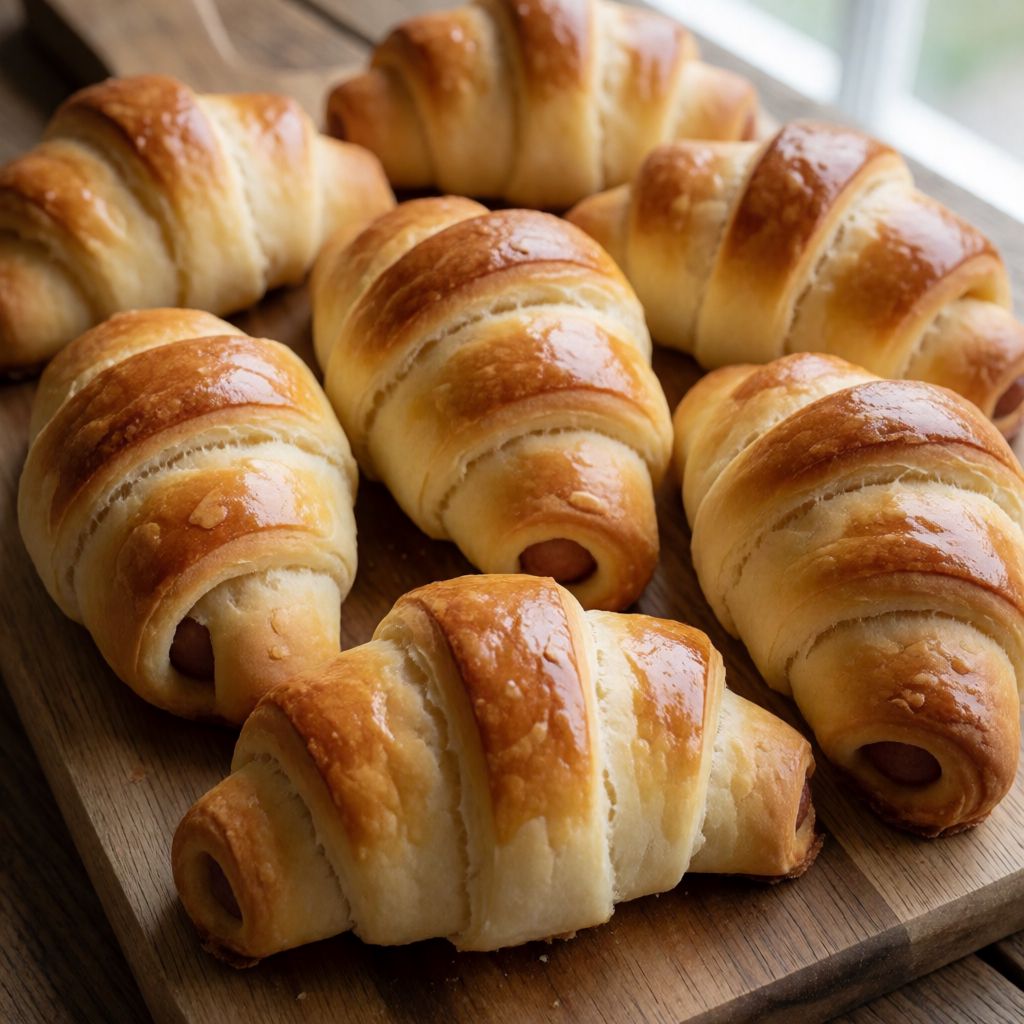
 AI photo
Sausage Rolls (Rogaliki Style)
Soft yeasted dough rolled around little sausages, brushed with egg and sesame — a fun homemade take on sausage rolls.
Labels are worked out automatically from the ingredients and can be wrong. Check the packaging if it matters to you.
Ingredients
- 20 g Yeast
- 100 ml Milk at room temperature
- 100 ml Yogurt
- 1 pcs Egg
- 1 tbsp Sugar
- 75 ml Olive oil
- 300 g Plain flour
- 100 g Wholemeal flour or graham flour
- 1 tsp Salt
- 8 pcs Frankfurter sausages
- 1 pcs Egg beaten, for glazing
- 1 pinch Sesame seeds
- 50 g Ketchup
- 50 g Tomato purée













Steps
Dissolve the yeast in room-temperature milk, add the yogurt, olive oil, sugar and egg, and mix well.
Gradually add the salt and flour, continuing to mix.
Knead the dough for 5–10 minutes, ideally in a mixer, until it becomes smooth and elastic.
10 minLeave the dough to rise in a bowl, covered with a clean towel, for an hour on the kitchen counter.
60 minDivide the dough in half and roll out into two circles, cutting each like a round pie into 8 equal triangles.
Spread the triangles with ketchup, or a mix of ketchup and tomato purée — a favourite variation.
Cut the sausages in half, place a piece at the wide end of each triangle and roll the dough around it.
Arrange on a lined baking tray and leave to rise for another hour on the kitchen counter, covered with a clean towel.
60 minBrush with beaten egg and sprinkle with sesame seeds.
Bake in a preheated fan oven at 175°C for about 14–15 minutes.
15 min
This is a croissant that went to work in a sausage factory — the shape of a French viennoiserie, the soul of a Soviet school canteen snack. Rogaliki means "little horns," and that's the whole geometry: a triangle of yeasted dough rolled around a sausage so the fat ends curl in like a crescent moon. What decides whether this works is not the filling — it's the dough, and whether you treat it with the patience a yeasted dough actually demands rather than the patience you'd give a quick bread.
Two rises, an hour apart, on the counter and not in the fridge — that's the engine here. Some say you can skip the second rise and just bake once the rolls are shaped. You can, but the dough will be tight and close-grained, because the yeast hasn't had time to re-inflate the gluten network you knocked flat when you rolled and cut and wrapped. The second rise isn't decoration — it's the dough recovering from the violence you just did to it with a rolling pin.
What you're aiming for by eye: dough that's gone from a stiff disc to something soft and slightly domed, that springs back slowly when you press a finger into it rather than snapping back instantly or staying dented. That's doneness for proofing — not a clock reading "60 minutes," though 60 minutes is your floor, not your target, especially in a cool British kitchen in winter where your counter might sit at 16°C rather than the 22°C a recipe writer in Moscow is assuming.
Yeast first, dissolved in milk that's actually at room temperature — not warm, not blood-heat, just left out of the fridge long enough to stop fighting the yeast. Some people scald milk for yeasted dough out of an old habit from when milk was unpasteurised and needed killing off before it would let yeast work. Shop milk today doesn't carry that enzyme that attacks gluten the way raw milk could — so skip the heating ceremony. Warm milk (properly hot) will just kill your yeast outright, which is a much bigger problem than the myth it's solving.
The yogurt and egg in the dough aren't filler — yogurt's acidity softens the gluten slightly so the dough stays extensible enough to roll out thin without springing back and shrinking your triangles, and the egg adds fat and protein that gives the crumb a close, slightly rich texture rather than the open holes of a plain bread dough. Olive oil here just needs to be any oil with no smell of its own strong enough to fight the sausage — a flavourless sunflower or rapeseed oil does the same structural job if that's what's in the cupboard; save the extra virgin for the salad.
Sugar is one tablespoon, not for sweetness you'll taste but to feed the yeast fast in the first twenty minutes and to help the crust brown — without it you'd get a paler, slower-rising dough, especially relevant given you're already asking the yeast to work twice.
The sausages: frankfurters are specified because they're already cooked, already the right diameter to disappear inside a rolled triangle, and they won't leak fat everywhere in the oven the way a raw British sausage would. If you only have raw sausages, you'd need to cook them through first — the rolls get fifteen minutes at 175°C, nowhere near enough to cook raw meat safely, only enough to brown dough that's already proofed and set an egg wash into a shine.
Ketchup and tomato purée together rather than ketchup alone — ketchup brings sugar and vinegar sharpness, tomato purée brings concentrated tomato body without the sweetness, so mixing them stops the filling tasting like a condiment and more like a sauce. Use what you've got; straight ketchup works, it's just a one-note version.
175°C in a fan oven, 14 to 15 minutes as your floor — what you're watching for is the egg wash turning from wet-yellow to a deep burnished gold, glossy, and the sesame seeds toasting a shade darker. If your oven runs hot or cold against its own dial (most domestic ovens do, by ten degrees either way), that colour change is your real thermometer, not the timer.
This recipe makes sixteen rolls from one batch of dough — enough for a Sunday afternoon when the roast's resting and you want something for the kids to eat standing up, or a tea-break snack with a cup of tea with milk, which, structurally, is exactly the kind of thing rogaliki were built for back when this recipe would've fed a classroom at morning break rather than a dinner table. The patience part — the two hours of rising you can't see, hidden inside "prep: 135 min" — is the actual ingredient doing the work while you do something else entirely.