
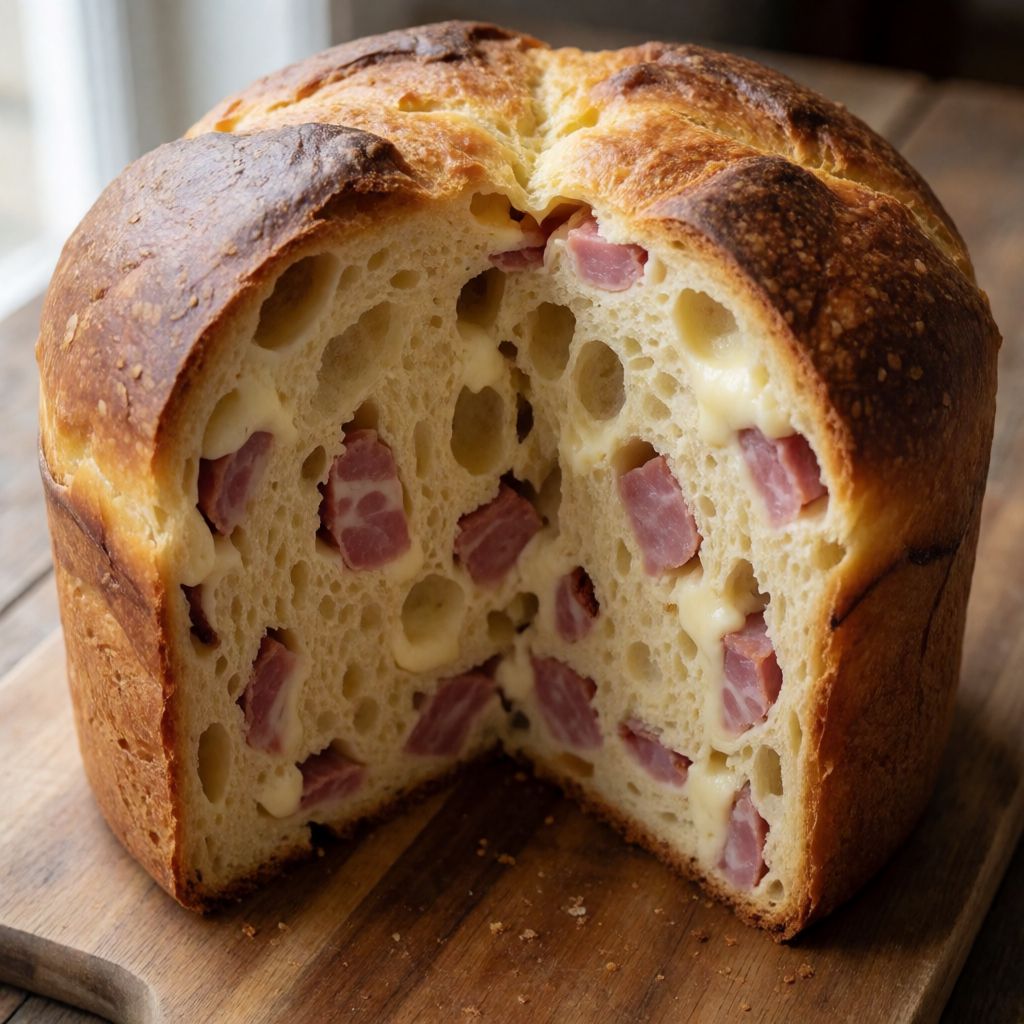
 AI photo
Savoury Panettone with Cured Meats and Cheese
A savoury version of panettone, enriched with cured meats and cheese.
Labels are worked out automatically from the ingredients and can be wrong. Check the packaging if it matters to you.
Ingredients
- 250 g Plain flour
- 250 g Strong flour
- 15 g Yeast
- 3 pcs Eggs
- 30 g Caster sugar
- 10 g Salt
- 150 ml Milk
- 100 g Butter
- 200 g Low-moisture mozzarella
- 100 g Mortadella
- 50 g Prosciutto
- 50 g Salami Napoli
- Seed mix for decoration to taste
- Almond flakes to taste









Steps
Pour the flour into a bowl, add the sugar and crumbled yeast. Pour in the warm milk.
Add 2 lightly beaten eggs. Begin kneading the dough with a dough hook or by hand, working vigorously on the work surface.
Once the dough starts to come together, gradually work in the butter in small pieces, 2-3 at a time.
Add the salt and continue kneading the dough (by hand or in a mixer) for about 15 minutes, until smooth and elastic.
15 minShape into a ball, cover with cling film and leave to rise until doubled in size.
150 minCut the mortadella, prosciutto, Salami Napoli and low-moisture mozzarella into cubes.
Roll out the risen dough into a rectangle with a rolling pin. Spread the filling evenly over the surface.
Fold the dough in two or three, like a book, and gently knead by hand to distribute the filling evenly inside.
Shape into a smooth ball and place in a low paper panettone mould.
Cover with cling film and let the dough double in size.
120 minBrush the surface with beaten egg mixed with milk, and decorate with the seed mix and almond flakes.
Bake in a preheated oven at 180°C (static/conventional) for about 45 minutes.
45 min
What was changed
The cheese was swapped for low-moisture mozzarella Low-moisture mozzarella, as it is more readily available in UK shops.
This isn't the sweet panettone you know from the Christmas aisle, dusted with icing sugar and sitting next to the Lindt balls. Same silhouette, same tall paper mould, completely different job: this one's built to hold cold cuts and melted mozzarella instead of candied peel. Think of it as a savoury brioche that's learned the shape of a celebration bread because that shape — a column, enriched, slow-risen — happens to suit a filling that needs pockets of air to sit in rather than a dense crumb to get lost in.
What decides whether it works is the dough, not the filling. Mortadella and prosciutto are forgiving; they don't care much how they're treated. The dough does. It's an enriched dough — butter and egg pushed into a flour-water structure that would really rather stay simple — and enriched doughs are slow by nature. Butter coats the gluten strands as you work it in, which is exactly why you add it bit by bit once the dough has already started to come together: throw it in all at once and it blankets the flour before gluten has formed, and you get a slack, greasy mess that never develops strength. Add it gradually and the dough has already built its net before the fat tries to soften it.
On the two flours: strong flour (high protein, bread flour in UK terms) gives you the gluten backbone that can carry butter, egg and a kilo of ham without collapsing. Plain flour alone, weak as it is, would give you a soft crumb but no scaffolding — fine for a Victoria sponge, wrong here. Mixing the two halves your risk: full strong flour can go tough and chewy when enriched this much, full plain won't hold the filling's weight. If you've only got plain flour in the cupboard, your loaf will be flatter and denser — still edible, just not the same bread.
The yeast and the warm milk: warm, not hot. Yeast is a living thing, and above a certain point — the point where the milk stings your wrist rather than feels like bathwater — you kill it rather than wake it. Some say you need the milk "hot to activate the yeast" — no, because heat that kills yeast cooks eggs too, and you'd be making custard, not bread. Lukewarm is the whole instruction; there's no thermometer needed, your wrist already has one.
The eggs do two jobs: they enrich the dough (protein and fat, same logic as the butter, same reason they go in early rather than being saved back), and the third one, beaten with milk, becomes the wash that gives you colour and a surface for the seeds and almonds to stick to. Without egg wash the top stays pale and the decoration falls off in the oven draught — that's the actual reason for brushing, not prettiness for its own sake.
On the filling: mortadella brings fat and softness, prosciutto brings salt and a dry chew that contrasts it, salami Napoli brings the spice kick, and low-moisture mozzarella is the one doing structural work — "low-moisture" matters because the fresh, wet kind (the ball sitting in its own water, the kind you'd tear onto a pizza) will leak whey into your dough as it bakes and leave you with a soggy patch instead of pockets of pull. If you can't get low-moisture mozzarella, a firm provolone or a mild cheddar — anything that holds its shape and doesn't weep — will do the same job honestly. Cube everything to roughly the same size; a chunk of salami twice the size of its neighbours either stays cold at the centre or tears the dough as it's folded.
On folding it in like a book: this isn't decoration either. Rolling the dough flat and folding it over the filling, rather than kneading the meat straight into a ball of dough, spreads everything in layers instead of clumps — so every slice you eventually cut gets a bit of everything, rather than one lucky slice getting all the mortadella and the rest getting none.
On the oven: 180°C static is a moderate, steady heat — gentle enough that an enriched dough this tall cooks through to the centre before the crust hardens shut. A fan oven circulates air harder and will dry and colour the crust faster, so if that's what you've got, drop it roughly 20°C and keep an eye on the top rather than trusting the clock. And the clock here really is a floor, not a verdict: 45 minutes gets you close, but the bread tells you when it's done by sound and feel, not by the timer — a cooked loaf sounds hollow when you knock the base, and a skewer through the centre comes out without wet dough clinging to it. If the top's browning before that happens, loose foil over it buys the inside more time without burning the crust — that's the actual fix, not opening the oven door to "check," which just lets the heat out and slows everything down.
Patience sits in both proving stages, and there's no way round it with a warmer kitchen or more yeast — you'd get a bread that's risen but tastes raw of yeast, gassy rather than savoury. Two and a half hours of total proving is the dough doing the one thing dough does slowly: building flavour while you get on with something else. That's not wasted time, that's the recipe working while you're not watching it.