
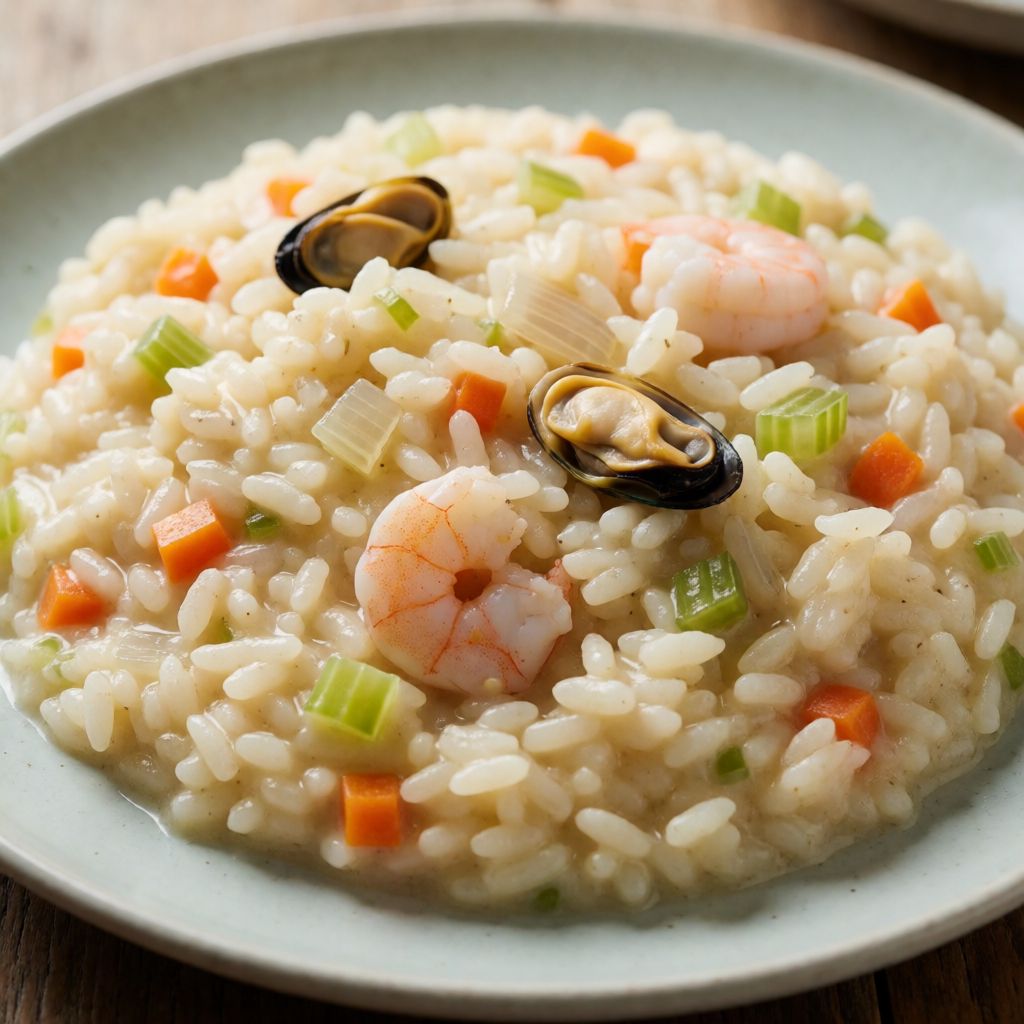
 AI photo
Seafood Risotto
A creamy seafood risotto with squid, prawns, mussels and clams in a fragrant seafood stock.
Labels are worked out automatically from the ingredients and can be wrong. Check the packaging if it matters to you.
Ingredients
- 180 g Carnaroli risotto rice
- 1 pcs Onion
- 1 pcs Carrot
- 1 pcs Celery stick
- Salt to taste
- Black pepper to taste
- 50 g Squid
- 50 g Prawns
- 50 g Mussels
- 50 g Clams
- 125 ml White wine
- 1 pcs Tomato
- Parsley to taste, chopped
- 20 g Butter
- 2 tbsp Olive oil
- 1 clove Garlic
















Steps
Rinse the mussels and remove the beards, put them in a pot over medium heat so they open and release their liquid. Discard any that don't open, and remove the shells from the open ones.
Boil the prawns, clams and chopped squid for 5 minutes, then drain. Peel the prawns and put the shells into a pot with half the carrot, half the onion, the celery stick and the mussel liquid.
5 minAdd water and bring to the boil to make a fragrant seafood stock.
Cut the tomato into pieces and pass it through a sieve. Peel the garlic and cut it into thin slices, finely chop the remaining carrot and onion.
Heat the olive oil in a wide pan, add the garlic and chopped vegetables, and sauté until lightly golden.
Add the rice and sauté briefly, then pour in 125 ml of white wine, and add salt and black pepper to taste.
After a few minutes add a little stock and cook for 5 minutes, until the rice has fully absorbed the liquid.
5 minGradually add the rest of the stock, stirring occasionally with a wooden spoon, until the rice is half cooked.
Add the sieved fresh tomato and the seafood, adding more stock if needed, and cook the risotto until done, about 20-30 minutes.
25 minAdd 20 g of butter and mix the risotto well so it becomes creamy, then add the chopped parsley and cook for 2 more minutes on low heat.
2 minServe the risotto immediately, with a glass of white wine if you like.
Risotto isn't a rice dish with seafood dropped in — it's a starch-extraction process, and the seafood is almost incidental to the mechanism. What makes it "creamy" has nothing to do with cream. Carnaroli grains have a hard core and a soft, starchy coat. Stir the grains against each other in a thin film of hot liquid and you scrub that starch off the surface. It dissolves into the stock around the rice and turns it into a loose, glossy sauce — that's the whole trick, and it's why the rice must never actually boil in a flood of water like pasta. Flood it and the starch washes away into the pot instead of staying as a coating; you get wet rice, not risotto.
So the two things that decide whether this works are: the stock, and your attention. The stock needs to taste of the sea before it touches the rice — that's why you boil the prawn shells and vegetable scraps separately rather than just tipping plain water in. Shells hold flavour that the meat doesn't, and throwing them away is throwing away half the dish for no reason. Your attention matters because risotto is fed, not left: a ladle of hot stock, stir, wait till it's gone, another ladle. Some people add it all at once to save time — that's a different, decent dish, but it isn't risotto, because the grain-on-grain friction is what releases the starch, and friction needs repetition, not a single pour.
Carnaroli is specified for a reason, not snobbery: it has more of that starchy outer layer relative to its firm core than ordinary rice, and it holds its bite longer while still giving up starch. Arborio works and is far easier to find in a UK supermarket — slightly softer, slightly less forgiving if you overcook it, but it'll get you there. What you can't substitute is any rice bred to stay separate and fluffy — basmati, jasmine, long-grain — because those varieties are selected for the opposite of what you want here. Wrong rice is the single most common reason home risotto turns to porridge or stays stubbornly dry: it was never built to release starch in the first place.
The soffritto — onion, carrot, celery, all finely chopped — isn't flavour for its own sake, it's the base note under the seafood, and it needs to go soft and faintly sweet in oil before the rice ever joins it, not brown and bitter. Watch it, don't time it: the onion loses its raw white-purple sharpness and turns translucent, the carrot gives a little under the spoon instead of staying rigid. Use olive oil here, or any neutral oil with no scent of its own, because you don't want a second competing smell before the sea flavours arrive — butter at this stage would brown and add a dairy note too early; it's saved for the end, where its job is different.
The wine goes in once the rice has had a minute in the hot oil, coated and slightly translucent at the edges — that minute toasts the grain's surface just enough that it won't turn gluey later, a step people skip because it looks like nothing is happening. The wine's alcohol needs to cook off, not sit there raw and sharp; you'll smell the difference, sharp and winey versus rounded and almost disappeared. Any dry white you'd actually drink works — don't reach for "cooking wine," which is usually salted and stale and a false economy for 125ml.
The stock from the prawn shells, scraps and mussel liquor is doing the work that a fish stock cube can't: real depth without the flat saltiness of a cube, built from parts you'd otherwise bin. This is kitchen economics, not romance — a grand kazan-cooked Spanish or Italian seafood rice tradition grew up around using every scrap of an expensive catch, because throwing away flavour when you've paid for the whole animal never made sense to anyone poor. If you genuinely have no shells to spare, a light fish or vegetable stock will carry you, but keep it thin and clean — a heavy, salty commercial stock will fight the delicate shellfish rather than support it.
Mussels and clams are temperamental and worth respecting rather than fearing: any that stay shut after cooking are shut because they were dead before you started, and a dead shellfish doesn't suddenly open from heat — it's sealed, not stubborn. Discard those without a second thought; it's not wastefulness, it's the one food-safety rule in this whole dish that isn't negotiable.
Patience is the actual ingredient that makes this a two-person Sunday dish rather than a Tuesday one — not a long active effort, but a long attended one, ladle by ladle, staying by the pan instead of leaving it. The butter stirred in at the very end, off rough heat, is what pulls all that released starch and stock together into something that moves like a wave when you shake the pan, not a solid clump. Skip that final beat and you've made good seafood rice. Do it, and you've made risotto.