
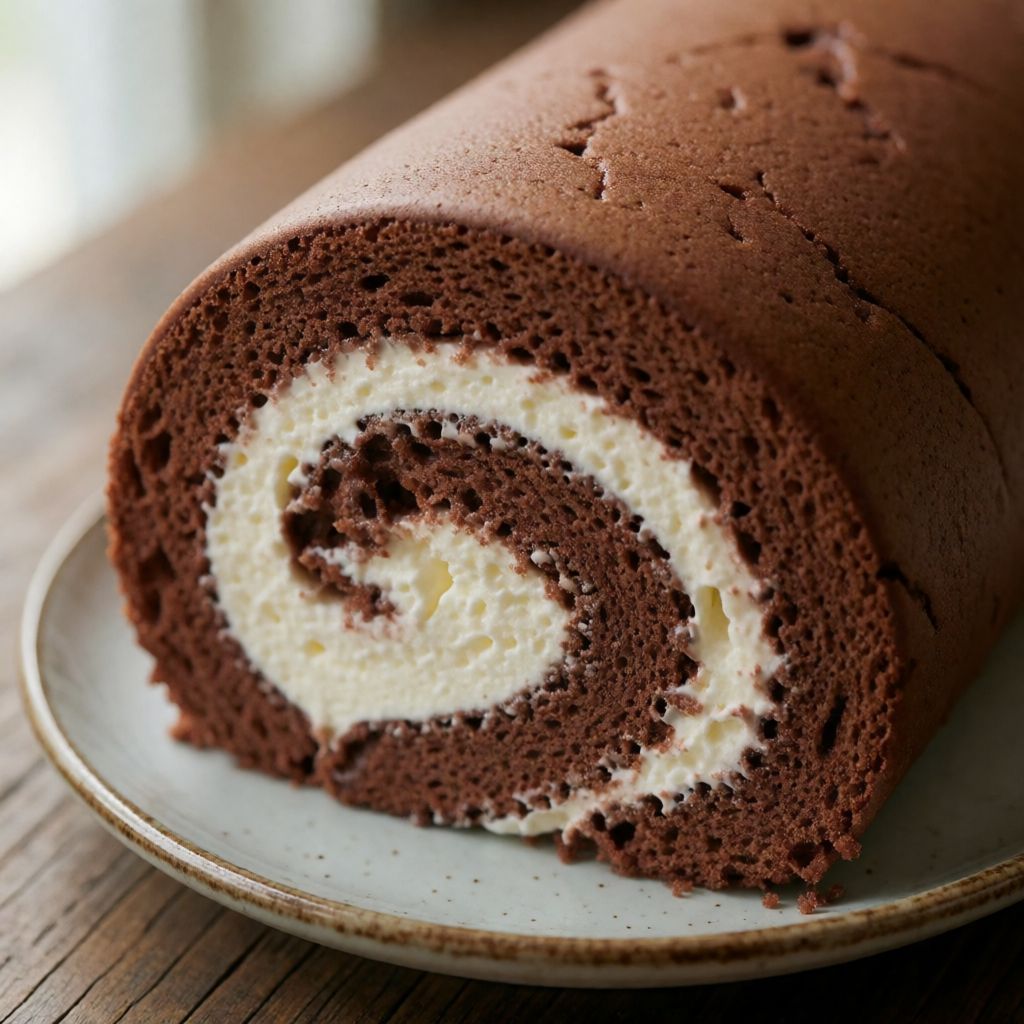
 AI photo
Chocolate Swiss Roll
A light sponge roll filled and coated with a rich dark chocolate ganache.
Labels are worked out automatically from the ingredients and can be wrong. Check the packaging if it matters to you.
Ingredients
- 4 pcs Eggs
- 130 g Sugar
- 100 g Plain flour
- 8 g Baking powder
- 1 tsp Vanilla extract
- 500 ml Double cream
- 600 g Dark chocolate







Steps
Whisk the eggs and sugar with an electric mixer until pale and fluffy.
Add the vanilla extract and mix until smooth.
Gently fold in the sifted flour and baking powder with a spatula.
Spread the batter evenly onto a baking tray lined with parchment paper.
Bake in a preheated oven at 180°C for about 10 minutes.
10 minCover the sponge with parchment paper and leave to cool completely.
Bring the double cream to the boil.
Add the dark chocolate, broken into pieces, let it sit, then stir until you have a smooth ganache.
Leave the ganache to cool slightly.
Carefully peel the parchment off the sponge and trim the edges.
Brush the surface with milk, spread half of the ganache over it evenly.
Roll up the sponge using the parchment, starting from the short side, wrap tightly and cover with cling film.
Place the roll in the fridge to set.
Place the roll on a wire rack and pour the remaining ganache over the top to cover it completely.
Chill in the fridge until the glaze sets.
A Swiss roll is really two separate pieces of cooking engineering stuck together under one name: a sponge that has to bend without cracking, and a ganache that has to be soft enough to spread but firm enough to hold a shape once it's cold. Everything in the method is there to manage those two facts.
The sponge works because of air, not fat. There's no butter or oil in it — the lift comes entirely from eggs whipped with sugar until the mixture is pale and holds a ribbon when you lift the whisk, plus a small hit of baking powder as backup. Whip eggs and sugar and you're beating in thousands of tiny bubbles stabilised by egg protein and sugar syrup; that structure is what lets the sponge stay thin and flexible instead of turning into a biscuit. Fold the flour in gently for the same reason you'd handle a soufflé gently — knock the air out and the roll won't bend, it'll snap.
Baking it thin and hot, then cooling it under paper rather than open to the air, is the part people skip and then wonder why it cracks. A thick sponge sets stiff all the way through and has no give. A thin one baked at a temperature that sets the crumb fast — around 180°C, enough to set the structure before it dries out — stays pliable. Covering it while it cools keeps the surface from drying into a crust; a dry crust is exactly what splits when you roll it. Some people blame "bad flour" or "bad eggs" when a roll cracks. No — it's almost always a sponge that cooled uncovered, or one that's thicker than it needs to be.
The fridge does the work an oven can't. Rolling a warm sponge around a ganache that's still loose gives you something that holds its shape only because you're pressing cling film around it — unroll that film too soon and it slumps. Chilling it set, firm enough to hold its own curve, is what lets you then stand it on a rack and pour more ganache over the top without the whole thing collapsing under the weight of the glaze. Patience here isn't a virtue for its own sake — it's the only thing separating a tidy roll from a puddle of cream and chocolate on a plate.
On eggs: four, whisked with sugar until the mixture triples in volume and falls off the whisk in a thick ribbon that sits on the surface for a second before sinking back in — that's the real doneness cue, not a stopwatch. Room-temperature eggs whip faster and hold more air than cold ones straight from the fridge, so if you've time, take them out beforehand; if you haven't, it still works, just takes longer at the mixer.
Flour and baking powder are the structure, not the rise — plain flour with a separate measured baking powder gives you more control than self-raising, where you can't adjust the amount. Sift it in and fold with a spatula in big slow strokes, cutting down and turning, not stirring in circles — stirring collapses exactly the bubbles you just spent five minutes whisking in.
Double cream is non-negotiable in the sense that it's the fat content doing the job: at roughly 48% fat it can carry melted chocolate and still set firm when cold, the way a lighter single cream can't — single cream will give you a glaze that never quite sets and a filling that weeps. Dark chocolate, broken into fairly even pieces so it melts at the same rate, gives the ganache enough cocoa solids and fat to firm up on chilling; swap in milk chocolate and you'll need less cream, because milk chocolate already carries extra milk fat and sugar and the ganache will set softer and sweeter than you want.
Vanilla extract is there for its own flavour, not as some mandatory ritual — leave it out if you don't have it and nothing structural changes. The brush of milk on the sponge before spreading the ganache is a small, practical move: it stops the sponge drying out at the point of contact and helps the first layer of ganache grip instead of sliding when you roll. If you're out of milk, a light brush of any mild syrup does the same job — the point is moisture, not the specific liquid.
If you don't have a mixer, know that whisking eggs and sugar to the right volume by hand is a long, arm-aching job, not a quick one — people reach for an electric mixer here for a reason, and it isn't laziness, it's that whipping enough air in by hand to carry a sponge with no added fat takes real time. And if your oven runs hot or cold against its dial, watch the sponge rather than the number: it's done when it springs back from a light touch and the edges just start to pull from the tin, not at some fixed minute mark that assumes your oven agrees with its own thermostat.