
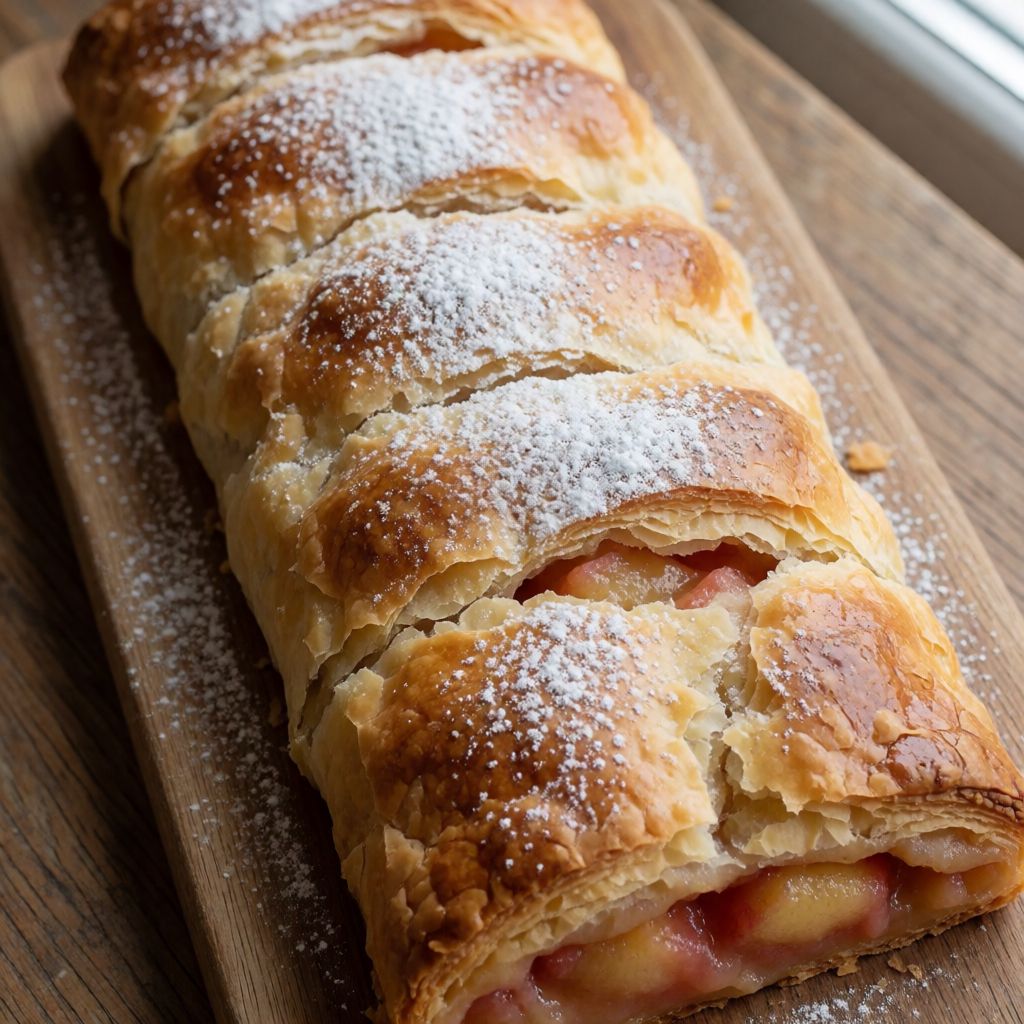
 AI photo
Quince Strudel
A homemade strudel filled with quince, raisins and pine nuts, fragrant with lemon zest and cinnamon.
Labels are worked out automatically from the ingredients and can be wrong. Check the packaging if it matters to you.
Ingredients
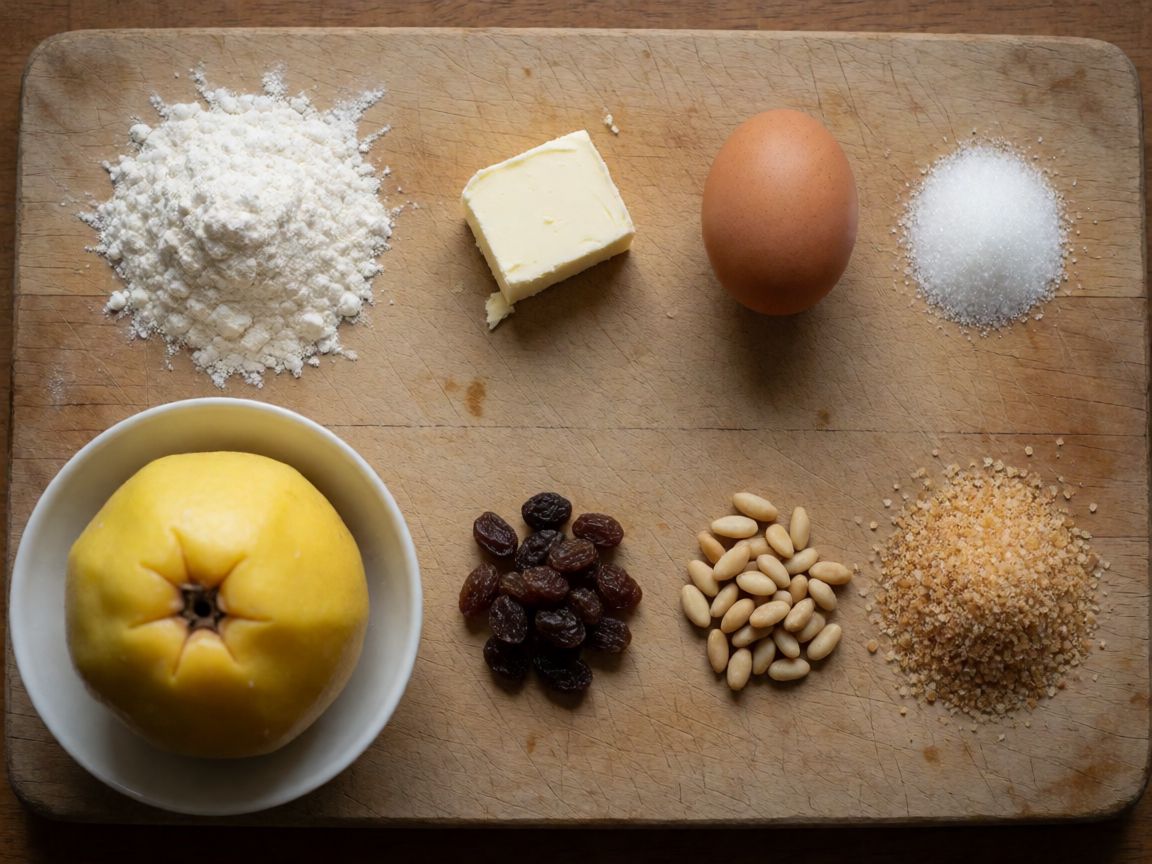
- 320 g Plain flour
- 150 g Butter
- 1 pcs Eggs
- pinch Salt a pinch
- 70 g Caster sugar
- 1 kg Quince
- 50 g Raisins
- 50 g Pine nuts
- 70 g Breadcrumbs dried
- 1 pcs Lemon zest
- 2 tsp Lemon juice
- 1 tsp Cinnamon
- 1 tbsp Apricot jam
- 70 ml Water
- pinch Icing sugar to taste











Steps
Sift the flour, add the salt, butter, egg and water. Knead into a smooth dough.
Shape the dough into a ball, wrap in cling film and leave to rest at room temperature.
30 minSoak the raisins in warm water to soften.
Peel the quince, cut into small cubes and add to the bowl with the raisins.
Add the pine nuts, sugar, lemon zest, cinnamon and lemon juice. Mix well.
In a pan over low heat, melt the butter with the breadcrumbs.
Roll out the dough on a lightly floured surface to a thickness of 3 mm into a rectangle.
Transfer the dough onto a tea towel or baking paper to make rolling easier.
Sprinkle the dough with the melted butter and breadcrumbs, leaving a 3 cm border free.
Spread the quince filling evenly over the surface of the dough.
Roll the dough into a log.
Tightly seal the ends of the strudel, pressing with your fingers.
Transfer the strudel onto a baking tray lined with baking paper.
Brush the strudel with warm apricot jam, melted in the microwave or over a water bath.
Bake in an oven preheated to 190°C.
35 minLet the strudel cool slightly, then dust with icing sugar.
A strudel is really two unrelated technologies glued together by a tea towel. One is a dough that has to be elastic enough to stretch paper-thin without tearing — that's the gluten in the flour, worked and then rested so it relaxes. The other is a fruit filling that has to survive forty minutes of oven heat without turning the pastry to mush. Everything in this recipe exists to manage that second problem.
Quince is the right fruit for this, not because tradition says so, but because quince is dry and hard raw — too hard to eat without cooking, unlike an apple you could bite into. That means it holds its cube shape and doesn't flood the dough with juice the way a ripe pear would. It also has very little natural sweetness and a kind of grainy toughness, which is exactly why it gets cut small and given time: it goes from a cube you could use as a dice to one that gives under a fork, turning amber instead of staying the pale yellow-white of raw flesh. That colour and give is your real doneness marker, not a clock.
The breadcrumbs fried in butter are not decoration. Raw dough laid straight against wet fruit filling steams instead of bakes — you get a soggy seam running down the strudel, which is the single most common strudel failure and has nothing to do with oven temperature. The breadcrumb layer is a moisture buffer: it toasts, it absorbs, and it keeps the dough underneath crisping instead of boiling. Some say a strudel fails because the oven's too cool. No — it fails because nothing stood between the filling and the dough.
Flour, butter, egg, salt, water — that's a short pastry list, but the ratio matters more than any single ingredient. Plain flour (320 g) gives you a dough that can be pulled thin without the stretchiness of bread flour fighting back too hard, nor the shortness of a flour low in gluten that would just crack. The butter (150 g) is there for flavour and a little tenderness, not for flakiness — this isn't puff pastry, you're not building layers, you're building one continuous sheet that has to survive rolling into a log. If you're out of butter, any neutral fat that's solid at room temperature will do roughly the same job, though butter's the one that actually tastes of something once it's baked.
The egg gives the dough a bit of structure and colour; the water is there to hydrate the flour fully, because without enough liquid gluten strands never link up properly and the dough tears the moment you try to stretch it over the back of your hand — which is the traditional test, by the way, not a ruler. You don't have a kazan or a big marble table; a kitchen table and a floured tea towel do the job a home baker's always used, strudel being originally a dish of people without bakery equipment, stretched by hand because that's what was available, not because rolling pins are forbidden.
The quince (1 kg) is peeled and cut small deliberately — small pieces cook through in the strudel's bake time without the strudel itself needing extra minutes in the oven, which would dry out the pastry waiting for the fruit to catch up. Raisins soaked in warm water aren't just plumped for looks: dry raisins dropped into a filling will pull moisture out of everything around them as they bake, leaving you with hard little currants and a slightly drier filling than you wanted. Soaking first means they arrive at the oven already carrying their own moisture, so they soften further instead of stealing it from the quince.
Pine nuts bring fat and a bit of bitterness against all that sugar and fruit; if they're pricey or you don't have them, a chopped walnut or flaked almond does a similar textural job — something with crunch and oil, that's the actual criterion, not the specific nut. Lemon zest and juice aren't there for a citrus flavour so much as to cut the sweetness of the quince and sugar and to stop the fruit discolouring while it sits waiting its turn — quince browns fast once cut, same mechanism as an apple.
Cinnamon is the only spice here, which tells you this filling is meant to taste mostly of the fruit itself, not a spice cupboard. The apricot jam brushed on at the end is a glaze, pure and simple — it's there so the top catches a shine and a faint sweetness as it sets in the oven heat, nothing more. 190°C is a heat where butter and sugar brown and gluten firms up into something crisp rather than just drying out — it's hot enough to colour the surface before the inside overcooks, which on a normal UK domestic oven means trusting your eyes near the end: when the pastry's gone the colour of a good crust on a Sunday roast potato, deep gold, not pale, it's done, and the 35 minutes is just where to start checking, not where to stop the clock blindly. This feeds six, cut into slices like a cake, and it's better eaten slightly warm with the kind of tea you'd have with milk anyway — it doesn't need anything more said about it than that.