
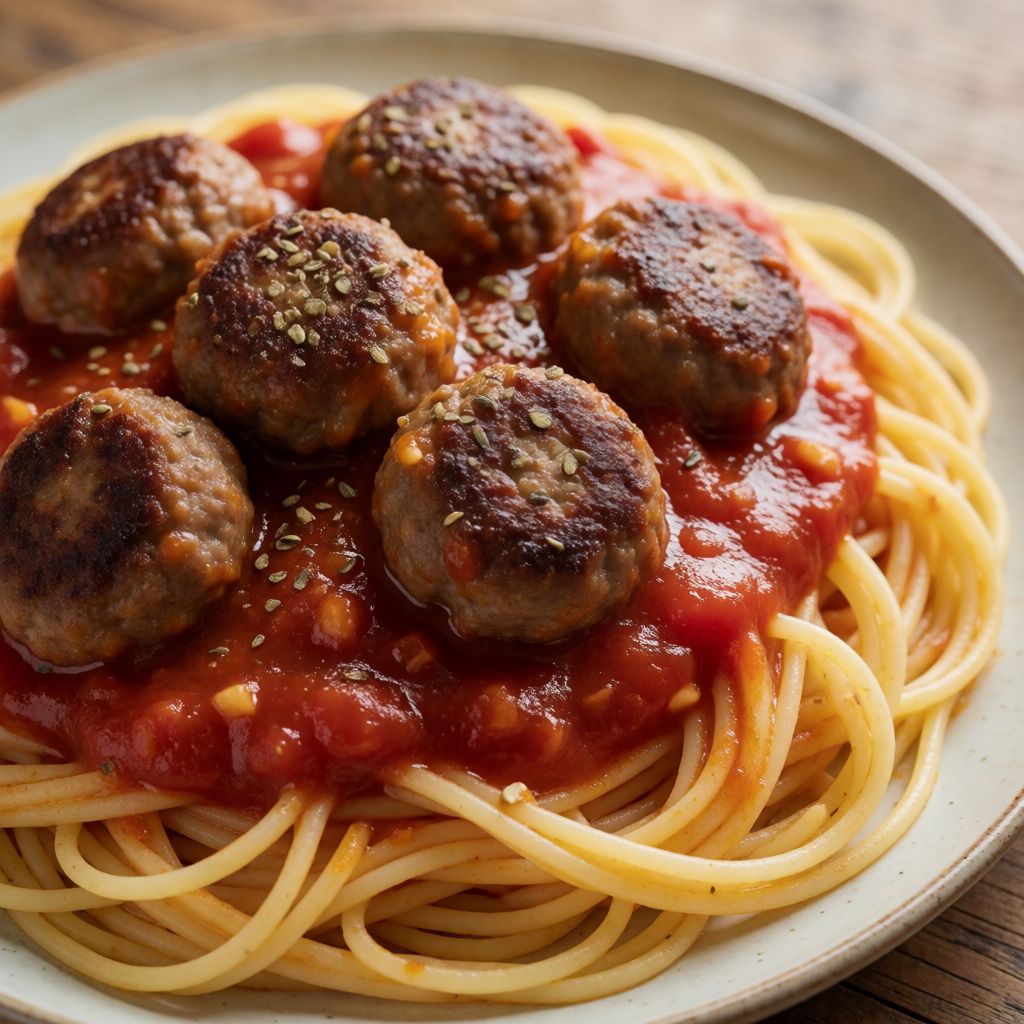
 AI photo
Spaghetti with Tomato Sauce and Meatballs
A classic plate of spaghetti and tomato sauce with tender beef meatballs.
Labels are worked out automatically from the ingredients and can be wrong. Check the packaging if it matters to you.
Ingredients
- 0.5 l stock for poaching
- 400 g pasta
- 50 g Parmesan
- 125 g mozzarella torn into pieces




Tomato sauce
- 400 g canned chopped tomatoes
- 1 clove garlic finely chopped
- 0.5 tsp dried oregano
- salt
- black pepper freshly ground





Meatballs
- 300 g beef mince
- 1 bunch parsley finely chopped
- 50 g Parmesan freshly grated
- 2 clove garlic pressed
- 1 pcs egg
- salt
- black pepper freshly ground



Steps
For the tomato sauce, combine the tomatoes, garlic, oregano, salt and black pepper in a saucepan and simmer gently, so the sauce just barely bubbles, until it reduces to a creamy consistency.
This takes about 20–30 minutes.
25 minYou can speed things up by boiling the sauce down, stirring constantly, for 7–10 minutes.
8 minFor the meatballs, mix the beef mince, parsley, Parmesan, garlic, egg, salt and black pepper well and shape the mixture into balls.
Bring the stock to the boil in a saucepan and lower the meatballs into it.
Cook for 1 minute, lift the meatballs out of the stock, transfer them to the hot tomato sauce and simmer for a further 5 minutes.
6 min
Forget the tangle of spaghetti buried under one giant meatball you get in a certain cartoon-restaurant idea of "Italian". This is two separate cooks running at once — a tomato sauce reducing slowly in one pan, small meatballs poached then finished in that sauce — and they only meet at the very end, on the plate. That separation is the whole trick. A sauce that's actually reduced, not just heated through, clings to pasta instead of pooling at the bottom of the bowl in a watery puddle.
What decides whether this works is patience with the tomatoes. Canned chopped tomatoes are mostly water dressed up as a sauce. Simmer them hard and fast and you get sour, broken liquid with lumps of garlic burning at the edges. Simmer them so the surface just trembles — a bubble every second or two, not a boil — and the water walks off as steam while the tomato solids concentrate and sweeten. Twenty to thirty minutes is the lower bound, not a deadline you can hit by turning the heat up. If you're short on time, there's an honest shortcut: boil it harder but stir constantly, because unwatched reduced tomato at high heat catches on the bottom of the pan and tastes of char, not of tomato.
On the ingredients, one by one, and what each is actually doing there.
Canned chopped tomatoes, not fresh, and that's not a compromise — it's arithmetic. Tinned tomatoes are picked and canned at peak ripeness within hours; a supermarket "fresh" tomato in a British January travelled further and ripened on a shelf, not on the vine. For a sauce you're going to reduce anyway, the tin wins on both flavour and convenience. If you only have whole peeled tomatoes, crush them by hand in the pan — don't blend, or you lose the texture that makes the sauce cling rather than run.
Garlic appears twice doing two different jobs: finely chopped in the sauce, where it has time to soften and sweeten over the long simmer, and pressed in the meatball mix, where it needs to distribute evenly through raw meat with no time to cook first. Don't swap the methods — a pressed clove dropped into a slow sauce burns fast and goes bitter because it's already broken down to nearly nothing; a rough-chopped clove in raw mince gives you unpleasant hard bites.
Oregano is dried on purpose here, not a lesser substitute for fresh. Dried oregano has had its water driven off and its oils concentrated, so a half teaspoon actually tastes of something across a long simmer; fresh oregano is milder and better suited to things added at the end, not things cooked down for half an hour.
Beef mince wants some fat in it — ask for something around 15–20%, not the leanest tray on the shelf. Fat is what keeps a meatball from turning into a dry pebble once it's poached and then simmered twice. If beef isn't to hand, pork mince or a beef-pork mix works on the same logic: enough fat, enough structure to hold a ball shape.
Parmesan, freshly grated, in both the meatball mix and at the table. The tub of ready-grated "parmesan" dust you find on some shelves is dried out and starts to clump and seize the moment it meets any heat — grate it yourself off a block and it melts and binds properly. If you genuinely can't get Parmesan, a hard, salty, aged cheese like Grana Padano does the same job; a mild cheddar does not, because the whole point is sharpness and salt in small amounts.
The egg in the meatball mix is the binder — without it the mince falls apart the second it hits boiling stock, because there's nothing holding the proteins together once heat hits them. One egg is enough for 300g mince; more and the mixture turns sticky and heavy.
Stock for poaching doesn't need to be anything precious — whatever you'd use for a Sunday gravy or a soup base is fine, since its job is just to carry heat gently into the meatballs for a minute, not to flavour them deeply. Mozzarella, torn rather than cubed, goes on right at the end over the hot pasta and sauce so residual heat melts it without cooking it rubbery — it's there for texture and a mild milky note, not for anything a sharper cheese could do better.
And the pasta itself: cook it separately, toss it with the sauce rather than drowning it under a sauce lake, and keep a cupful of its cooking water back. If the sauce has reduced properly it'll be thick enough to need loosening with a splash of that starchy water to coat the spaghetti rather than sit on top of it.