
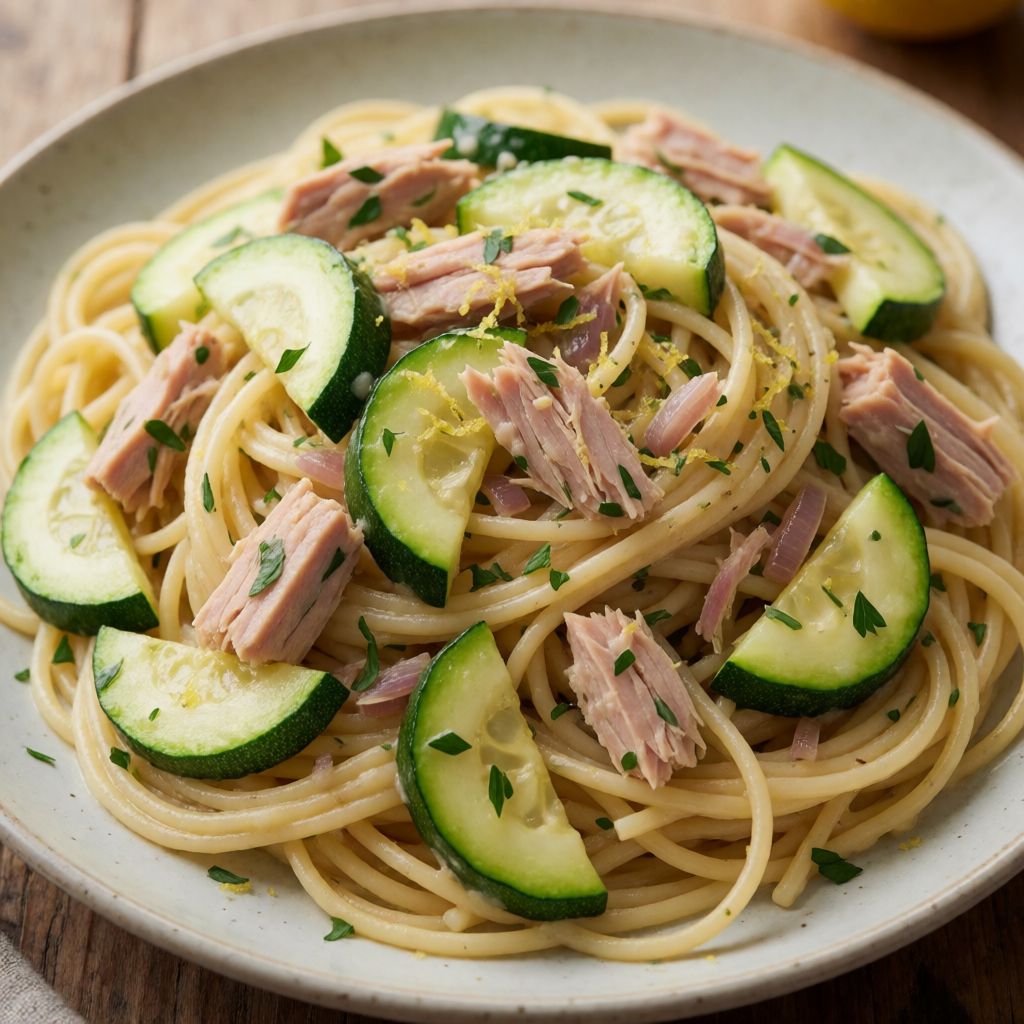
 AI photo
Spaghetti with Tuna, Courgette and Lemon
A quick spaghetti dish with tuna, courgette, lemon and parsley.
Labels are worked out automatically from the ingredients and can be wrong. Check the packaging if it matters to you.
Ingredients
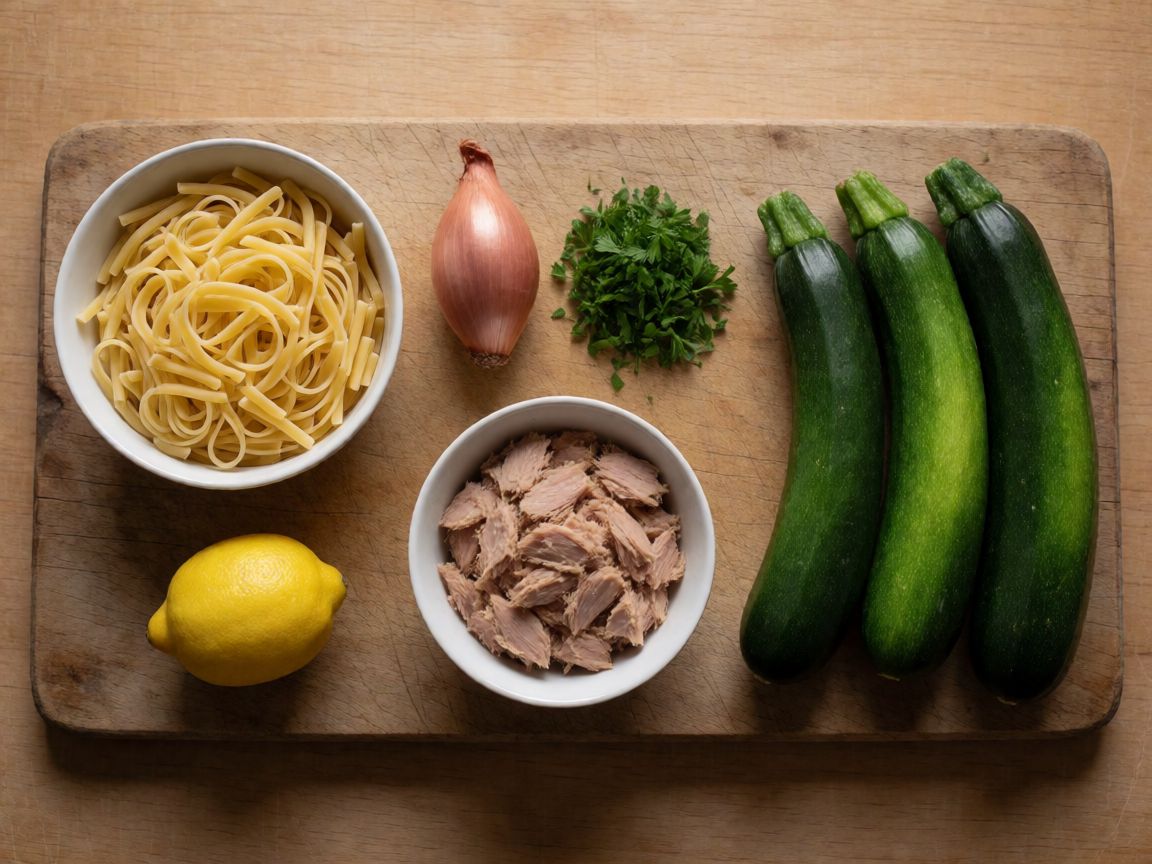









Steps
Fry the finely chopped shallot together with the parsley in a pan.
Add the courgette, cut into cubes, and cook over a low heat for a few minutes.
Add the tuna and pour in the lemon juice, cook for a little longer.
Boil the spaghetti in a large amount of salted water.
In a bowl, zest the lemon, grind the black pepper and add the chopped parsley to the zest.
Drain the spaghetti, transfer to the pan with the mixture and fry everything together.
Serve, sprinkled with parsley on top.
This is not a sauce poured over pasta — it's a dish built in one pan, where the spaghetti finishes its life inside the vegetables and fish rather than next to them. That's the economics behind it too: a tin of tuna from the cupboard, a few courgettes that were going soft in the fridge, a lemon that's been sitting in the fruit bowl a week too long. Southern coastal Italian cooking runs on exactly this kind of thrift — nothing rare, nothing that needs a special shop, fast enough for a Tuesday after work rather than a Sunday with the oven on since noon.
What decides whether it works is restraint in two places. The courgette goes in over low heat because it is almost entirely water held inside a thin skin — turn the heat up and that water floods out before the edges have any chance to colour, and you get grey, slack cubes sitting in their own puddle instead of something with a bit of bite. Low and slow lets the water leave gradually while the surface still catches some gold. Patience is the ingredient the card doesn't list, and it's the one doing the work here.
The tuna is the other trap. Some cooks treat it like raw fish that still needs cooking through — no, because it came out of the tin already cooked, once in the cannery, and now a second time if you fry it hard in the pan. It only needs a few minutes to pick up the heat and the lemon juice around it. Push it longer and it turns stringy and dry, which is the real reason tinned-tuna pasta has a poor reputation — not the fish itself, but what gets done to it afterwards.
Start with the shallot, chopped fine for a reason: small pieces heat through evenly, so the outer layer doesn't scorch while the centre is still raw and biting. Any mild allium does the same job — half a white onion, or the white ends of spring onions if that's what's in the fridge. A shallot just gets there with less sting and a touch more sweetness, which matters in a dish with no long-cooked base to round things off.
For the courgette, pick small to medium ones — the giant ones from a glut are mostly seed and water, and that water is exactly what you're trying to manage with low heat. If a marrow is all you've got, cut the seeded core out first; that's the wettest, most flavourless part, and it'll fight the low-heat method no matter how patient you are. Cube them roughly the same size so they all lose their water at the same rate — one oversized chunk left wet in the middle undoes the whole point of cooking them gently.
Tinned tuna comes in oil or in water or brine, and that choice changes what you do next. Oil-packed tuna brings its own fat into the pan, so go lighter on the olive oil you add or the dish turns greasy. Water-packed is leaner and needs draining properly — tip it onto a plate lined with a paper towel for a minute, since a domestic hob has no gentle simmer-and-reduce the way a wider pan over real heat would, and loose liquid here just waters down what you're building. Any firm tinned fish follows the same logic — mackerel works, though it's a stronger, oilier flavour and will say so.
The lemon needs two things from it: zest and juice, in that order, because you can't zest a lemon you've already squeezed flat. Buy unwaxed if you can, or scrub a waxed one hard under hot water first — the wax coating sits between you and the aromatic oil in the skin, which is the entire reason you're zesting at all rather than relying on juice alone.
Parsley wants to be fresh, because half of it goes in raw at the end and dried parsley has nothing left to offer raw — the oils that carry its smell are long gone by the time it's dried and bottled. If fresh isn't to hand, put dried parsley into the pan early with the shallot, where heat and moisture can still coax something out of it, and use less than you think, since dried is muted in a different, flatter way, not simply weaker.
On the oil: normally the rule is to pick something with no character of its own, so it doesn't fight the dish. Here it's the opposite — you want olive oil that actually tastes of olive oil, because it isn't just a cooking medium, it's part of the flavour alongside the lemon. A mild, everyday olive oil still works if that's what's in the cupboard; a neutral vegetable oil does not, because then there's nothing standing in for the missing richness that a longer-cooked sauce would normally give you. Salt the pasta water properly — it's the only seasoning that goes inside the noodle rather than sitting on top of it — and if the finished dish looks tight and dry when you toss everything together, a splash of that same starchy water loosens it without watering down the taste, because the starch is what makes the sauce cling to the spaghetti instead of pooling at the bottom of the bowl.