
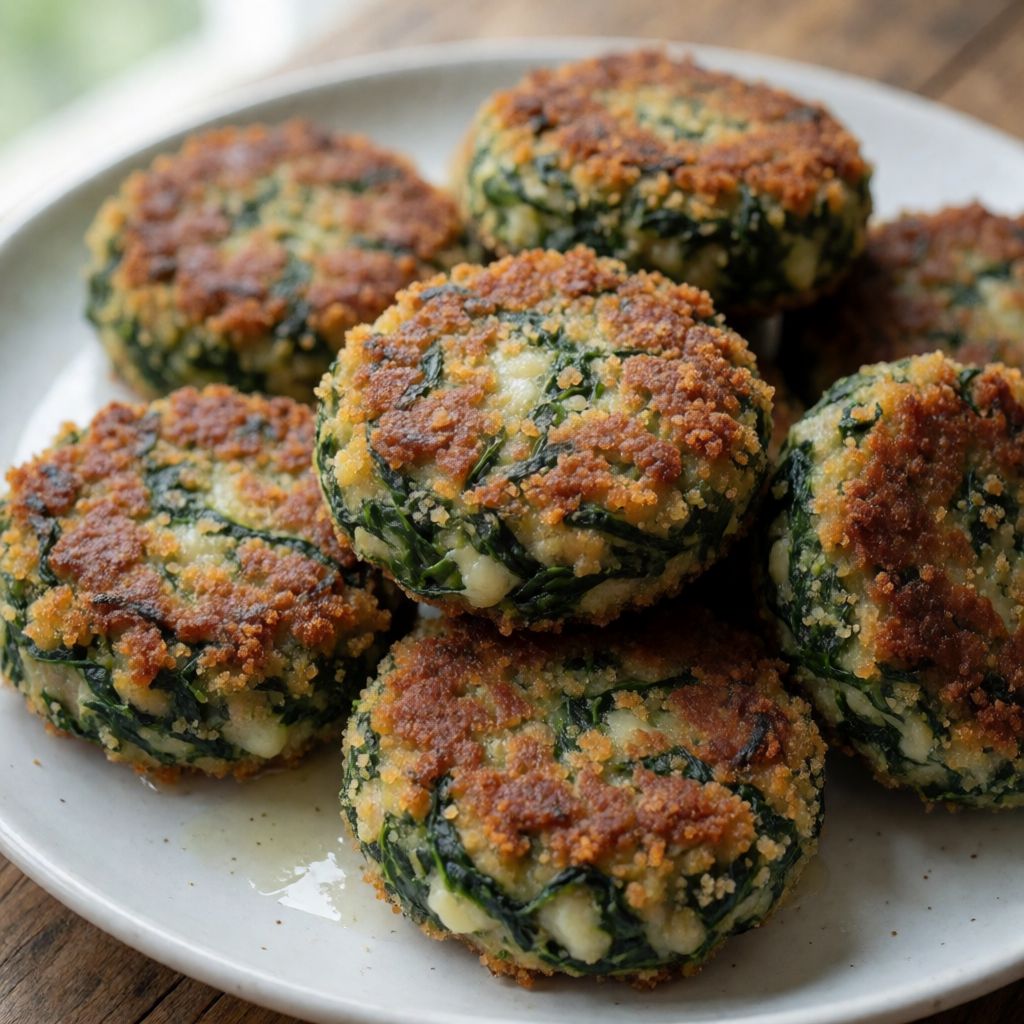
 AI photo
Spinach Cutlets
Soft spinach and cheese cutlets with a melting provolone centre.
Labels are worked out automatically from the ingredients and can be wrong. Check the packaging if it matters to you.
Ingredients
- 300 g Spinach fresh or frozen
- 1 pcs Egg
- 30 g Parmesan
- 10 g Breadcrumbs dried
- 50 g Bread soft white, crusts removed, torn into crumbs
- 50 g Provolone
- Salt to taste
- Black pepper to taste
- Olive oil to taste
- Groundnut oil to taste








Steps
Boil the fresh or frozen spinach, squeeze out all the water well and chop it finely.
10 minIn a bowl, combine the spinach, egg, Parmesan, the soft white bread (crusts removed, torn into crumbs) and the dried breadcrumbs, then add salt and black pepper. Mix until smooth.
5 minShape the mixture into balls, make a hollow in the centre, place a cube of provolone inside, close it up and reshape into a ball.
10 minCoat the cutlets in breadcrumbs.
5 minPlace the cutlets on a baking tray lined with parchment, drizzle with olive oil and bake at 180°C.
20 minAlternatively, fry the cutlets in groundnut oil at 170°C until golden brown.
10 minPlace the cooked cutlets on a paper towel to drain the oil and serve.
2 min
What you are making here is not a cutlet in the meat sense at all — it is a spinach-and-cheese ball shaped like one, with a core of melting cheese hidden inside, baked or fried until the outside sets hard and the inside goes soft and stringy. The shape is a borrowed one: Italian home cooks have long used the cotoletta form to make a handful of cheap greens feel like a proper course, the same trick as a vegetable "schnitzel". Nothing wrong with that — it's just economics wearing a familiar coat.
What decides whether this works is almost entirely about water and sealing. Spinach holds an enormous amount of liquid, far more than looks possible from a small handful of leaves, and if that liquid stays in the mixture, nothing binds — the egg and breadcrumb can't hold a wet paste together, and the ball collapses the moment it meets heat. So the squeezing in step one is not fussiness, it is the one step the whole dish depends on. Squeeze until your hands ache and you think there's nothing left, then squeeze again.
The second thing that decides success is how well you close the cheese inside. You're not dropping a cube on top and folding spinach over it loosely — you need a proper seal, no seam, no thin patch, because any weak point is where the provolone will find its way out once it melts and expands. A cutlet that weeps cheese into the pan isn't ruined for flavour, but it loses the whole point of the dish, which is the surprise of cutting in.
Go through the two breads and you'll see they're doing two different jobs, not one job twice. The soft white bread, torn and crustless, breaks down into the mixture and holds moisture — it's what keeps the inside of the cutlet tender rather than dense and dry, like fresh breadcrumbs do in meatballs. The dried breadcrumbs do the opposite: they absorb the last of the moisture and give the mixture enough body to hold its shape in your hand. Skip the dried crumb and rely on the soft bread alone, and you'll find the ball slumping before it even reaches the oil. If you've no dried breadcrumbs, stale bread grated on a box grater and left to air-dry for an hour does the same job.
The egg is the glue, nothing more mystical than that — its proteins tighten as they meet heat and lock spinach, cheese and crumb into one mass. One egg is enough for 300g of spinach because the bread is already carrying most of the structural weight; if your mixture still won't hold together, the fault is almost never the egg, it's water you failed to squeeze out.
Parmesan and provolone are not interchangeable even though both are cheese — they're doing opposite work. The Parmesan goes through the mixture, finely grated, for salt and a background savouriness; it does not melt so much as season. The provolone is the one cheese in the dish that's there purely to melt and stretch, so it has to be mild and soft enough to go molten and stringy rather than just softening. Any cheese with that same stretch — a block mozzarella, a young caciocavallo, even a firm halloumi-style cheese in a pinch, though it won't pull quite the same way — will do the job the provolone is doing. For the Parmesan, any hard, aged, salt-crystalled cheese works: a Grana Padano, a mature Pecorino if you cut back the added salt, since Pecorino is sharper.
On oil: groundnut oil for frying is chosen for having almost no taste of its own and a high point before it starts to smoke, which gives you room to fry at 170°C without drifting into scorching if your hob runs a little hot — and most domestic hobs don't give you a reliable 170°C, so judge by the oil: it should shimmer gently and a breadcrumb dropped in should sizzle and rise straight away, not sit sullenly on the bottom. The rule for any oil used this way is simple — no flavour of its own, high smoke point — so sunflower or rapeseed oil both qualify if groundnut isn't in your cupboard. The olive oil for baking is used in the open, only as a light coat before the tray goes in, so there its flavour actually gets to show through a little, which is the one place in this dish where it's allowed to.
Baking at 180°C versus frying at 170°C oil is not a typo — they're not meant to be identical heats. Dry oven air is a slower, gentler way to crisp a crumb, so it needs the higher number to get any colour at all in twenty minutes; oil touching the crumb directly transfers heat far faster, so a lower number already gives you a proper golden crust without cooking the outside to leather before the cheese inside has had time to go soft. Whichever way you go, the paper towel at the end isn't decoration — it's pulling surface oil off the crust so what you eat is crisp, not greasy, the difference between a cutlet and a sponge.
In a British kitchen this sits well as a starter before a roast rather than instead of one, or as the vegetarian course when everyone else is getting lamb — three or four cutlets to a person, and a wide frying pan with a couple of centimetres of oil does the frying version perfectly well without needing anything like a proper deep-fryer. Just don't crowd the pan: too many cutlets in at once drops the oil temperature, and that's exactly when they turn greasy instead of crisp. Give them space, and give yourself the patience to squeeze that spinach properly before you start — that's the one ingredient on the list that never gets weighed, and it matters more than any of the ones that do.