
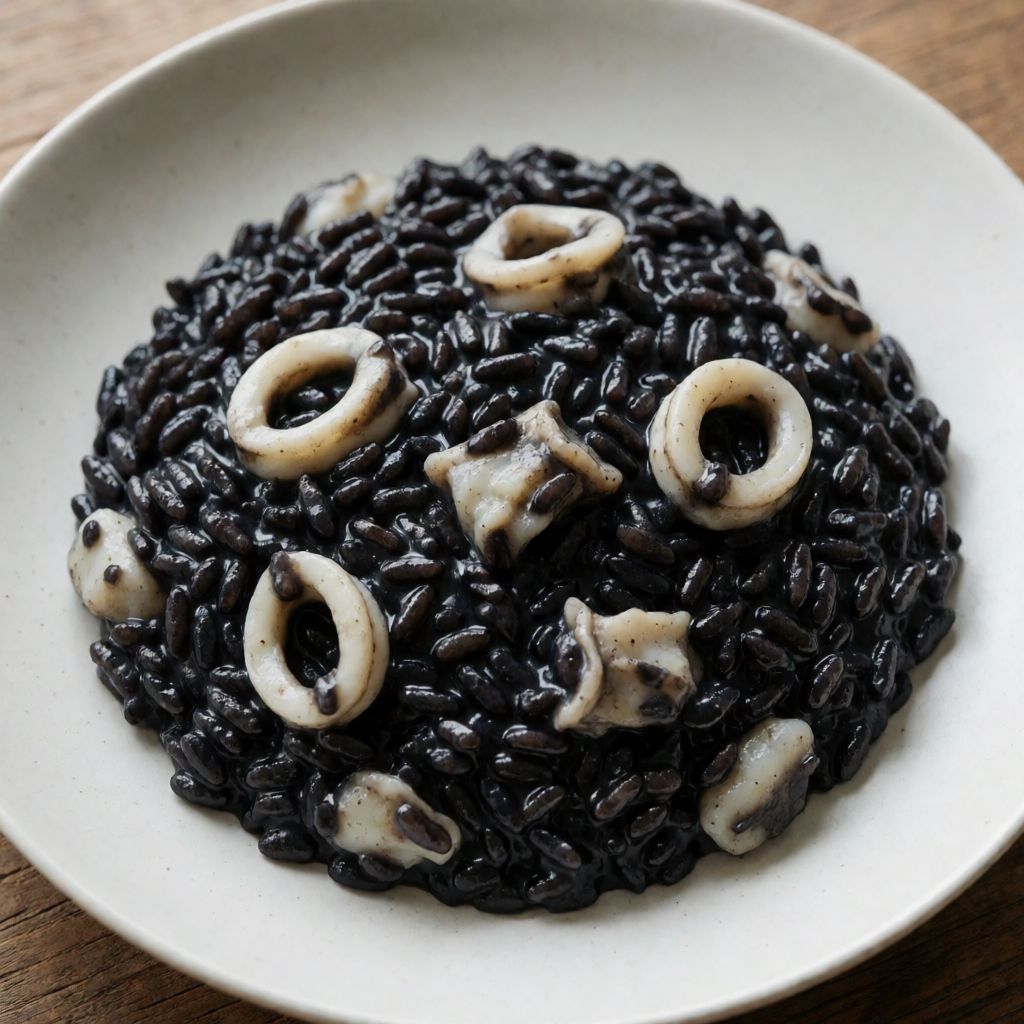
 AI photo
Cuttlefish Ink Risotto
A striking black risotto flavoured with cuttlefish ink and tender pieces of cuttlefish, finished with garlic, parsley and lemon zest.
Labels are worked out automatically from the ingredients and can be wrong. Check the packaging if it matters to you.
Ingredients
- 340 g Vialone Nano rice
- 340 g Risotto rice or use instead of Vialone Nano
- 250 g Cuttlefish
- 1 pcs Shallot
- 10 g Cuttlefish ink
- 250 ml White wine
- Olive oil to taste
- 1 l Fish stock
- 2 clove Garlic
- 1 tbsp Parsley
- 0.5 pcs Lemon zest zest of half a lemon
- 20 g Butter
- Salt to taste










Steps
Clean the fresh cuttlefish, setting the ink sacs aside separately, or use ready-made ink from a shop. Cut the cuttlefish into thin strips or cubes.
Heat olive oil in a pan with crushed garlic, then fry the cuttlefish over high heat, stirring often. Doneness: 63°C at the thickest point.
Remove the cuttlefish from the heat and cover with a lid.
What was changed
Fish stock has been corrected to fish stock, since the ingredient row was linked to cod by mistake.
This is risotto that's gone over to the dark side — literally. The black comes from cuttlefish ink, and the whole dish is built on a quiet tension: rice wants a slow, patient hand; cuttlefish wants speed and high heat, or it turns to rubber. You can't run both logics in the same pan at the same time, which is exactly why the cuttlefish goes in and comes straight back out, early, under a lid, resting on its own heat while the rice does its slower work later.
It sits filed here under "pasta" — ignore that, it's an accident of how recipe databases file their courses. In Italy risotto takes the same slot on the menu that pasta does, as a primo, so somewhere a database decided they're cousins. They are not cousins in the pan. Rice is not pasta. It doesn't want to be boiled and drained; it wants to be coaxed, a ladle at a time, into giving up its own starch.
Rice choice is not a brand loyalty question, it's a starch question. Vialone Nano and the usual risotto rices (Carnaroli, Arborio) are short, round-grained varieties bred to hold a firm core while shedding amylopectin starch from their outer layer into the liquid around them — that starch is what turns stock into sauce. A long-grain rice won't do this; it's built to stay separate, grain from grain, which is lovely for a pilaf and useless here. If you can't find Vialone Nano, any other short-grain risotto rice is a straight swap, same criterion: round, starchy, sold specifically as risotto rice.
The ink is the one ingredient people get precious about. Cuttlefish — genus Sepia, which is where the pigment's old name comes from, the same word painters once used for brown-black ink before synthetic dyes took over — carries this sac as a defence, a smokescreen to cover its escape. Fresh ink from the animal you're cleaning is the real thing; shop-bought sachets are the same compound, harvested commercially, and there's no shame in using them — most kitchens in Venice that serve this dish at volume are buying it in too. What it isn't is a flavour bomb on its own. Any bitterness in the finished risotto almost never comes from the ink; it comes from garlic pushed past gold into brown, or from old ink that's been sitting too long. Fresh, correctly handled, the ink reads as a faint, briny sweetness, not bitter at all.
Shallot instead of onion earns its place by being gentler — fewer of the sulphur compounds that make raw onion sharp, so it goes soft and sweet quicker without needing long, slow cooking to tame it. If you've only got onion in the house, use it; just give it a few more minutes over gentle heat before the rice goes in, until it's soft and pale rather than just translucent. The wine's job is acid, not flavour for its own sake — it deglazes whatever's caught on the pan base and cuts through the coming richness of butter and ink. Cook it down until the sharp, raw-alcohol smell in the steam turns into something rounder and sweeter; that smell change is the tell, not a clock.
Stock has to go in hot, not from the fridge. Cold liquid hitting hot rice drops the pan's temperature hard, and the grains stop cooking evenly — the outside stalls while the centre stays undercooked, or you end up boiling rather than gently simmering the starch out. Keep it on a low heat beside the pan the whole time. The litre given is a lower bound, not a target: how much a batch of rice drinks depends on how dry it was when you bought it, and on your pan, and on your hob's idea of a simmer. Add it a ladle at a time and let each one disappear into the rice before the next — this is also why you stir, not mainly to stop sticking, but to keep knocking the grains against each other so they release starch into the liquid instead of just sitting in it. Skip the stirring and you get wet rice in stock, not risotto. If you're in the UK and don't fancy making fish stock from scratch, a good carton fish stock is an honest substitute — just taste it unsalted first, most are seasoned heavily already, and you're about to reduce it further.
Butter, parsley and lemon zest go in at the very end, off the heat, which is the one genuinely fussy-looking step worth defending. Beating cold butter into hot, starchy rice emulsifies the fat into that starch and water, and that's what gives risotto its shine and its cling rather than a puddle of sauce sitting under dry grains — Milan calls this mantecatura, and it only works if the heat's off, because butter split over direct heat just turns greasy. Parsley and zest on top are not decoration; they're acid and freshness cutting against ink and butter, the one bright note in a dish that's otherwise all dark and rich. A standard domestic hob and a wide pan are not a compromise here, for once — risotto actually wants a shallow, wide surface so the liquid reduces evenly, which is exactly what most kitchens already have standing by the cooker. The only thing you can't buy or substitute is the fifteen or twenty minutes of standing there, ladle in hand. That part is patience, and it's as much an ingredient as the rice.