
 AI photo
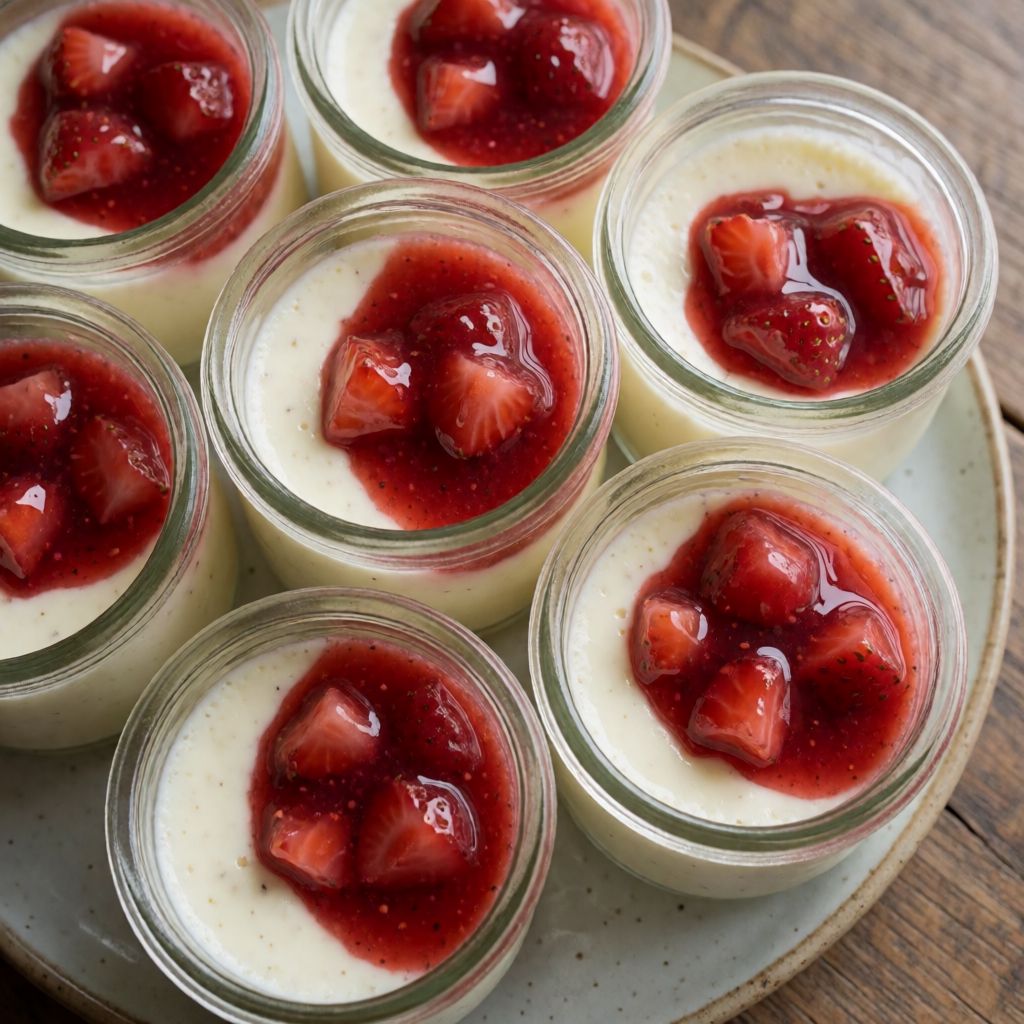
Strawberry and Vanilla Cream Pots
A layered dessert of strawberries, almond macarons and vanilla cream, served in glasses.
Labels are worked out automatically from the ingredients and can be wrong. Check the packaging if it matters to you.
Ingredients
- 80 g almond flour
- 100 g icing sugar
- 30 g egg whites
- 3 pcs egg yolks
- 60 g sugar
- 1 pcs vanilla pod
- 150 ml whipping cream
- 350 g strawberries cut into quarters
- 20 g sugar
- 0.5 tsp vanilla sugar
- 2 pcs mint fresh






Steps
Blitz the almond flour and icing sugar in a mini chopper until completely smooth.
Add the egg white and blitz again until smooth.
Spoon the mixture into a piping bag and pipe 2½ cm rounds onto a baking tray lined with baking parchment.
Bake in a preheated fan oven at 150°C for about 25 minutes.
25 minCool on a wire rack, then crumble slightly.
Whisk the egg yolks, sugar and vanilla seeds together until light and creamy.
In a separate bowl, whip the cream to soft peaks.
Fold the egg mixture into the whipped cream.
Toss the strawberries with the sugar and vanilla sugar and leave to sit for 10 minutes.
10 minLayer the strawberries, macarons and vanilla cream in individual glasses and finish with a sprig of mint.
This is a trifle wearing a macaron's clothes. You bake almond meringue discs, break them up so they lose their showy roundness, and bury them under raw whipped cream and sugared strawberries in a glass. Nobody's slicing a perfect dome here — the crumbling is the point, because a cracked macaron shell soaks cream and goes soft in exactly the way a whole one, kept crisp, never would.
What decides whether it works is two separate, unrelated jobs done well: a dry, structured biscuit, and a raw custard-cream that's barely cooked at all — just egg yolk and sugar whisked to ribbon stage, no heat involved, folded into whipped cream. The yolk mixture is doing the work a crème anglaise would do if you had the patience to stand over a pan watching for 82°C. Here you skip the stove entirely and let the sugar and whisking dissolve the grains and thicken the yolk by sheer mechanical work — that's why "light and creamy" matters more than any clock: you're watching the ribbon fall back on itself and hold its shape for a second, not counting whisks.
Some say macarons need a rest before baking, a "skin," or they crack. True for the French kind piped into perfect rounds for sandwiching — here you're deliberately crumbling them afterward, so a hairline crack costs you nothing. That's one tradition this recipe quietly ignores because the end use doesn't need it.
Almond flour plus icing sugar, blitzed together, is just making sure no gritty almond particle survives — a food processor does in seconds what hand-sieving used to take an irritable hour over. Skip this and your "smooth" meringue bakes with sandy pockets. If your almond flour already feels talc-fine, you can shorten the blitz, but don't skip it on cheap, coarser ground almonds — they vary a lot by brand.
The egg white here (30g, barely more than one small white) isn't for volume or whipping — you're not making a soufflé base. It's a binder, turning almond-sugar powder into a pipeable paste. Don't whisk it to foam first; that's a different recipe's instinct. Here it just needs stirring in until the paste is uniform, loose enough to pipe through a small nozzle.
150°C fan for the discs is a low, drying heat — not a heat that browns, but one that sets egg protein and dries sugar syrup slowly enough that the inside doesn't collapse once it cools. You're watching for a firm, pale shell that lifts off the parchment cleanly; if it still clings and feels tacky, it needs longer, because that tackiness means the inside is still wet and will turn chewy-wrong, not crisp, once cooled. The 25 minutes is where to start checking, not where to stop.
For the cream: whipping cream to soft peaks only — not stiff. Soft peaks still have give, so when you fold in the yolk-sugar-vanilla mixture, you can combine without deflating everything into cream soup. Any cream over about 35% fat will whip; UK whipping cream (35%) sits right at the edge, so don't overwhip waiting for stiffness that barely wants to arrive — it'll turn grainy before it turns stiff. If you only have double cream, it whips faster and more stiffly, so stop earlier.
Vanilla pod scraped for seeds, not the whole pod boiled in milk — because there's no milk being heated here to extract flavour from the pod's structure. The seeds go straight into the raw yolk mixture, where whisking disperses them. If you don't have a pod, a good vanilla extract — not the artificial, single-note kind — stirred in at the same stage does the same job; you lose the visual fleck but not much flavour.
Strawberries in an English kitchen in summer are sweet enough on their own some years; the sugar maceration isn't correcting underripe fruit so much as building syrup, the liquid that makes the glass look layered rather than just stacked. If your berries are already very ripe and juicy, 20g sugar is plenty — more just masks them. Vanilla sugar (sugar that's lived with a pod) is a small echo of the vanilla in the cream above it; ordinary caster sugar with a pinch more vanilla extract covers for it.
This whole assembly — crumbled biscuit, cream, fruit, in a glass — is cheaper engineering than it looks. A proper macaron, piped, matched in pairs, filled and rested overnight, is restaurant labour. Breaking the shells and layering them in a verre is the same flavour with none of the fuss of matching sizes — a dessert built for a Sunday glass, not a pastry case.