
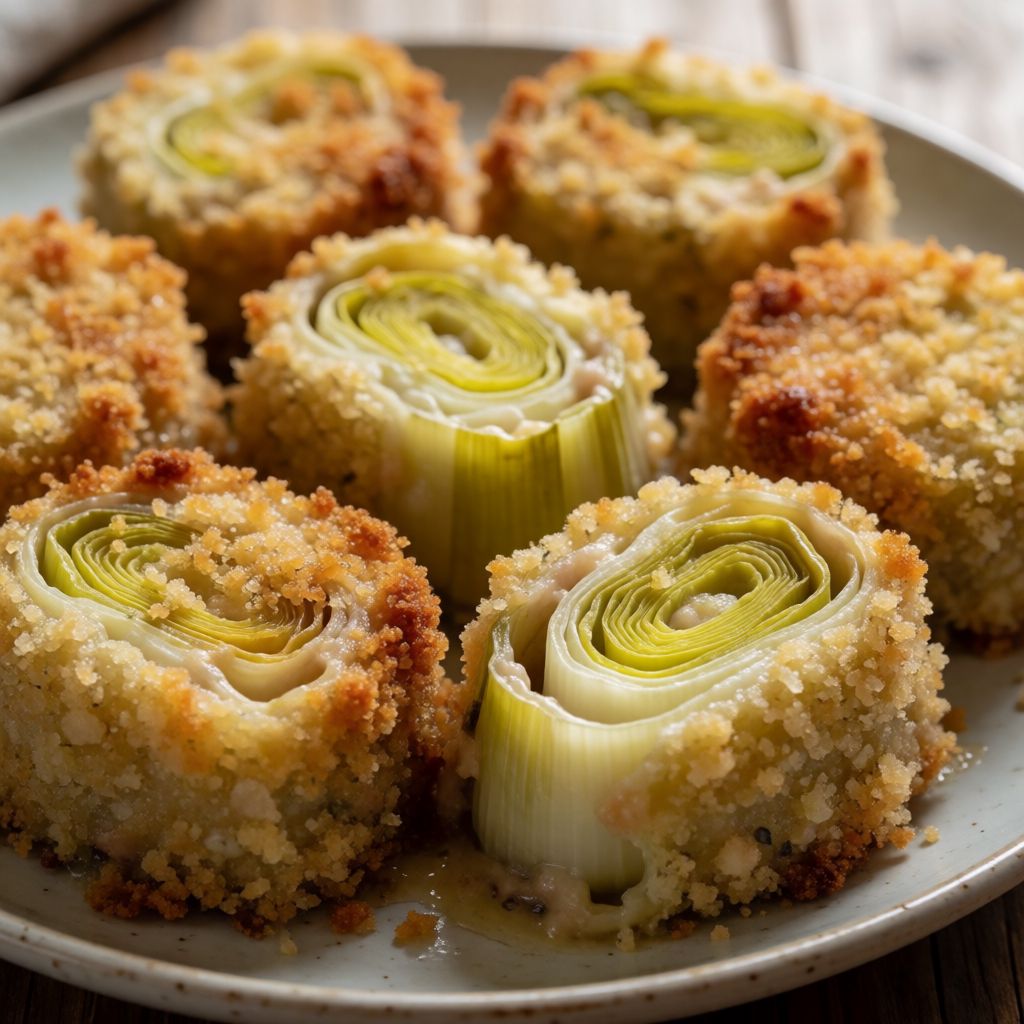
 AI photo
Stuffed Leeks
Tender leeks wrapped around a herby pork filling, breaded and pan-fried until crisp.
Labels are worked out automatically from the ingredients and can be wrong. Check the packaging if it matters to you.
Ingredients
- 2 pcs Leek
- 1 tsp Plain flour
- 1 pcs Egg beaten
- 100 g Breadcrumbs dried
- 1 tbsp Butter for frying
- 1 pcs Olive oil for frying
- 1 pinch Salt
- 1 pinch Black pepper freshly ground
- 400 g Minced pork
- 1 pcs Egg
- 1 pcs Onion finely chopped or grated
- 2 clove Garlic finely chopped
- 1 tbsp Thyme fresh leaves or dried
- 15 g Oats fine
- 200 ml Milk
- 1 pinch Salt
- 1 pinch Black pepper freshly ground














Steps
Prepare the filling: put all the filling ingredients in a bowl and beat with a hand mixer for 1-2 minutes, then chill in the fridge.
2 minTrim the leeks, cut off the top green part, halve crosswise and rinse thoroughly under running water.
5 minPut four leek pieces into a pot of salted water, bring to the boil and simmer gently for about 5 minutes.
5 minPat the leeks dry, dust with flour, divide the filling into 4 portions and shape it around each piece of leek.
Wrap each leek in baking parchment, then foil, place in a pan of hot water, bring to the boil and simmer gently for about 7-8 minutes.
8 minUnwrap the parcels, let cool slightly, coat in the beaten egg, then in breadcrumbs mixed with salt and pepper.
3 minFry in a hot pan with oil and butter until crisp and golden on all sides, cut in half and serve hot.
6 min
Stuffed leek like this is a meat rissole that borrowed a vegetable's clothes. Take away the leek and you've got a pork pattie built the way you'd build stuffing for a Sunday roast — thyme, onion, a soft binder — except here it's cooked twice and never sees a baking tray. First it's poached inside its own leek wrapper, then it's crumbed and fried. Two different jobs, two different heats, and that's the whole trick of the dish.
What decides whether it holds together is the leek, not the meat. A leek is really dozens of thin tubes nested inside each other, and that's exactly why it traps soil between the layers — rinsing the surface does nothing, you have to run water through the layers themselves, which is why the recipe has you halve it first. Parboil it just enough that it bends instead of resisting: too little and it splits when you wrap meat round it, too much and it goes slack and lets the filling slide off. You're not cooking the leek to eating-doneness here, you're cooking it to bending-point.
Some say you fry meat first to "seal in the juices." No — nothing seals, meat isn't a bag. Here the order is the opposite of that myth and it tells you the truth: the filling is fully cooked gently in its parcel first, and the frying at the end is only ever about colour and crust, done to meat that's already safe and already moist. If frying sealed juices in, you wouldn't need the panade of oats and milk in the mix at all — and you do need it, because minced pork run through two separate heats will dry out unless something in the mix is holding water and releasing it slowly.
Buy leeks with a long, firm white part and tight, unblemished layers — that's the part doing the structural work, the green is only there for flavouring stock, not this dish. If a leek feels floppy in the white, it's old and its layers will tear rather than bend when you try to wrap them.
The mince wants some fat in it, somewhere around the proportion you'd want in a sausage — a fifth fat to four-fifths lean is a fair target. Lean mince alone, cooked first by poaching and then by frying, will come out dry and a bit sandy on the tongue; the fat is what's left to baste it from the inside on the second cooking. If all you've got is very lean mince, work in a spoon of soft butter or some finely chopped bacon before you start, not after.
The oats soaked in milk are a panade, the oldest trick for keeping ground meat from seizing up into something rubbery. Oats swell with the milk and hold onto that moisture right through both cooks, releasing it slowly as the meat firms. If you've no oats, fine fresh breadcrumbs do the same job — the criterion is something starchy and absorbent that won't fight the pork's own flavour, not any specific grain.
Beating the filling with a mixer for a minute or two isn't about mixing evenly, it's about working the proteins in the meat until they go slightly sticky and bind to each other — that's what lets you shape a ball of raw mince round a wet leek and have it stay put rather than slump off. Chilling it afterwards firms the fat back up, which matters more than it sounds: warm fat is soft and lets the whole thing slide, cold fat holds a shape while you work. That chilling time is not dead time, it's doing something.
The dusting of flour on the leek before you add the filling is glue, nothing more — a dry surface for a wet meat mix to grip, so skip it and the filling simply won't stay on. The egg-and-crumb coat at the end is a different job entirely: it's there to crisp and colour, so use dried breadcrumbs rather than fresh ones — fresh crumbs hold moisture and go leathery in the pan instead of crackling.
For the final fry, butter alone will burn before the crumb browns, and oil alone gives you colour without the flavour butter brings from its milk solids browning — that's why the two go in together, exactly the logic behind frying anything in a British kitchen where butter alone has let you down before. Any neutral oil with no smell of its own will do — sunflower, groundnut, whatever's in the cupboard — the only wrong choice is one that smells of itself and argues with the thyme and pork. Watch the pan, not the clock: the oil should ripple gently before the parcels go in, and you're fishing them out when all sides have gone an even gold, because by this point the meat inside is already done and all you're risking is burning the crust, not undercooking the middle.