
 AI photo
Stuffed Courgettes
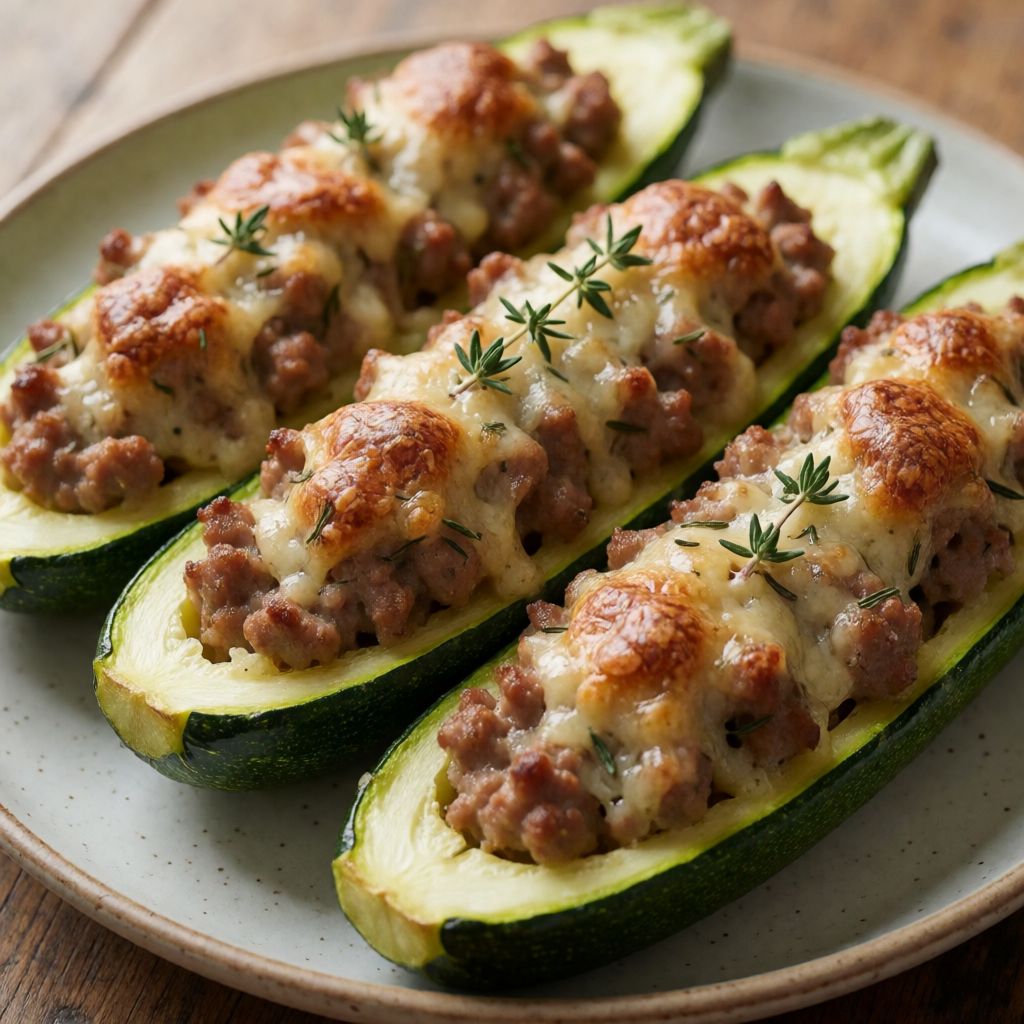
Courgettes filled with a savoury beef and sausage stuffing, topped with Parmesan and baked until golden.
Labels are worked out automatically from the ingredients and can be wrong. Check the packaging if it matters to you.
Ingredients
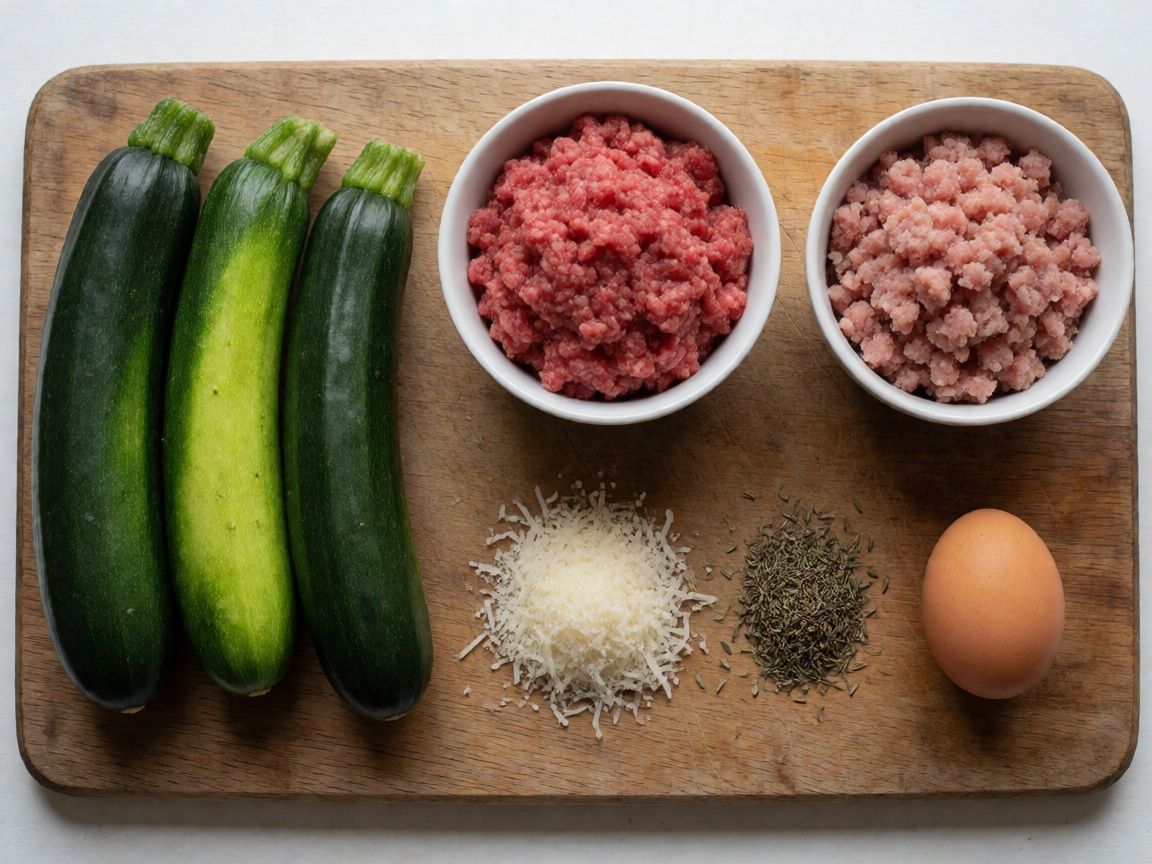
- 3 pcs Courgette
- 200 g Beef mince
- 200 g Sausage meat casing removed
- 50 g Parmesan
- 1 pcs Egg
- Thyme to taste
- Salt to taste
- Black pepper to taste
- Olive oil to taste









Steps
Wash the courgettes and trim the ends. Cut each courgette into 4 pieces and scoop out the flesh with a teaspoon.
10 minFinely chop the courgette flesh and mix with the beef mince and sausage meat. Add the Parmesan, thyme, egg, salt and pepper. Mix until well combined.
10 minGrease a baking dish with olive oil, arrange the courgette halves and fill them with the stuffing.
5 minSprinkle the stuffing with Parmesan and drizzle with olive oil.
2 minBake in a preheated fan oven at 170°C until done: the inside should reach 71°C.
35 minServe the stuffed courgettes hot.
A courgette stuffed with meat is not a vegetable dish pretending to be meat, and it's not meat pretending to be light. It's an edible pot: the courgette shell holds the meat the way a kazan holds a pilaf, except here the pot itself eventually gets eaten too. Everything that decides whether this works comes down to an argument between two materials — a vegetable that's almost entirely water, and ground meat that has to be pushed to a core temperature of 71°C to be safe, because grinding spreads whatever bacteria sat on the meat's surface right through the mix, unlike a steak, which only needs a hot surface sear. One material wants to collapse into mush long before the other is cooked through. The whole construction of the filling exists to referee that fight.
Courgette left whole would take forever to soften; cut into quarters and scooped, it's thin enough that the better part of an hour in a real oven gets through it, no blanching required. Some cooks parboil the shells first, thinking raw courgette can't be trusted to cook in the time the filling needs — no, because the oven time here is long precisely on account of the meat, and a thin courgette wall softens well within that window on its own. Parboil it and you've got an extra pan to wash and a shell more likely to tear the moment you try to fill it.
Start with why the filling is beef mince and sausage meat together, not mince alone. Plain lean mince, pushed to 71°C and baked uncovered for most of an hour, dries out — there isn't enough fat in it to baste itself from the inside. Sausage meat solves that without you doing anything, because it already carries fat, salt, and usually a little rusk or breadcrumb to bind it — a sausage maker worked all that out a long time ago, for the same reason: ground meat left to its own devices goes dry and crumbly. If you want to skip the sausage meat, use any mince with real visible fat, 15–20% if you're buying it loose; just understand you're putting back by hand what the sausage meat gave you ready-made.
The egg's job is structural, not flavour — around 63–70°C it sets and holds the mixture together, so when you cut into a courgette boat it holds its shape instead of crumbling into loose grains. Parmesan does two different jobs depending on where it sits: mixed in, it's salt and savoury depth; on top, it's there to melt and then brown, because a thin layer of fat and protein under direct oven heat is what gives you a crust rather than a melted puddle. Any hard, aged, salted cheese does either job — pecorino, an aged gouda — the criterion is a cheese that browns, not one that just goes stringy. Thyme earns its place by surviving three quarters of an hour of dry heat without turning bitter or disappearing; a soft herb like basil would vanish. Rosemary, finely chopped, or oregano, work on the same logic.
Don't scoop the courgettes down to a paper-thin shell and bin the rest — that flesh, chopped and folded into the meat, is doing real work. It's water going back into a filling that would otherwise bake into something dense and dry over 35 minutes; it loosens the texture and bastes the meat from inside as it cooks off. Scoop enough for a proper cavity, no more — a wall left too thin won't hold its shape once it's hot and full.
The oil, in the dish and drizzled on top, isn't really about sticking — it's about getting the top brown rather than merely melted. Cheese and meat juices alone, under indirect oven heat, will melt and separate before they ever brown; a little fat conducts heat into the surface faster and lets that crust actually form in the time you've got. Any oil with no smell of its own does the job — rapeseed, sunflower, whatever's in the cupboard; olive oil's only advantage here is flavour, not chemistry, and a mild rapeseed oil, cheaper and more local to a British kitchen, will brown that top just as well.
A fan oven is genuinely the right tool, not a compromise — the circulating air means no hot spot scorching the Parmesan before the centre of a dense filling catches up, which is exactly the problem you'd have under a single top element. You don't need anything specialist here, no kazan, just an ordinary oven dish, greased. What you do need, if you want to stop guessing, is a cheap probe thermometer — far more honest than cutting one open and hoping the juices look right.
Patience here means not pulling the dish the moment the top looks golden — I've done exactly that chasing a nice crust and regretted it, because the surface browns well before the centre of a dense meat filling reaches 71°C. Three courgettes, cut into four each, give you twelve pieces — six apiece for two people, generous for a side and close to a light meal with bread alongside. It sits well next to the kind of plain roasted thing a Sunday roast leaves you wanting midweek, no gravy required.