
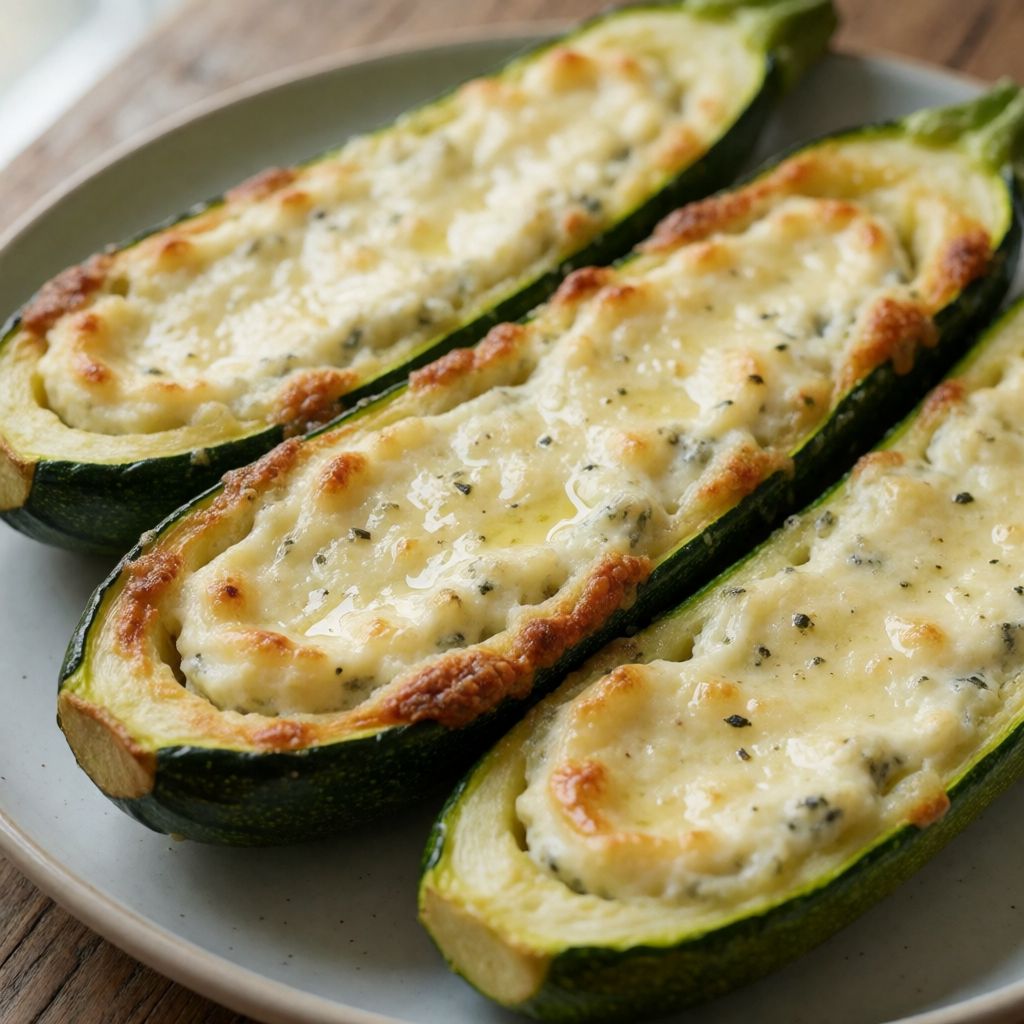
 AI photo
Stuffed Courgettes
A homely dish of courgettes hollowed out and filled with a cheesy ricotta stuffing, then baked until golden.
Labels are worked out automatically from the ingredients and can be wrong. Check the packaging if it matters to you.
Ingredients
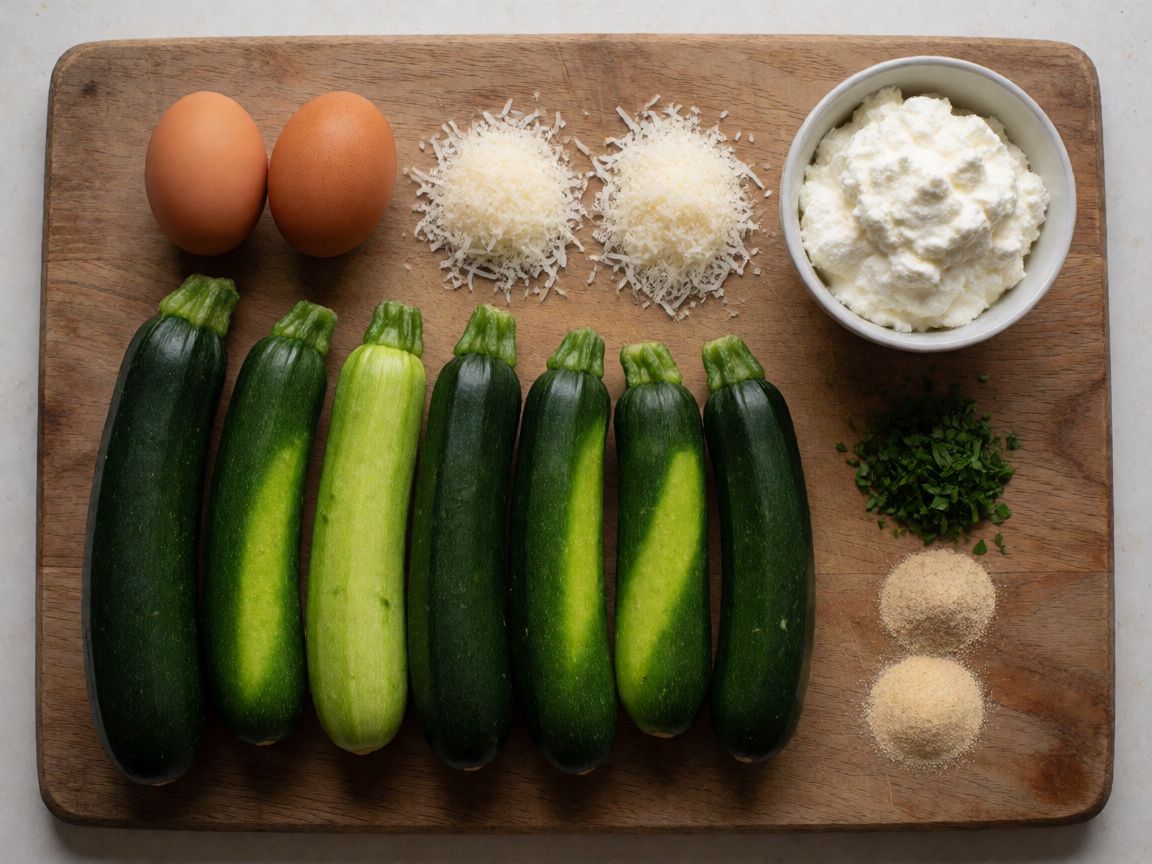
- 8 pcs Courgette
- 2 pcs Eggs
- 50 g Parmesan
- 50 g Pecorino Romano
- 200 g Ricotta
- Olive oil to taste
- Parsley to taste
- Nutmeg to taste
- Garlic powder to taste
- Mint to taste
- Salt to taste
- White pepper to taste










Steps
Wash the courgettes, cut off the top and set aside. Carefully scoop out the flesh.
Place the courgettes in a steamer, add half a cup of water and a pinch of salt.
12 minRemove the cooked courgettes and place on a plate lined with kitchen paper.
In a food processor bowl, chop the parsley for 4 seconds on speed 7.
Add the Parmesan and Pecorino and process for a further 15 seconds on speed 7.
Add the ricotta, garlic powder, white pepper, salt, nutmeg and eggs, and blend for 15 seconds on speed 3.
Transfer the finished filling to a glass bowl and let it rest.
Chop the courgette flesh with a knife and fry in a pan with olive oil and parsley until golden.
In the same pan, lightly fry the cut-off courgette tops.
Combine the fried flesh with the rest of the filling.
Using a spoon, fill the courgettes with the stuffing; cover them with the tops.
Place the courgettes on a non-stick baking tray and drizzle with olive oil.
20 minBake in an oven preheated to 200°C for 20 minutes.
Stuffed courgettes are a hollowed-out shell and a cheese-bound filling going back in the oven to set — the courgette is really just an edible dish, chosen because it's sturdy enough to hold its shape once emptied and cooks through at the same rate as what's inside it. What decides whether this works isn't the baking, it's everything that happens before: how much water you've driven out of the courgette and the filling before they meet in the oven.
Courgette is almost entirely water. Left raw and stuffed straight away, it weeps as it bakes, and that water has nowhere to go but into your filling — which turns from a firm, cuttable custard into something closer to wet scrambled egg sliding around a puddle. So you steam the shells first and sit them on paper. The steaming firms the walls just enough to hold a spoon's worth of filling without collapsing; the paper underneath takes the last of the moisture that keeps dripping out even after cooking. Skip that step, and no amount of baking fixes a watery base — you're not solving a heat problem, you're solving a drainage problem.
The scooped-out flesh isn't waste, and binning it is the first mistake people make. It's fried hard and fast until it genuinely goes golden — not softened, coloured — because that's the only way to cook off its own water and concentrate its flavour before it goes back into the filling as texture, not sog. Folding it in raw or barely cooked would just reintroduce the exact moisture problem the steaming step was solving.
This feeds four generously as a side — allow two courgettes a head, which also tells you something about size: you want courgettes small enough that two feel like a proper portion, not one enormous one cut in half. Oversized courgettes (the ones that grow unnoticed at the back of an allotment) have thick seeded cores and thin, less flavourful flesh around the edge — fine for soup, wrong for this, where the wall itself is doing structural work.
Ricotta is the body of the filling — mild, slightly grainy, and it won't fight the two hard cheeses. If you can't get it, cottage cheese blitzed smooth is the honest substitute; full-fat soft cheese works but tastes flatter, with none of ricotta's faint sweetness. Parmesan and Pecorino together are doing two different jobs: Parmesan gives savoury depth, Pecorino (being sheep's milk) gives a sharper, saltier edge. If you only have one, use more of it and go lighter-handed with the separate salt, because Pecorino especially is salty enough on its own to oversalt a dish you've also added seasoning to by habit.
Eggs are the actual binder — without them the filling bakes into warm cheese that won't hold a slice when you cut it. Two eggs for this quantity of cheese is roughly the ratio that sets a filling of this volume in twenty minutes at 200°C; more eggs and you're baking something closer to a savoury flan, less egg and the top sets while the middle stays loose.
Nutmeg here isn't decoration — it's the classic partner to ricotta and any soft, milky filling, the same logic as nutmeg in béchamel. A few scrapes is plenty; too much and it turns medicinal rather than warm. Garlic powder rather than fresh garlic is a deliberate choice, not corner-cutting: fresh garlic blitzed raw into a cold filling stays raw and sharp all the way through baking, since the filling never gets hot enough for long enough to cook it out, whereas the powder distributes evenly and mellows from the start. If you'd rather use fresh, mince it fine and sweat it briefly in the same pan as the flesh, so it's cooked before it joins the filling, not after.
White pepper rather than black is about keeping the filling pale and unspeckled — black pepper is no worse flavour-wise, it's purely a question of whether you want visible dark flecks in a cream-coloured filling. Mint alongside the parsley is doing what it does in a lot of Mediterranean courgette cooking: cutting the richness of the cheese with something cooler, and it's worth not skipping even though it's listed almost as an afterthought.
Use an olive oil without a strong peppery bite for frying the flesh — you want something that carries heat and flavour without arguing with the cheese; any neutral oil works if that's what's in the cupboard, you just lose a bit of the characteristic savoury base note. On a domestic hob, "steam" means a lidded pan with an inch of water and a colander or steamer basket sat above it, not touching the water — the point is moist heat circulating, not boiling the courgettes from underneath, which would waterlog rather than firm them.
And patience matters twice here, in two different places. Once while the filling rests in the bowl — it's not an idle step, that's the cheeses and egg settling into each other rather than staying three separate textures. And once while the fried flesh actually colours, which takes longer over honest heat than people expect and can't be rushed by turning the hob up, because above a certain point the outside burns before the water inside has had a chance to leave.