
 AI photo
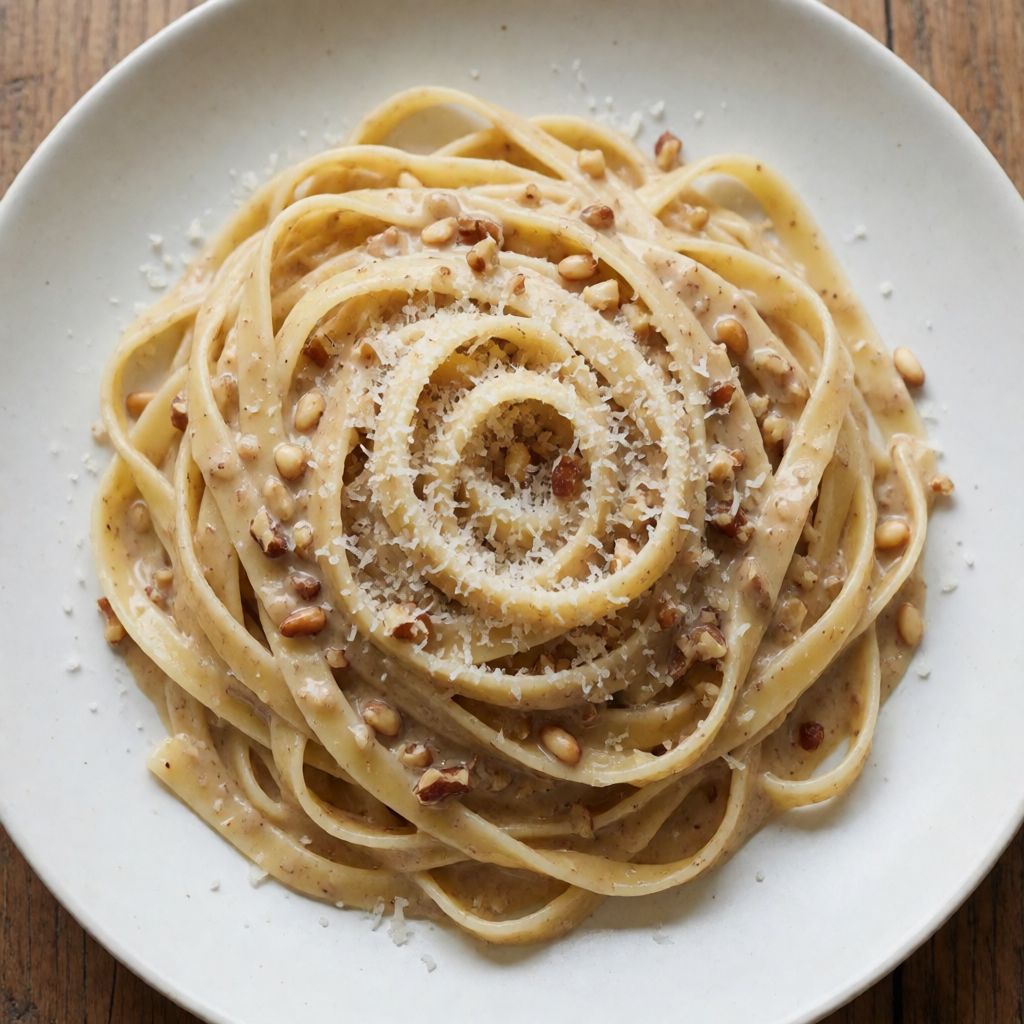
Tagliatelle with Walnut Sauce
A comforting pasta dish tossed in a rich, creamy walnut and parmesan sauce.
Labels are worked out automatically from the ingredients and can be wrong. Check the packaging if it matters to you.
Ingredients
- 400 g Egg Tagliatelle
- 100 g Walnuts
- 1 tbsp Pine Nuts
- 50 g Butter
- 50 g Parmesan
- 1 clove Garlic
- 2 tbsp Vegetable Oil
- 1 pinch Salt
- 1 pinch Black Pepper







Steps
Lightly toast the walnuts in the oven, then put them together with the pine nuts in a mortar.
Grind the nuts well, then fry the resulting paste in the butter or oil.
Transfer the sauce to a bowl, add the parmesan, salt and black pepper, mix, and finish with the chopped garlic.
Dilute the mixture with warm water, stir in the oil and mix well.
Cook the tagliatelle and drain.
10 minToss the tagliatelle with the prepared sauce.
This is a Ligurian dish wearing a slightly looser coat than usual — the same mortar-and-nut logic that gives you pesto, but with walnuts instead of basil, and a crucial extra step: the ground paste gets fried. That frying is what decides everything. Raw walnut paste, straight from the mortar, tastes chalky and a little bitter — the skin round the kernel carries tannins, the same family of compound that makes strong tea pucker your mouth. A short turn in hot butter or oil cooks that edge off, the way you'd toast flour for a roux. Skip it and the sauce tastes dusty no matter how good your walnuts were.
Some people assume any ground-nut-in-a-mortar sauce is just pesto by another name. No — because pesto stays raw from first crush to last toss; this one is cooked twice over, once when you toast the nuts and once when you fry the paste. That's not a shortcut someone forgot to simplify, it's the whole point: walnuts need taming that basil doesn't.
The second thing that decides whether it works is temperature matching when you loosen the sauce. Warm water into warm butter-and-nut paste stays together; cold water into it splits, the fat pulling away in little beads like a sauce gone wrong on purpose. You're not thinning a soup, you're building an emulsion, and emulsions are polite about temperature — treat them roughly and they separate.
Tossed with fresh egg tagliatelle, which has enough surface roughness to actually hold a paste-sauce rather than let it slide off the way it would off smooth dried pasta, this feeds four as a proper plate, not a starter.
Walnuts are the engine, and toasting them first isn't decoration — it drives off the last of their moisture and wakes up the oil sitting in the kernel, so when you crush them that oil comes out generously instead of grudgingly. In the oven, go by colour and smell: pale cream turning light gold, and the smell shifting from raw and slightly green to properly nutty. No oven worth firing up for 100g — a dry frying pan on the hob, nuts shaken constantly so they don't catch unevenly on one side, does the same job; you'll know by the same colour and the same smell.
Grind them in a mortar, not a food processor, if you can bear the extra ten minutes. A blade spins fast enough to heat the nut as it cuts, and hot oil in a confined jug oxidises quickly — you get a bitterness that has nothing to do with the walnut's own tannins and everything to do with your machine. A mortar crushes by pressure, slowly, keeping things cool. No mortar at home? A sturdy bowl and the blunt end of a rolling pin does the pressing job almost as well. If you must use a processor, pulse in short bursts and let it rest between — don't let it run.
The butter you fry the paste in does two things: it carries fat-soluble aroma onto your tongue, and if you let it go very gently past melted into the first blush of gold, it adds its own toasted-milk note on top of the walnut's. Vegetable oil is the fallback when you want it lighter or dairy-free, but it won't give you that extra layer — it's a neutral stand-in, nothing more. The oil you stir in later, at the diluting stage, is a different job entirely: there it needs to have no flavour of its own, because its only task is to loosen the sauce without arguing with the walnut. Sunflower or a light rapeseed oil does that; a punchy extra-virgin olive oil doesn't, it just adds a second opinion nobody asked for.
Parmesan and garlic go in off the heat, in the bowl, and that's deliberate. Cheese thrown into a hot pan can seize into grains instead of melting smooth — cooling the base first avoids that. Garlic added raw and finely chopped keeps its sharp bite; cook it and it turns sweet and mellow, a different ingredient with the same name. Buy a block of parmesan rather than the ready-grated tub — the tub is dusted with anti-caking starch that stops it melting cleanly into fat, which is exactly what you need it to do here. Any hard, aged, well-salted cheese will stand in if parmesan's not to hand — pecorino, for instance, though it brings more salt with it, so taste before you add your own pinch.
Pine nuts are there for a softer, sweeter fat alongside the walnut's sharper one — they're pricier in a UK shop than they have any right to be, so blanched almonds or cashews, something equally mild and oily rather than crunchy, will do the job for less money without changing the character of the sauce much.
Patience is the actual ingredient nobody lists. Crushing nuts by hand, frying the paste just until it smells right rather than for a fixed count of minutes, waiting for the pasta to bend rather than snap — none of it is hard, all of it takes longer than opening a jar. That's the whole trade you're making here.