
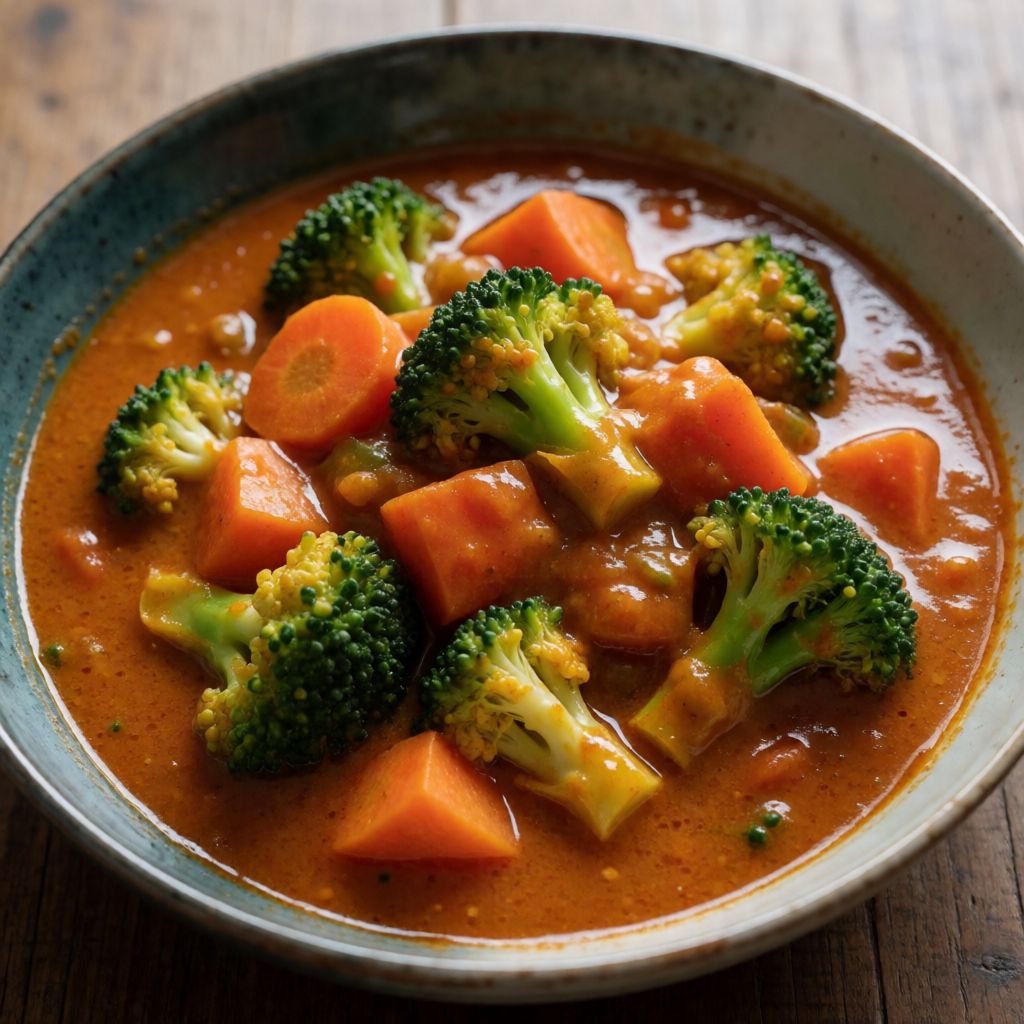
 AI photo
Thai Vegetable Curry
A fragrant Thai-style vegetable curry with coconut milk, peanut butter and lime.
Labels are worked out automatically from the ingredients and can be wrong. Check the packaging if it matters to you.
Ingredients
- 2 pcs Onion finely chopped
- 4 clove Garlic finely chopped
- 20 g Ginger freshly grated
- 2 tbsp Red Curry Paste
- 3 pcs Carrot cut into strips
- 200 g Broccoli broken into florets
- 100 g Edamame
- 400 ml Coconut Milk
- 2 pcs Bell Pepper cut into strips
- 1 can Chickpeas drained and rinsed
- 2 tbsp Peanut Butter
- 1 tsp Sugar
- 1 tbsp Soy Sauce
- 1 pcs Lime finely grated zest and juice
- 1 tbsp Sesame Oil or another oil for frying
- 300 ml Rice brown rice, or basmati
- 1 bunch Coriander
- 100 ml Peanut salted













Steps
Cook the brown rice according to the packet instructions.
In a pan, fry the onion and garlic in sesame oil over medium heat until soft.
Add the ginger and curry paste and mix well.
Add the carrot, broccoli, edamame and coconut milk, and heat through well, stirring.
Cover and simmer for 15 minutes.
Add the bell pepper, chickpeas and peanut butter.
Mix well and season to taste with sugar, soy sauce, and the finely grated zest and juice of the lime.
Serve in bowls with rice, fresh coriander and salted peanuts.
This isn't really a curry in the Thai sense — no fish sauce, no palm sugar, no bird's eye chilli bruised in a mortar. It's a coconut-and-vegetable stew wearing a curry paste for flavour, and once you see it that way, the whole thing stops being mysterious. What decides whether it works is fat and sequence: the paste has to hit hot oil before it hits liquid, and the vegetables have to go in by how long they take to give in, not all at once because the recipe lists them in one breath.
The paste is the engine. Those pounded chillies, lemongrass, galangal and shrimp paste are oil-soluble — their flavour sits in fat, not water. Fry the paste for a minute before the coconut milk goes anywhere near it, and you wake up compounds that would otherwise just float past your tongue. Skip that minute and dump everything in together, and you get a pan that tastes vaguely of curry rather than one that tastes of this curry. Some say you can just stir the paste into the coconut milk at the end to save a step — no, because you'll taste raw chilli and nothing else; the paste needs heat and fat to open up, the same way you don't eat raw garlic and call it garlic bread.
Onion and garlic go in first because they're the base, not a garnish — finely chopped so they melt rather than crunch, cooked until soft and translucent rather than coloured. You're not browning here, you're softening, because this isn't a dish built on caramelisation like a roast or a bolognese base; it's built on aromatics dissolving into fat. On a domestic hob, your pan is wide and thin-walled compared to a kazan or a wok, so heat spreads less evenly — keep the onion moving and don't walk away, because the thin edges of a flat pan scorch faster than the centre, and a scorched onion tastes bitter right through the dish.
Ginger goes in after the onion has already softened, grated fresh rather than from a jar — the volatile oils in fresh ginger fade fast once cut, so pre-grated ginger paste tastes flat by comparison, more like a memory of ginger than the thing itself.
Coconut milk is the liquid and the fat both. Buy the tinned kind with a high coconut content — cheap tins are mostly water and stabiliser, and they'll separate and taste thin instead of rounding the chilli heat the way proper coconut milk does. If you only have coconut cream, thin it with water; if you've genuinely got none, a tin of evaporated milk with a spoon of desiccated coconut stirred through gets you closer than skipping it altogether, though it won't carry the same fat.
Peanut butter and salted peanuts are doing two different jobs, so don't assume one covers the other. The peanut butter melts into the sauce and thickens it, giving body and a round, slightly bitter edge that balances the sugar — any smooth, unsweetened peanut butter works, and a sesame or cashew butter could stand in if you've got a peanut allergy in the house, since the role is "nut fat emulsified into sauce," not "peanut specifically." The whole peanuts at the end are texture, not flavour — they stay crunchy sitting on top of a soft stew, and that contrast is the point, so don't stir them in early or they just go soggy like cereal left in milk too long.
Lime zest and juice go in last, off the heat or near it, because citrus oil and acidity cook away or turn flat and metallic if simmered — add it too early and you lose the lift it's meant to give. Soy sauce here is standing in for fish sauce, giving salt and a savoury depth without the fermented-fish note; it's not traditional, but it's honest about what a British pantry has in it, and there's no shame in that substitution — Thai cooking at home has always adapted to what's on the shelf.
Rice is the plate, and brown rice takes real patience — check your packet timing but trust the grain: it should have a slight bite left, not the give of white rice, because brown rice keeps its bran layer and that layer resists water longer. If you're short on time, basmati is listed as the alternative for a reason — it cooks faster and won't throw off your whole timing if the vegetables are ready before the rice is.
Sesame oil is there for a faint nutty note under everything else, but it's not load-bearing — any neutral oil with no smell of its own, sunflower or groundnut, does the actual job of frying the onion without burning. If you only have olive oil, it'll work, though its own flavour sits slightly against the dish rather than inside it — use it if that's what's in the cupboard, not out of principle.