
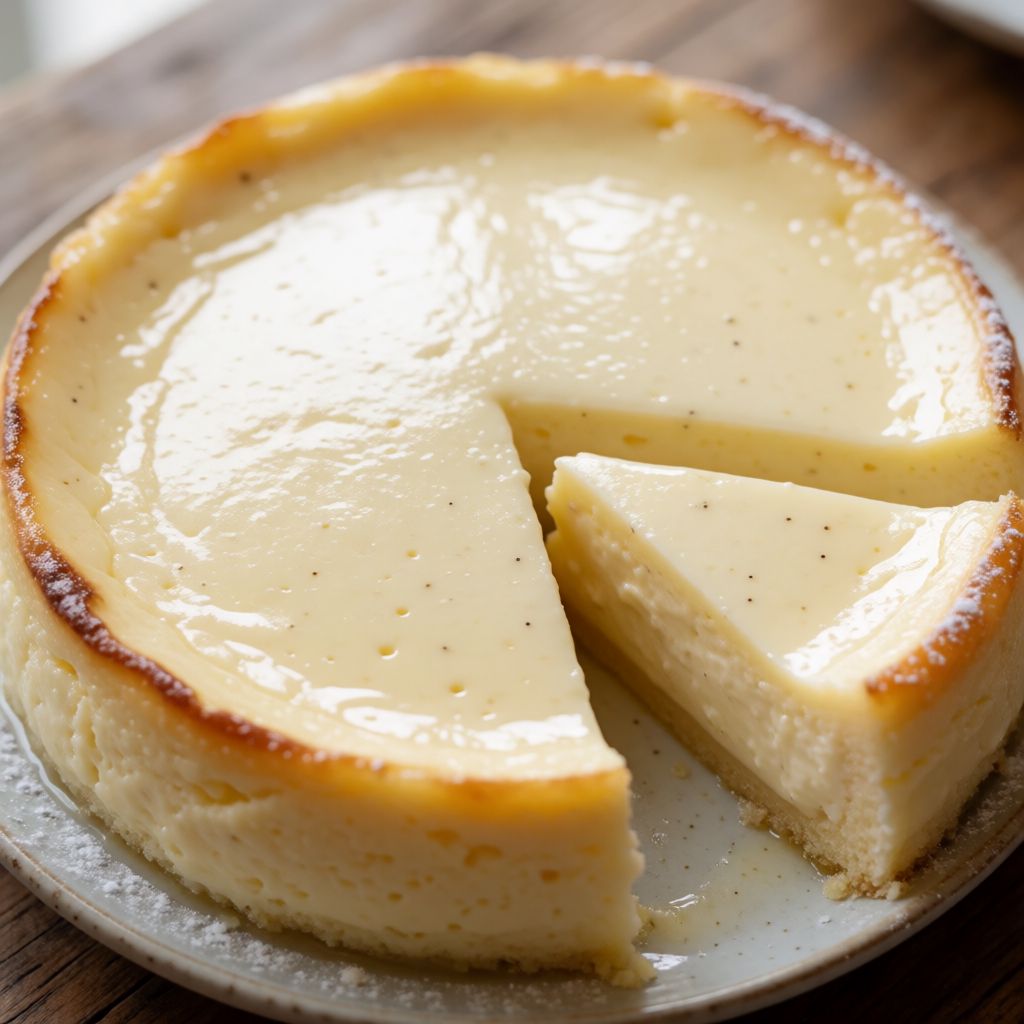
 AI photo
Torta Nua
A soft Italian sponge cake filled with vanilla custard cream, baked with a smooth crust on top.
Labels are worked out automatically from the ingredients and can be wrong. Check the packaging if it matters to you.
Ingredients
- 250 ml Milk
- 2 pcs Egg yolk
- 30 g Caster sugar
- 20 g Plain flour
- 1/2 pcs Vanilla pod
- 4 pcs Eggs
- 180 g Caster sugar
- 100 g Butter softened
- 130 ml Milk
- 300 g Plain flour sifted
- 8 g Baking powder
- 1 pcs Lemon zest





Steps
Bring the milk to the boil with half a vanilla pod in a small saucepan, for flavour.
In a bowl, whisk the egg yolks with the sugar until pale, then add the flour and mix thoroughly.
Remove the vanilla pod and pour the hot milk into the egg mixture in a thin stream, stirring constantly.
Pour everything back into the saucepan, place over low heat and cook, stirring constantly, until thickened.
Transfer the custard to a bowl, cover with cling film touching the surface and leave to cool.
In a large bowl, whisk the eggs with the sugar using a mixer for a few minutes, until pale and fluffy.
Add the softened butter and milk, continuing to whisk with the mixer.
Add the lemon zest, then fold in the sifted flour a little at a time, and finally the baking powder. Mix thoroughly.
Pour the batter into a 24 cm tin, greased with butter and dusted with flour.
Spread the custard over the surface of the batter with a spoon.
Bake the cake in a preheated fan oven at 180°C for 40-45 minutes, or in a conventional oven at 180°C for 45-50 minutes.
45 min
Torta Nua — "new cake" — is a sponge with a secret custard layer hiding inside it, not on top. You pour a plain lemon-and-butter batter into the tin, spoon unset custard over it, and bake. The custard doesn't mix in — it sinks a little, stays softer than the crumb around it, and gives you a cake with two textures from one bake. No layering, no filling after the fact, no assembly.
What decides whether it works is the custard's thickness going in. It has to be thick enough to sit on the batter without vanishing straight through to the bottom, but still pourable — spoon-able, as the recipe says. Too thin and it just mixes into the batter and you've made an ordinary cake with wasted egg yolks. Too thick — overcooked on the stove — and it won't settle into the batter at all, it'll bake as a separate skin on top. You're aiming for the texture of a loose pastry cream, cooled under cling film so it doesn't skin over.
Some say custard and sponge can't share an oven, that the custard will "curdle" or the cake will stay raw underneath. No — because the custard is already cooked before it goes near the oven. The heat in the oven isn't cooking the eggs in the custard a second time, it's cooking the raw batter around it. The custard just needs to warm through and settle, not set from scratch. That's why it survives 40-45 minutes at 180°C without breaking down.
Two eggs split two ways here: the yolks go into the custard for richness and colour, the whites' absence from that half of the recipe is deliberate — whole eggs would set the custard like a flan, and you don't want flan, you want cream. The second batch of eggs, four whole ones, goes into the batter for structure and lift, whisked to pale and fluffy with the mixer because that's what actually aerates a cake — not the baking powder, which only holds air that's already there. Skip the long whisking and the baking powder has nothing to work with; the cake comes out dense no matter how much of it you add.
Milk does two different jobs in two different places. In the custard it's the medium the yolks and flour cook in — bring it to the boil with half a vanilla pod so the vanilla has heat to release its flavour into, not just sit cold and inert. In the batter, the milk loosens the mixture so the softened butter can fold through it rather than clumping. Any full-fat milk works; skimmed will make a thinner, less rounded custard because there's less fat to carry the vanilla's flavour.
Flour appears twice as well, in very different amounts. 20g in the custard is there purely to stabilise it — just enough starch so the yolks thicken smoothly over heat instead of scrambling into grains the moment they hit too much heat too fast. That's also why you cook the custard over low heat — curdled custard is egg that's been shocked, not egg that's gone wrong by nature. 300g in the batter is structural, the actual bones of the cake, which is why it's sifted and folded in gradually — dump it in all at once and you knock the air straight back out of the eggs you just spent minutes whisking in.
Butter softened, not melted, is the usual reason given for cakes that don't rise evenly — melted butter is liquid fat, it slides out of the structure during baking instead of creaming in and holding tiny air pockets. Softened means spreadable with a spoon but not greasy on your fingers. If you've only got fridge-cold butter, a few seconds cut into small pieces, left on the counter, does more good than ten seconds in the microwave, which overshoots into melted before you notice.
Lemon zest is for lift in flavour, not acidity — you're not using it to react with the baking powder, just to cut through the richness of butter and custard both. Any citrus zest with a clean smell does the same job; orange zest is the obvious swap if you want something softer. Use the zest only, not the pith underneath, which brings bitterness you didn't ask for.
On an ordinary domestic hob, the custard step is the one to watch, because home rings run hotter at "low" than a chef's low. Stir constantly and if you see steam rising hard rather than lazily, pull the pan off the heat for a few seconds — the custard keeps cooking off the heat anyway. A 24cm tin suits six people generously; this isn't a cake you rush, not in the baking and not in the cooling of that custard beforehand — give it the time to come down to room temperature properly before it goes anywhere near the batter, or you'll melt the butter structure you just built.