
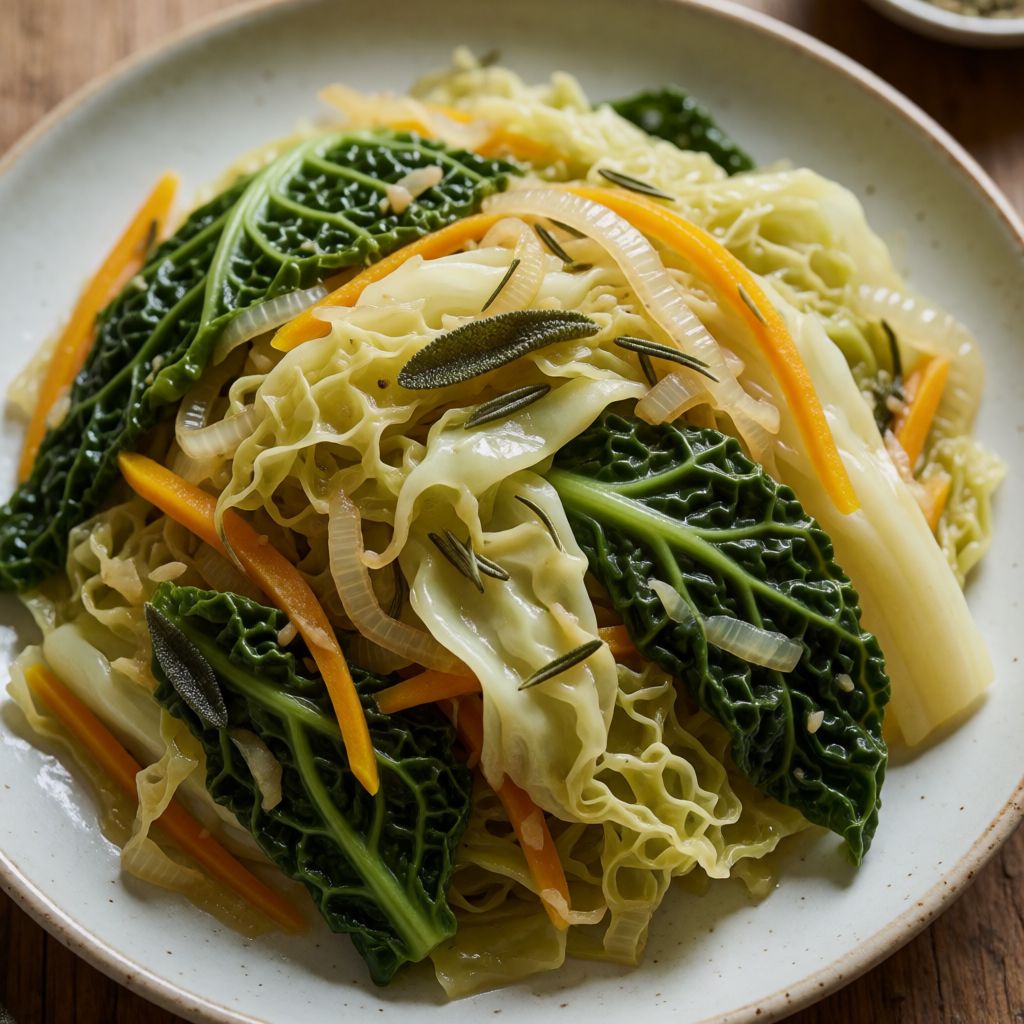
 AI photo
Tyrolean-style Cabbage
A braised savoy cabbage side dish with carrot, onion, herbs and white wine, cooked low and slow until tender.
Labels are worked out automatically from the ingredients and can be wrong. Check the packaging if it matters to you.
Ingredients
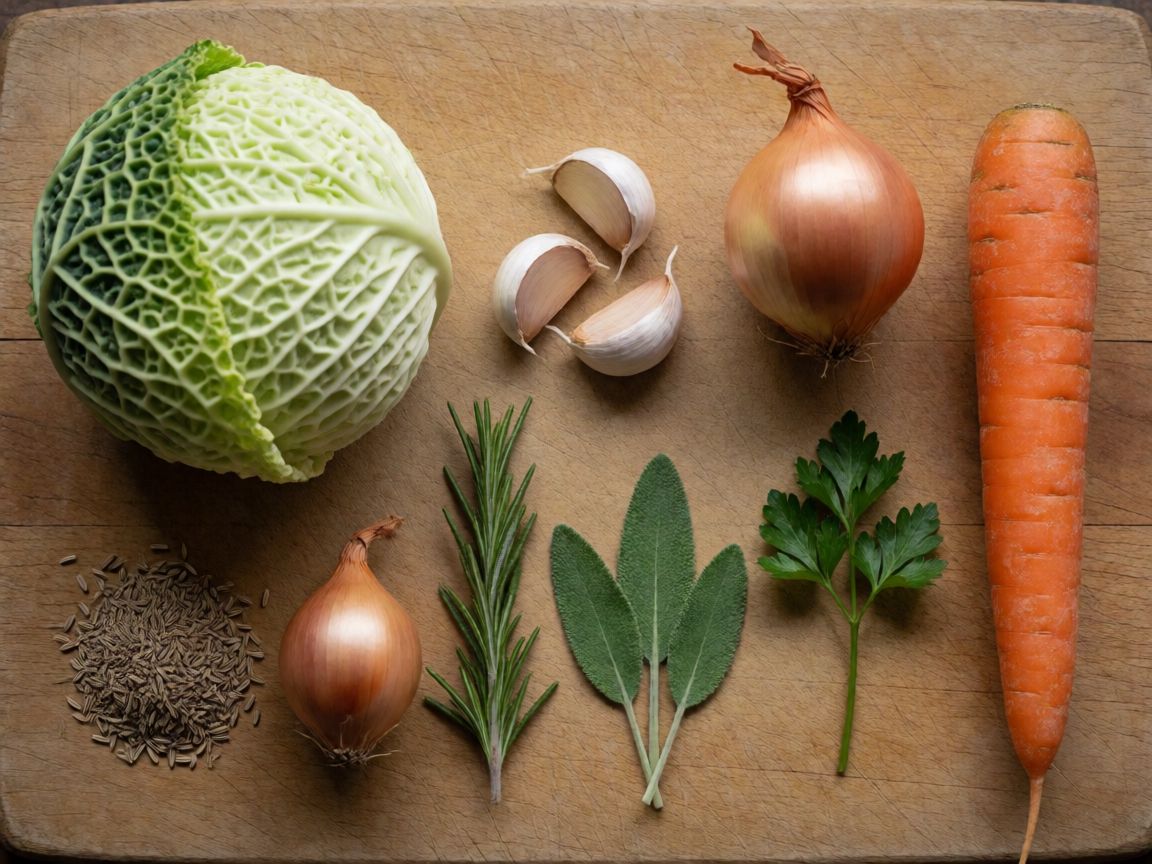
- 1 kg Savoy cabbage
- 3 clove Garlic
- 2 pcs Onion
- 1 pcs Carrot
- 1 bunch Rosemary
- 3 pcs Sage
- 1 bunch Parsley
- Fennel seeds to taste
- 0.5 l Vegetable stock
- 300 ml White wine
- 100 g Butter
- Salt to taste
- Black pepper to taste
- 3 tbsp Olive oil













Steps
Separate the cabbage leaves, wash them and let them drain. Cut the carrot into thin strips and finely dice the onion.
Peel the garlic and finely chop it together with the sage and rosemary (washed and dried beforehand). Wash the parsley and chop it finely.
In a wide pan, melt the butter with a spoon of olive oil.
Add the chopped garlic, sage and rosemary together with the carrot and onion, and sauté until softened.
As soon as the vegetables have softened, add the cabbage, cut into thin strips. Mix well and let everything stew together.
Pour in the white wine and let it evaporate, then add the vegetable stock.
Season with fennel seeds, crushed in a mortar, and a pinch of salt and ground black pepper.
Stir, cover with a lid and simmer on a very low heat until done.
60 minTransfer the finished dish to a serving plate and sprinkle with chopped parsley.
Serve at once, while the dish is still hot.
Savoy cabbage, slow-stewed with wine, stock and butter until it gives up being a vegetable and becomes something closer to a sauce that happens to be made of leaves. This is not coleslaw's crunchy cousin — it's the opposite instinct. You're not preserving bite, you're dissolving it, trading crispness for depth. The whole dish stands or falls on whether you let that trade happen fully, which means resisting the urge to pull it off the heat early because it "looks done" after twenty minutes.
What decides it is heat and time together, and specifically low heat held for long enough. Savoy cabbage has more structure than the flat white kind — those crinkled leaves are full of air pockets and tougher ribs — so it needs real time to break down into tenderness rather than mush. High heat here doesn't speed that up; it just scorches the sugars on the bottom of the pan while the inside stays stubborn. A very gentle simmer, lid on, lets the wine and stock work through the leaves slowly instead of boiling them from the outside in.
The wine goes in before the stock for a reason: it needs a minute to lose its raw alcohol edge — you'll see it stop looking glassy and start to cling to the vegetables — before you add liquid that will mostly just sit there and steam things. Skip that step and the dish keeps a faint sourness that no amount of simmering afterwards fully cooks out.
On the ingredients: the carrot and onion aren't really a vegetable component here, they're a flavour base — what Italians would call a soffritto, cut small and sweated gently so they melt into the background rather than stay as discrete chunks you can pick out. Cut the carrot too thick and it'll still have a snap when the cabbage has long gone soft; cut it in thin strips, as the recipe says, and it softens on the same timeline. That's the test for doneness on the carrot too, by the way — not a clock, but whether it bends without resistance.
Sage and rosemary are the aromatic backbone, and they go in with the butter at the start, not at the end, because their flavour is largely oil-soluble — it needs fat and gentle heat to draw it out before anything watery arrives. Add them at the end instead and you get sharp, raw herb notes sitting on top of the dish rather than running through it. Parsley is the opposite case: added raw, right at the end, for brightness and colour, because long cooking would just turn it muddy and grey.
Fennel seed, crushed rather than left whole, is doing a specific job: whole seeds mostly pass through releasing little, crushed ones give up their oil into the stew immediately. A mortar and pestle is the honest tool; the flat of a knife on a chopping board does the same job if you don't own one.
Butter plus a spoon of olive oil isn't indecision — butter alone can catch and brown too fast at the point you're trying to just soften onion and garlic, so a little oil raises the point at which that happens and buys you a gentler start. Any neutral oil with no real smell of its own will do the same job — a light vegetable or sunflower oil, nothing that announces itself.
On wine: dry white, something you'd actually drink a glass of, because its acidity is what's cutting through the richness of the butter and balancing what would otherwise be a heavy, flat dish. If you don't keep wine in, a small splash of cider vinegar or lemon juice loosened with a bit more stock gets you the acidity, though you lose the aromatic lift wine gives as it cooks off.
On the British kitchen specifically: you don't need a kazan or anything specialist — a wide, heavy-based pan with a lid, the kind you'd do a stew in, is exactly right, and it's actually better suited to this than a tall narrow pot, because it gives the cabbage room to lie in a shallow layer rather than steam itself in a heap. If the lid doesn't seal well, a plate sat on top does the same job of holding moisture in — that moisture is what stops the bottom layer catching while the top stays raw.
And on patience: this is not a dish you rescue by turning the heat up when you're hungry and it's taking a while. The sixty minutes is doing real chemical work — breaking down cellulose, letting flavours exchange between wine, stock, butter and leaf — and there's no shortcut that doesn't just leave you with pale, bitter cabbage and a sauce that never got the chance to deepen into something more than its parts.