
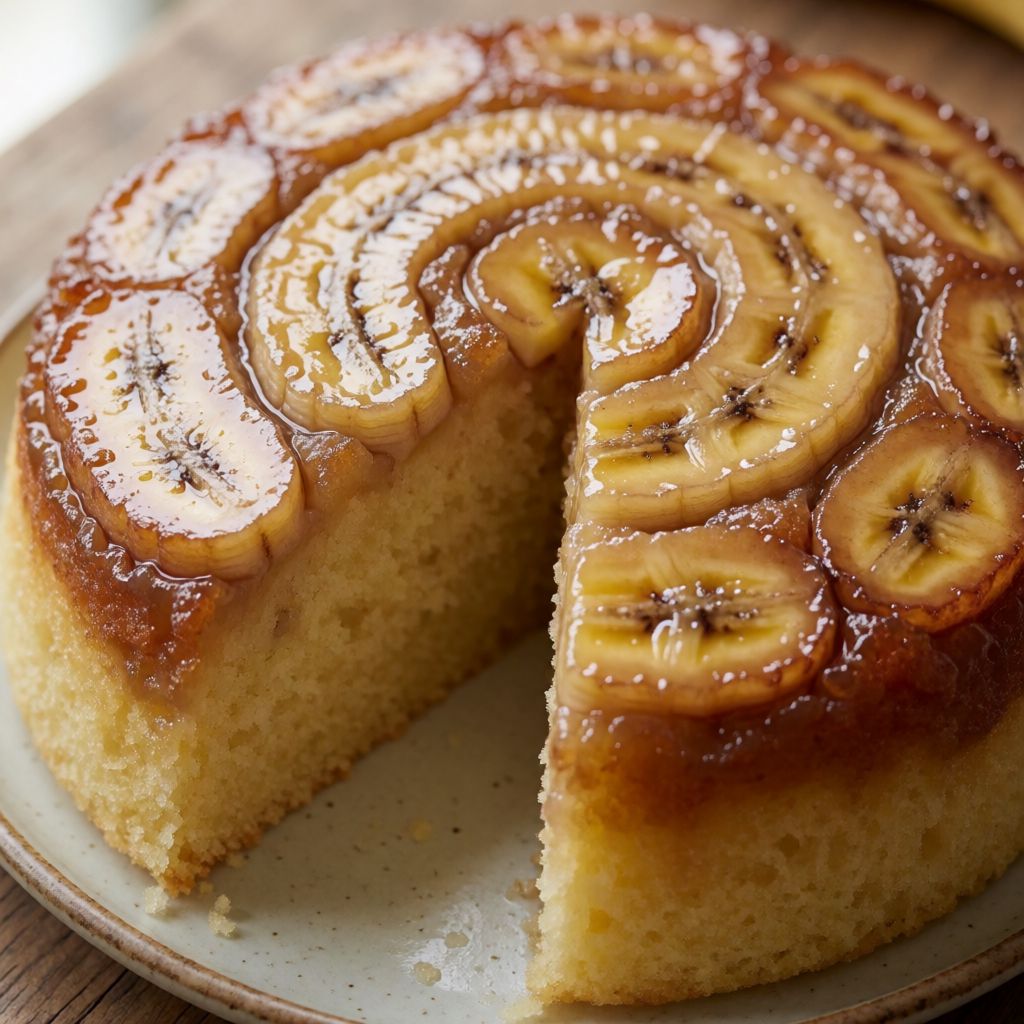
 AI photo
Upside-Down Banana Cake
An upside-down banana cake with a buttery caramel topping and lemon zest, finished with a soft wholemeal and plain flour sponge.
Labels are worked out automatically from the ingredients and can be wrong. Check the packaging if it matters to you.
Ingredients
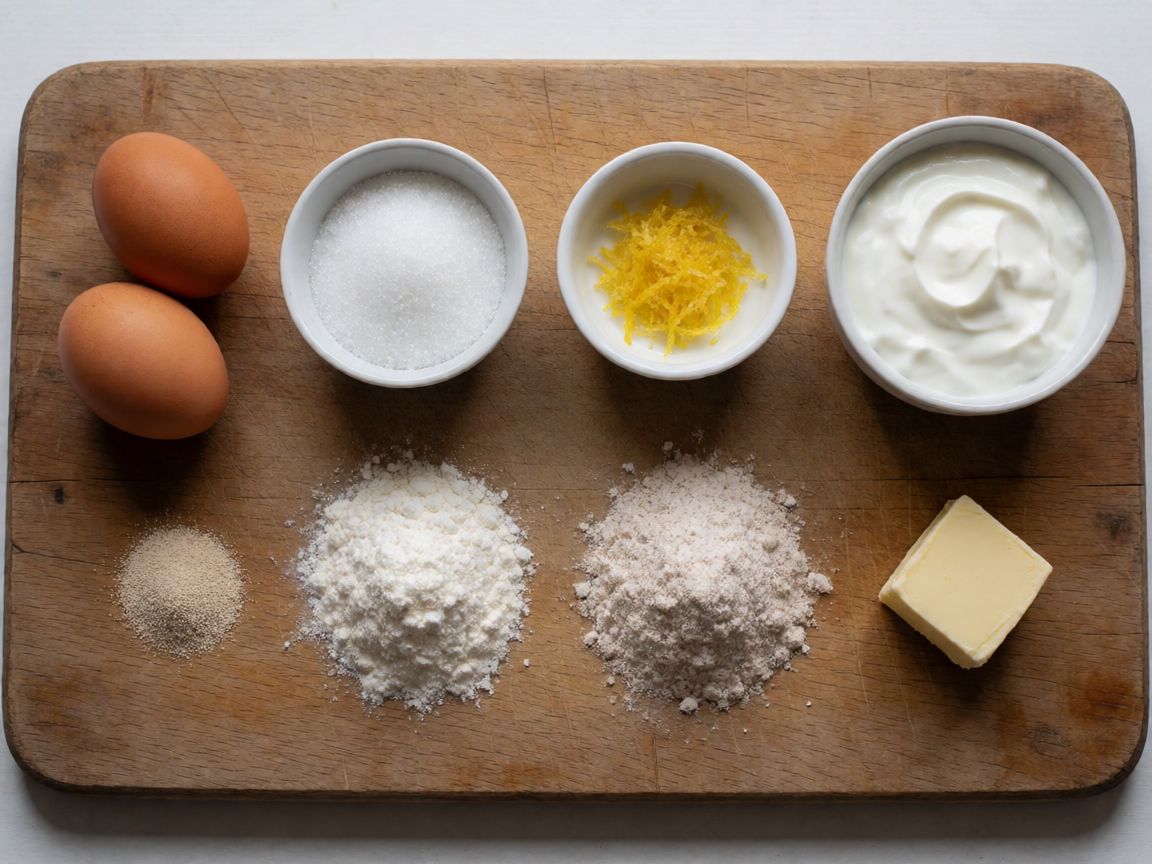
- 2 pcs Eggs
- 230 g Sugar
- 1 pcs Lemon zest
- 150 g Greek yogurt
- 10 g Yeast
- 90 g Plain flour
- 100 g Wholemeal flour
- 40 g Water
- 50 g Butter
- 5 pcs Banana







Steps
Whisk the whole eggs with the sugar until light and fluffy, add the lemon zest and mix.
Add the Greek yogurt and yeast, then gradually fold in the sifted plain flour and wholemeal flour.
Mix the batter until smooth and even.
Make the caramel: pour in the water, add the sugar and melt over a low heat; melt the butter separately.
Add the hot melted butter to the caramel, stir and leave to cool.
Peel and slice the bananas: four into 2-3 cm thick slices, the last one diced.
Line a buttered 22 cm baking tin with baking paper.
Arrange the banana slices over the base of the tin, cover with the caramel and then the batter.
Heat the oven to 170°C and bake the cake.
33 minLeave to cool for a few minutes, turn out onto a flat plate and remove the baking paper.
This is a tarte tatin logic applied to banana bread: caramel and fruit go in the tin first, batter goes on top, and the oven does the one thing a stovetop can't — it bakes the top of the cake and the underside of the caramel at the same time. Turn it out, and what was the bottom becomes the glossy, sticky top. The whole dish is built backwards on purpose, and that's not a trick — it's the only order that works, because caramel poured onto a finished cake just slides off; caramel baked under one soaks into it.
What decides whether it works is the caramel stage, not the cake batter — the batter here is forgiving, a simple whisked sponge with yeast folded in almost like a cheat for lift. The caramel is where people panic and either burn sugar or get a grainy, seized mess. Sugar and water melted low and slow, then hot melted butter stirred in — that butter has to be hot, because cold butter hitting hot sugar is a thermal shock that splits the caramel into oil and crystal instead of marrying into it.
The banana itself is doing structural work, not just flavour. Thick slices across the base hold their shape and give you clean rings when you turn the cake out; the last banana diced into the batter collapses into it and sweetens the crumb from inside, so you get banana as a visible pattern and banana as a flavour running through, by two different mechanical routes.
Eggs and sugar whisked until "light and fluffy" aren't decoration — that's you beating air into the mixture mechanically, because this cake has no baking powder working alone; it leans partly on trapped air and partly on the yeast. Whisk too briefly and the crumb stays dense and wet-feeling even when fully cooked, because there was never enough structure to hold rise.
The yeast at 10g is doing a quieter job than in bread — there's no long proof here, it's folded straight into a wet batter and goes into the oven almost immediately, so its lift is a slow top-up to the eggs' air rather than the main event. Don't confuse it with baking powder and expect it to work the same way; it needs a little warmth from the oven itself to really get going, which is one more reason this isn't a cake you rush into a too-cool oven out of impatience.
Two flours — plain and wholemeal — split the job between structure and character. Plain flour gives you the fine, even crumb; wholemeal brings bran and a nuttier flavour but also more water-thirsty bran that can dry a cake out if it's the only flour used. If you've only got plain in the cupboard, use it for the whole 190g — you'll lose some depth of flavour, not the structure of the cake. Greek yogurt sits in for buttermilk or soured cream here: anything thick, soured, and dairy will do the same acid-tenderising job on the crumb. Thin yogurt won't — it adds liquid without the fat and acid balance, so the batter goes slack.
For the caramel, butter is there for two reasons at once: fat for gloss and richness, and — because it's added hot into hot sugar rather than cold — to stop the sugar seizing into a grainy mass as it cools. Use a butter with no strong off-flavour of its own; this isn't the place for a heavily salted or very grassy one, since caramel has nowhere to hide an odd taste.
Lemon zest is a small thing but it's cutting through the banana and caramel's one-note sweetness — without it the cake can taste flat-sweet rather than bright-sweet. If you've no lemon, a little orange zest does roughly the same job of lifting sugar without adding sourness.
On turning it out: the few minutes' rest before flipping isn't optional fussiness. Caramel straight from the oven is still liquid-hot and will run off the cake and burn your hand or the plate rather than cling to it; a short rest lets it firm just enough to hold its shape as a glaze while still being warm enough to pour and settle. Flip too late, after it's gone cold and set hard, and it may stick to the paper instead of releasing.