
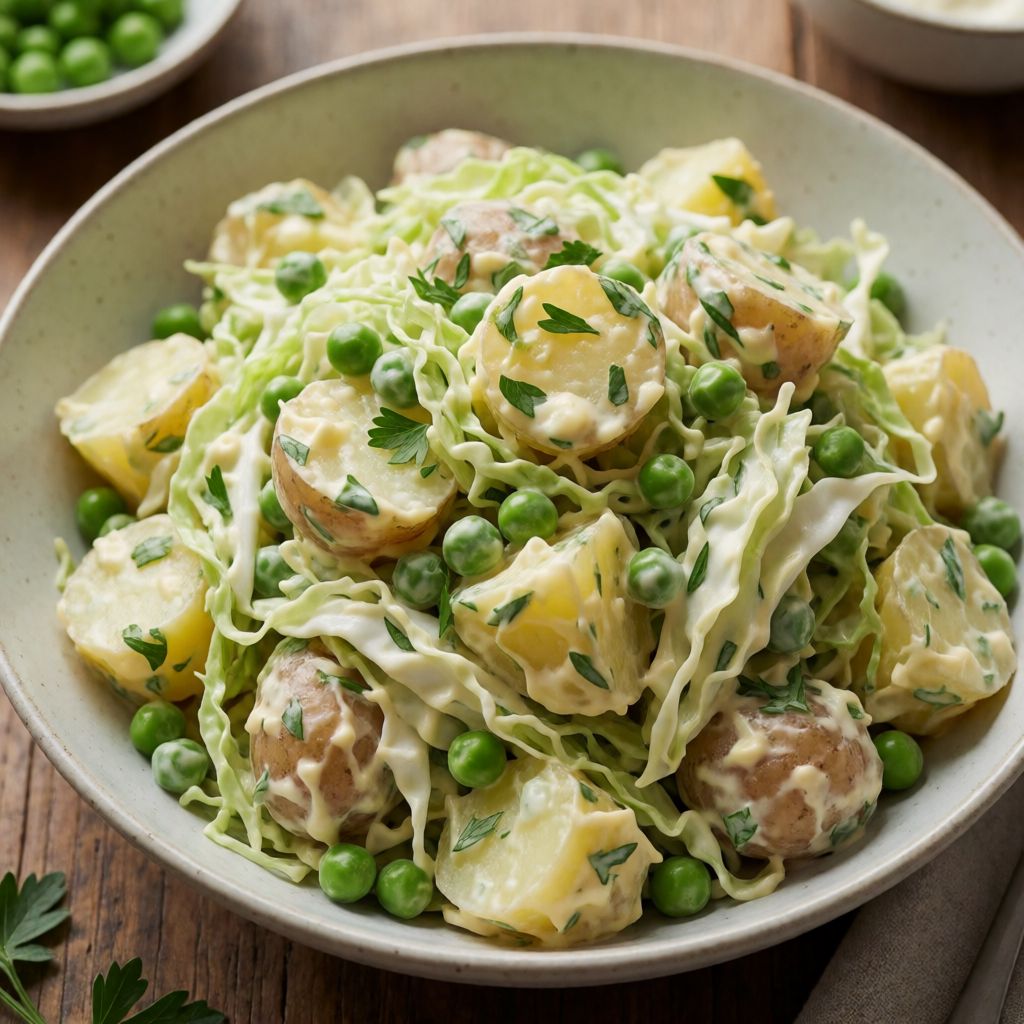
 AI photo
Warm Potato Salad with Spring Cabbage
A warm potato salad with spring cabbage, peas and a creamy mustard dressing.
Labels are worked out automatically from the ingredients and can be wrong. Check the packaging if it matters to you.
Ingredients
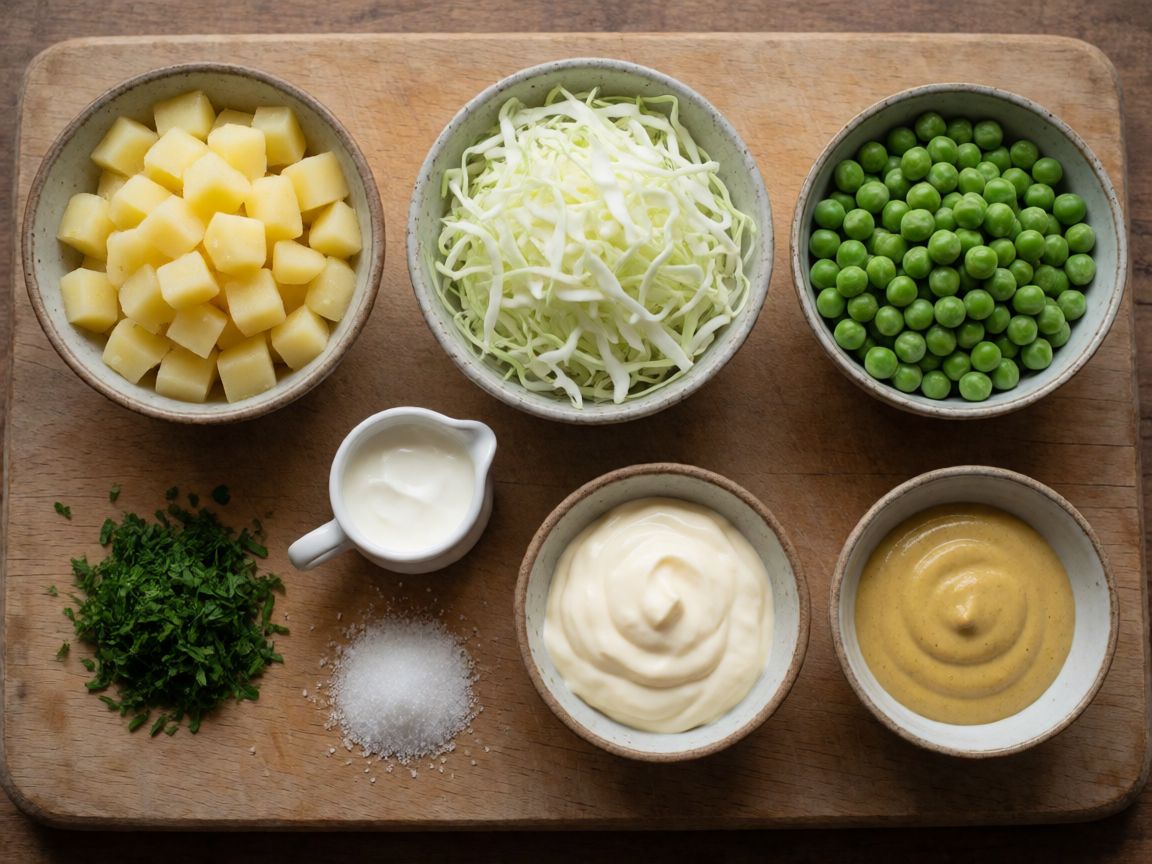
- 1 kg Potatoes
- 1 pcs Spring cabbage thinly sliced
- 150 g Peas fresh
- 1 bunch Parsley finely chopped
- 100 ml Crème fraîche
- 2 tbsp Mayonnaise
- 2 tsp Dijon mustard
- 2 tsp Sugar
- 1 bunch Parsley finely chopped
- 1 bunch Chives finely chopped
- Salt to taste
- Black pepper freshly ground











Steps
Wash the potatoes and boil them until tender in a pot of lightly salted water.
A minute before the potatoes are ready, add the cabbage and peas, cover with a lid, then drain after a minute.
1 minLet the potatoes, cabbage and peas cool slightly in a bowl, then sprinkle with parsley.
For the dressing, mix the crème fraîche, mayonnaise, mustard, sugar, parsley, chives, salt and pepper until smooth and well combined.
Toss the warm potatoes, cabbage and peas with the dressing.
This is a potato salad that refuses to cool down before it's dressed — which is the whole point of it. Think of it as a halfway house between a British boiled-veg plate and a French bistro salad: boiled potatoes and spring greens, but held together with crème fraîche and mustard instead of vinegar and oil alone.
What decides whether it works is temperature at the moment of dressing, not at the moment of serving. A hot potato is full of starch that has just gelatinised and is sitting there with its structure open and thirsty. Toss the dressing through while it's still warm and the potato drinks some of it in — you get seasoning all the way through, not a coating on the outside. Let it go cold first and the starch has already set like glue around itself; the dressing just slides off and pools at the bottom of the bowl. So some say potato salad should be made cold, for safety's sake or convenience — no, because that's exactly the state in which it refuses to take the dressing properly. Warm isn't a style choice here, it's a mechanical requirement.
Potatoes: you want a kind that holds its shape through boiling but still has enough starch to take on dressing — a general all-rounder rather than a waxy salad potato bred for staying firm and dry, and not a pure floury baker that will collapse into mash the moment it's tender. Boil them whole in their skins if you can manage the peeling afterwards, or peel first if that's easier on a weekday — skin-on keeps more of the potato's own flavour and starch inside it, skin-off boils a touch faster and is less fuss with a knife at the end. Either way, the test for done is a knife or skewer going in without resistance, not a clock — a kilo of potatoes cut into similar-sized pieces will roughly agree on timing, but size variation is the usual reason one piece is raw while another's falling apart, not the water or the heat.
Spring cabbage is chosen here for its youth: thin, pale, still-tender leaves that need almost no cooking, unlike a dense winter cabbage that would need real boiling time to soften and would turn the whole dish heavy. If spring cabbage isn't in the shop, use the lightest, freshest cabbage you can find and slice it thinner to compensate — you're buying tenderness either with the plant's own youth or with your knife.
Peas: fresh in season are better here only because they're sweeter and firmer for that one minute of cooking; frozen peas are already blanched at the factory within hours of picking, so they're a perfectly honest substitute and in a British winter the more realistic one — just add them straight from the freezer, they'll be ready before the potatoes are drained.
The dressing runs on three jobs done by three ingredients. Crème fraîche brings the tang and enough fat to carry flavour without tasting of fat; soured cream is close enough if that's what's in the fridge, double cream with a squeeze of lemon is a thinner stand-in. Mayonnaise brings body — more fat, more hold, so the dressing coats a spoon instead of running off it. And mustard isn't there for heat; it's the emulsifier, the thing that lets fat and liquid sit together instead of splitting into a greasy layer and a watery one. This is why Dijon specifically and not a hot English mustard — Dijon is mild and smooth, built from wine must rather than vinegar and horseradish-sharp seeds, and it binds without fighting the cream for attention. Some think any mustard will do the same job: no, because English mustard's sharpness would sit on top of the dressing rather than inside it, and you'd taste mustard instead of tasting potato salad. The sugar is there to answer the acidity of the crème fraîche and mustard together — without it the dressing tastes thin and sour rather than rounded; it's a correction, not a sweetener.
Parsley and chives go in twice over — once through the warm vegetables on their own, once into the dressing — because herbs stirred into something hot lose their brightness fast, while herbs kept in the cool dressing stay green and sharp until the moment of serving. Salt the potato water properly, the way you'd season pasta water, because that's the only chance the potato itself gets to be seasoned from the inside; salting only at the end seasons the surface and nothing else. And give the whole thing the one thing a recipe like this can't be rushed on: a few minutes for the boiled vegetables to drop from scalding to merely warm before the cream goes anywhere near them — crème fraîche split over genuinely hot potato is a common, fixable, and entirely avoidable disappointment.