
 AI photo
Zeppole Without Resting the Dough
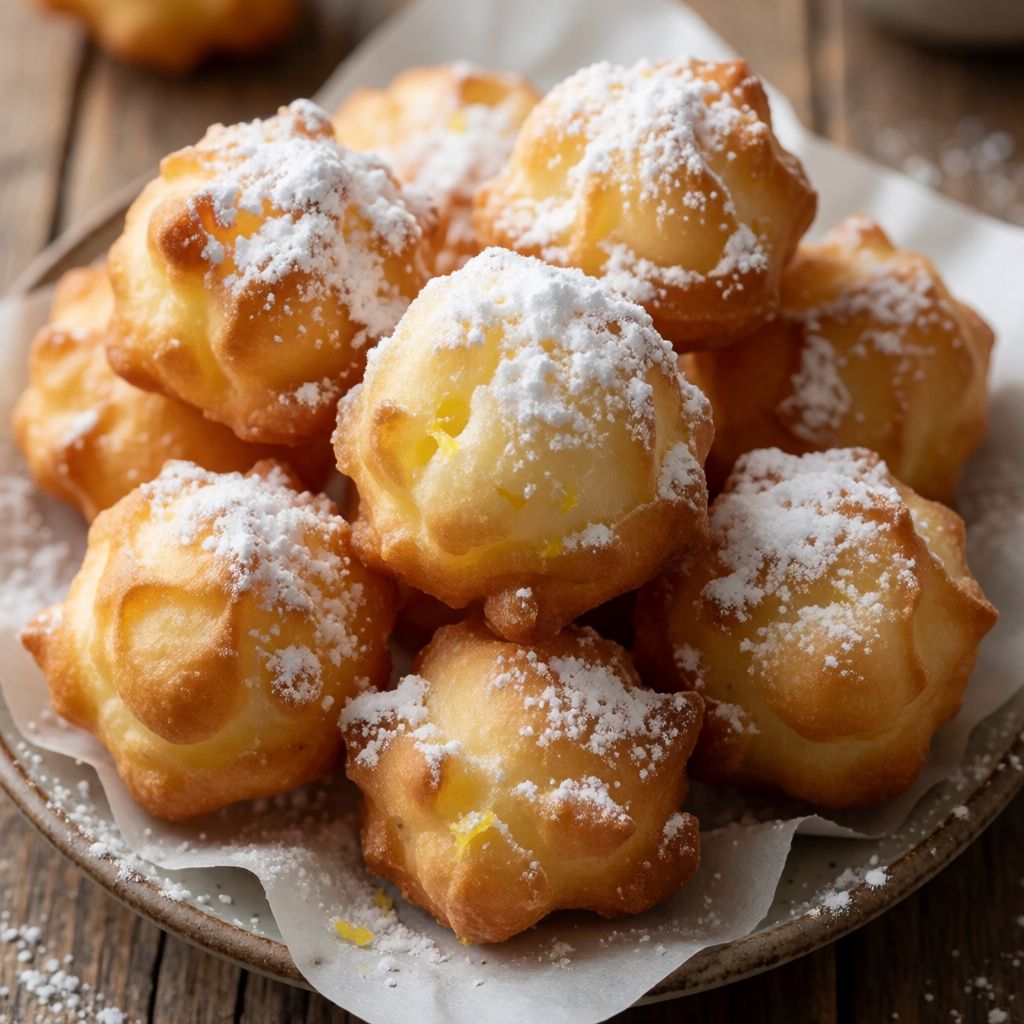
Deep-fried ricotta zeppole flavoured with citrus zest, ready to fry as soon as the dough comes together — no resting needed.
Labels are worked out automatically from the ingredients and can be wrong. Check the packaging if it matters to you.
Ingredients
- 400 g Plain flour
- 250 g Ricotta
- 100 g Caster sugar
- 1 pcs Egg
- 50 ml Apple juice
- 1 pcs Lemon zest
- 1 pcs Orange zest
- 8 g Baking powder
- Groundnut oil for deep-frying









Steps
In a large bowl, mash the ricotta with a fork together with the egg and sugar until smooth and creamy.
Add the lemon zest, orange zest and apple juice, and mix well.
Stir in the flour and baking powder and mix until you have a soft, even dough.
Divide the dough into pieces of about 60–70 g each and roll each one into a rope about 20 cm long.
Join the ends of each rope firmly together to form a zeppole ring.
In a deep saucepan, heat the groundnut oil to 170°C and fry the zeppole in small batches, turning so they brown evenly on all sides.
15 minLift the zeppole onto a paper towel to drain off excess oil, then roll them in sugar on all sides.
This is zeppole built on a shortcut most Italian grandmothers would raise an eyebrow at: no yeast, no hours under a tea towel waiting for a dough to double. Here the lift comes from baking powder working against the moisture and acid in ricotta, egg and citrus — a chemical rise instead of a biological one. That's the whole point of the title: you go from mixing bowl to hot oil in twenty minutes, because there is nothing here that needs time to develop. What there is needs care instead.
What decides if it works is the dough's texture at the rolling stage. Mash the ricotta properly — lumps mean pockets that won't take the egg and sugar evenly, and a dough that fries unevenly, dense in one spot, hollow in another. Stir in the flour just until it comes together. This isn't bread; you're not building gluten, you're barely tolerating it. Overwork it and the ropes turn elastic and springy instead of soft, and a springy rope won't hold its ring shape — it'll shrink back into a lump the second you let go.
Some say any dough needs to rest before frying, flour needs to "relax". No — because that rule belongs to yeasted or hand-kneaded doughs, where gluten strands are tight and need time to go slack. Here there's no gluten network worth relaxing, and the baking powder has already started its work the moment it met moisture. Let this dough sit and you're not improving it, you're losing lift before it ever sees the oil.
Ricotta is doing three jobs at once: it's the moisture that binds the flour, the fat that keeps the crumb short rather than chewy, and — because fresh ricotta carries a touch of acidity from the whey — part of what sets the baking powder going. Buy it fresh and well-drained; if it's sitting in a pool of liquid in the tub, tip that off first or your dough will be loose and sticky and you'll be tempted to add flour to fix it, which just makes the zeppole tough. No ricotta in the fridge? Quark or a soft curd cheese works on the same logic — mild, a little moist, no graininess.
The egg is structure insurance: without yeast's gluten-building time, egg protein is what sets around the air bubbles baking powder creates, so the rings hold a ring shape instead of slumping flat in the oil. Plain flour is right here precisely because you don't want strong gluten — a bread flour would fight you at the rolling stage, making the ropes spring back instead of staying put.
Baking powder is the engine. It needs heat and moisture to release its gas properly — this is why the dough goes into hot oil almost as soon as it's mixed, not later. Wait too long on the counter and some of that lift escapes before it's trapped by the egg and crust; the zeppole come out flatter and denser, and people blame the ricotta when it was really the clock.
Lemon and orange zest are there for the oils in the peel, not the juice — that's why it has to be fresh zest, grated just before mixing. Dried citrus peel won't release the same fragrance; it's been baked out of it. The apple juice does double duty as the dough's liquid and a quiet source of sweetness and acidity, nudging the baking powder along. Any fruit juice with a little natural sugar and acid does the same job — orange juice is the obvious stand-in, since you're zesting one anyway.
Groundnut oil is chosen for what it doesn't bring to the pan: almost no smell of its own, and a smoke point well above 170°C, so it won't scorch or flavour the dough while it fries. Any neutral oil with a high smoke point does the same — sunflower, rapeseed, plain vegetable oil. Leave olive oil for the salad; its flavour and lower smoke point have no business here. In a domestic kitchen without a thermometer, drop a pea-sized bit of dough in first — if it sinks and sits before slowly bubbling up, the oil's not ready; if it rises straight away surrounded by brisk small bubbles, you're close to the mark.
The sugar roll at the end works because the zeppole are still faintly warm and oily from the fryer — that residual film is what the sugar grips onto. Let them go properly cold on the paper towel first and the sugar just sits there loose, not stuck. Four people, eight rings at 60–70g each — two apiece, maybe three if nobody's watching, and they're a tea-with-milk sort of thing more than a dessert course, best eaten the same afternoon, because without yeast's structure they don't keep their crust past a day.