
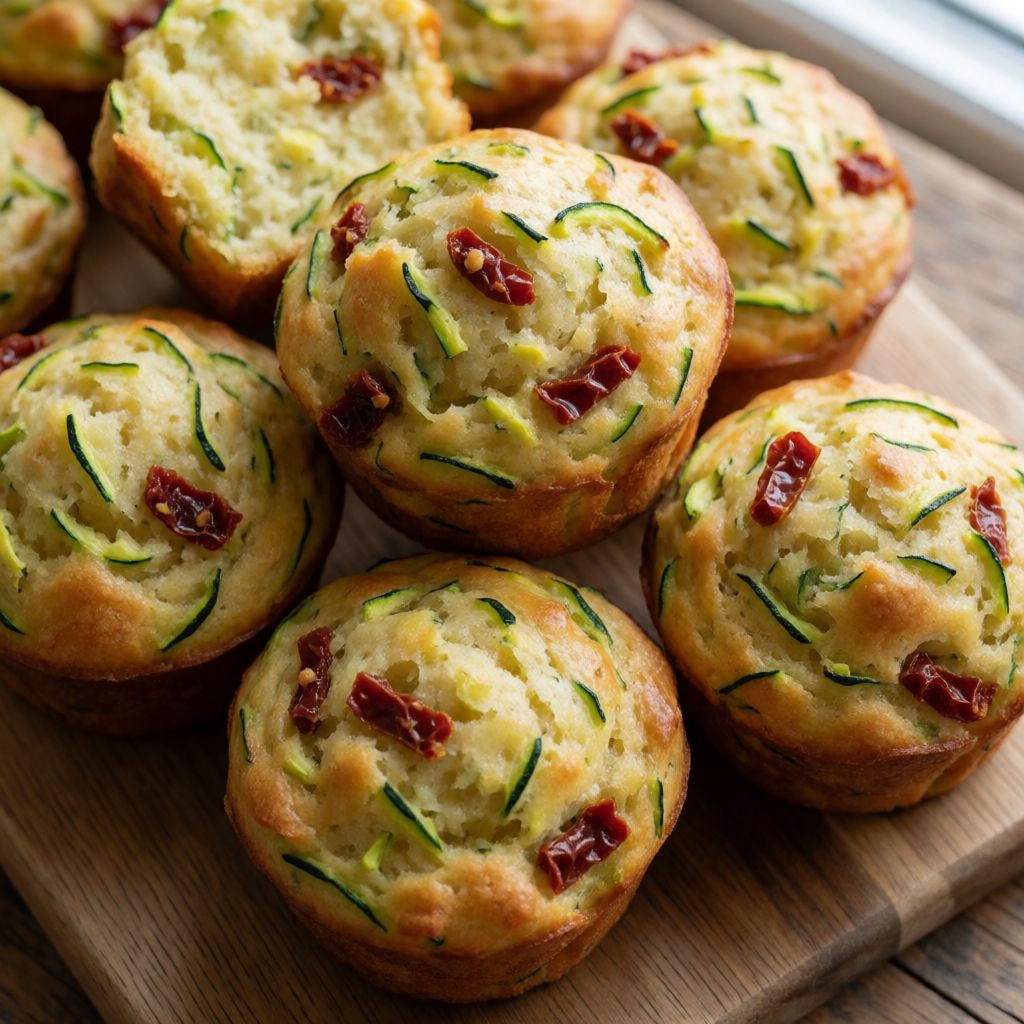
 AI photo
Courgette and Sun-Dried Tomato Muffins
Savoury muffins with courgette, sun-dried tomatoes and parmesan, lovely warm or at room temperature.
Labels are worked out automatically from the ingredients and can be wrong. Check the packaging if it matters to you.
Ingredients
- 200 g Plain flour
- 10 g Baking powder for savoury bakes
- 3 pcs Eggs
- 100 ml Milk
- 200 g Courgette
- 80 g Sun-dried tomatoes
- 100 g Parmesan
- 100 ml Olive oil
- Salt to taste
- Black pepper to taste
- Parsley to taste









Steps
Wash the courgette, trim the ends and slice into rounds.
Fry the courgette in a little olive oil for about 10 minutes, then add the sun-dried tomatoes.
10 minWhen the courgette softens, stop frying, season with salt and pepper and remove from the heat.
In a bowl, whisk together the milk, eggs, chopped parsley and olive oil.
In another bowl, combine the flour with the baking powder and gradually pour in the liquid mixture, adding the parmesan at the end.
Mix until the batter is smooth and even.
Fold in the courgette and sun-dried tomatoes, and season with salt and pepper to taste.
Prepare a muffin tin or individual moulds, greasing them thoroughly with butter.
Spoon the batter into the moulds, filling them almost to the top.
Place a piece of sun-dried tomato on top of each muffin.
Bake for about 20-25 minutes in an oven preheated to 180°C.
23 minRemove the muffins from the oven, let them cool slightly and serve.
A savoury muffin is really just a quick bread wearing a party hat — no yeast, no waiting for anything to rise on its own schedule, because baking powder does the lifting the moment it hits heat and moisture. That's the whole mechanism here: fat-and-egg batter around courgette that's been fried, not raw, and parmesan that's been melted into the mix rather than just scattered on top. What decides whether these work is water. Courgette is mostly water, and if you don't drive some of it off in the pan first, it weeps into the batter during baking and you get a muffin that's gummy in the middle and never quite sets — damp bottom, pale sides, the crumb never closing up properly.
Frying the courgette rounds for those ten minutes isn't about cooking them through — they'll finish in the oven. It's about getting the surface moisture to steam off so what goes into the batter is concentrated courgette flavour, not a sponge full of liquid waiting to leak. You're looking for the slices to go slightly limp and a shade darker, losing their squeak when you push them with a spoon. That's the cue, not a clock.
Some say sun-dried tomatoes need soaking before you use them. No — not these. The oil-packed kind (or dry ones you've already rehydrated) go in as they are; soaking them further just dilutes the thing you bought them for, which is concentrated, slightly leathery sweetness against the soft courgette. If yours are bone-dry and brittle, a short soak in warm water is fixing your tomatoes, not following a rule.
Flour and baking powder are the structure — 10 g of baking powder to 200 g flour is a strong ratio, which tells you this batter has a lot of wet, heavy things to lift (courgette, tomatoes, cheese, oil) and needs the extra push. If you're buying baking powder off a UK shelf, check it says "for baking" generically — the double-acting kind sold here works fine; what you don't want is bicarbonate of soda substituted in without an acid to react against, because then nothing rises and you've made a dense savoury pancake in disguise.
Eggs and milk are the glue and the moisture that lets the flour's gluten form just enough net to trap the baking powder's gas. Three eggs for 200 g flour is a rich ratio — this is closer to a clafoutis-adjacent batter than a British teabread. Milk with the usual fat content is fine; if you're out, a splash of cream cut with water does the same job, since what matters is fat plus liquid, not the brand on the carton.
Courgette is the main vegetable and also, inconveniently, the main source of water in this batter — see above for why it's fried first, not grated raw and folded in as some quicker recipes suggest. Choose firm, glossy ones without soft spots; a limp courgette has already started losing structure and will turn to mush faster than you want.
Sun-dried tomatoes bring acidity and concentrated sweetness that plain courgette doesn't have — without them the muffin reads as "bland vegetable bread." Oil-packed ones from a jar are the easiest in a UK shop and carry their own oil, which you can use for the frying step instead of fresh olive oil, getting two jobs from one purchase.
Parmesan is salt, fat, and savoury depth (umami, if you want the word) rather than just "cheese flavour" — it's why the salt measure in this recipe is modest; the parmesan is doing a lot of that work already. A hard, well-aged grating cheese is the criterion — any firm, salty, aged hard cheese with a dry crumble to it works, so a mature Cheddar or Grana Padano stands in fine if parmesan's not in the fridge; a young, wet cheese won't give you the same savoury hit and will make the batter wetter besides.
Olive oil is "any oil with no smell of its own that can take frying heat" for the courgette step, and a flavour-carrier in the batter itself — a mild olive oil is traditional here because it doesn't fight the parmesan, but a neutral vegetable or sunflower oil does the structural job if that's what's in the cupboard.
On the oven: 180°C is where the batter sets without the outside hardening before the inside catches up — a domestic fan oven runs a touch hotter than it claims, so the real cue is the muffin rising, the top turning the colour of a roast potato skin, and a skewer coming out clean rather than wet. Twenty minutes is the lower bound, not the finish line — leave them if they're pale, pull them the moment a skewer tells you, not the timer.
And greasing the tin thoroughly with butter isn't fussiness — it's the only thing standing between a clean release and a muffin that tears its base off in the tin, because parmesan toasts and sticks far more aggressively than a sweet batter ever does. Patience here is less about waiting and more about not rushing the fry — ten quiet minutes with the courgette is what buys you a muffin that holds together instead of one that slumps on the plate.