
 AI photo
Apple Dessert with Rye Breadcrumbs and Cream
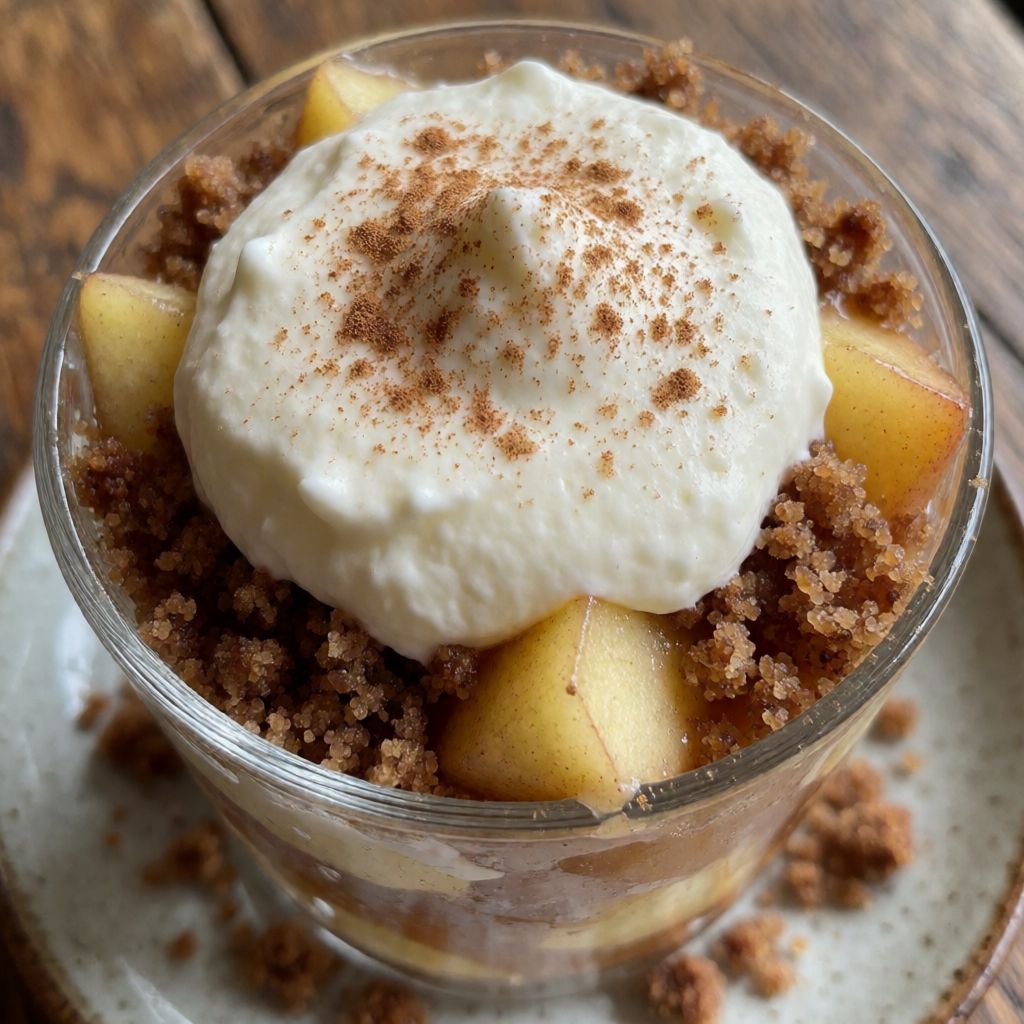
A layered apple dessert with buttery spiced rye breadcrumbs, whipped cream and a spoonful of jam.
Labels are worked out automatically from the ingredients and can be wrong. Check the packaging if it matters to you.
Ingredients










Steps
Bring the apples, water, spices and sugar to the boil and simmer uncovered for 15 minutes, stirring occasionally.
15 minChill the purée in the fridge.
Melt the butter in a frying pan, add the rye bread and sugar.
Fry, stirring, until the sugar has melted.
Leave to cool.
Whip the cream until light and fluffy.
In serving glasses, layer the apple purée and rye crumbs alternately.
Add a spoonful of jam between one of the layers.
Finish with whipped cream and sprinkle rye crumbs on top.
This is a Baltic-German trick dressed up as a dessert: stale rye bread, fried in butter and sugar until it behaves like a crumble topping, layered with apple purée and cream. The Germans and the Latvians who made this dish didn't invent it for pleasure first — they invented it because throwing away bread was not something a poor household did. Rye bread goes hard in two days; frying it in fat and sugar is what you do with a thing you can't eat straight but won't bin either. So the "recipe" is really a solution to a storage problem, later discovered to taste good enough to keep around once nobody needed to save bread anymore.
What decides whether it works is contrast, not flavour exactly — three textures stacked so each one defends the next. Soft purée, crisp-dark crumb, soft cream again. If the crumbs go soggy before you eat the thing, you've lost the whole point of making them in the first place; they become wet bread again, which is where they started. So the crumbs are not a garnish, they're the engine.
Some say rye bread is "too sour" or "too heavy" for a dessert — no, because frying it in butter and sugar until the sugar melts is exactly what cancels that heaviness. The caramelising sugar coats the crumb and mutes the sourness; what you taste afterwards is toasted and faintly bitter, like a good dark biscuit, not like bread at all. That's the whole chemistry of the step, and it's also why you don't skip the frying and just sprinkle raw crumbs on — raw rye crumb tastes of rye bread, which nobody wants on top of cream.
Start with the apples. 800 g peeled and cubed sounds like a lot until you remember apples are mostly water and shrink fast once the water starts escaping in the pan — that's the whole purpose of the 100 ml of water added with them: not to cook the apple so much as to stop the pan going dry and scorching the sugar before the fruit has softened. Any firm, slightly tart apple works — Bramley if you want it to collapse almost on its own, Granny Smith or a crisp eating apple if you want it to hold more shape and need the full 15 minutes to get there. A soft, sweet apple like a Gala will just turn to mush fast and give you less flavour to work with, since tartness is what's cutting through the sugar and cream later. You're not looking for a clock here — you're looking for apple that falls apart when you press it with the spoon rather than apple that still snaps.
Vanilla, cinnamon, cardamom — this isn't three flavours competing, it's one job split three ways. Vanilla rounds, cinnamon warms, cardamom gives a sharper, almost citrus lift that stops the whole thing tasting like plain stewed apple from a British kitchen table. If you don't have a vanilla pod, a teaspoon of vanilla extract added off the heat does nearly the same job — the pod just gives you visible black seed and a cleaner flavour, no alcohol note. Skip cardamom if you must, but don't skip cinnamon; it's doing more of the work than its one pinch suggests.
The rye bread is the part a British kitchen won't have lying around by habit — this is where you reach for a dense, dark German- or Scandinavian-style rye, the kind sold as "pumpernickel" or "dark rye" in supermarkets, not a soft sandwich loaf. The density matters: it's what gives you crumb that holds its crunch under cream instead of dissolving. If you genuinely can't get rye, use any stale, dense wholemeal — you lose the sour edge but keep the mechanism. Frying it in butter (any fat with a clean taste works, but butter's browning gives you flavour a neutral oil won't) with sugar until the sugar melts is the step that turns bread into something closer to a biscuit crumb: the sugar caramelises around the crumb pieces and seals them, so when they later sit against cold cream they stay crisp for the length of a dessert course rather than the length of a photograph. Do this in a wide pan, stirring properly, because rye crumb left still in a pan burns at the edges before the centre catches up — a wide domestic frying pan actually suits this better than anything deep.
The cream needs no instruction beyond: whip it until it holds its own shape but before it turns grainy — that grainy stage is cream that's been pushed past soft peaks into the start of butter, and once it's there you can't walk it back. Use whipping or double cream, not single — single cream has too little fat to hold air and will just go runny under its own weight in the glass.
Jam is the one ingredient with real latitude. A cooked fruit jam — plum, cherry, even a tart apricot — gives a sharp, concentrated note between the soft layers, something the apple purée alone, already quite gentle after cooking, doesn't supply on its own. Use whatever's at the back of your cupboard; this was never a dessert fussy about which fruit sat in the jar.
Patience here isn't dramatic — it's the fridge time for the purée and the cooling time for the crumb, both of which you can't rush by turning up any heat. Warm purée melts the cream it sits against; warm crumb goes soft before it's even layered. Let both come down to room temperature or below before you build the glass, and the texture holds together right through to the last spoonful.