
 AI photo
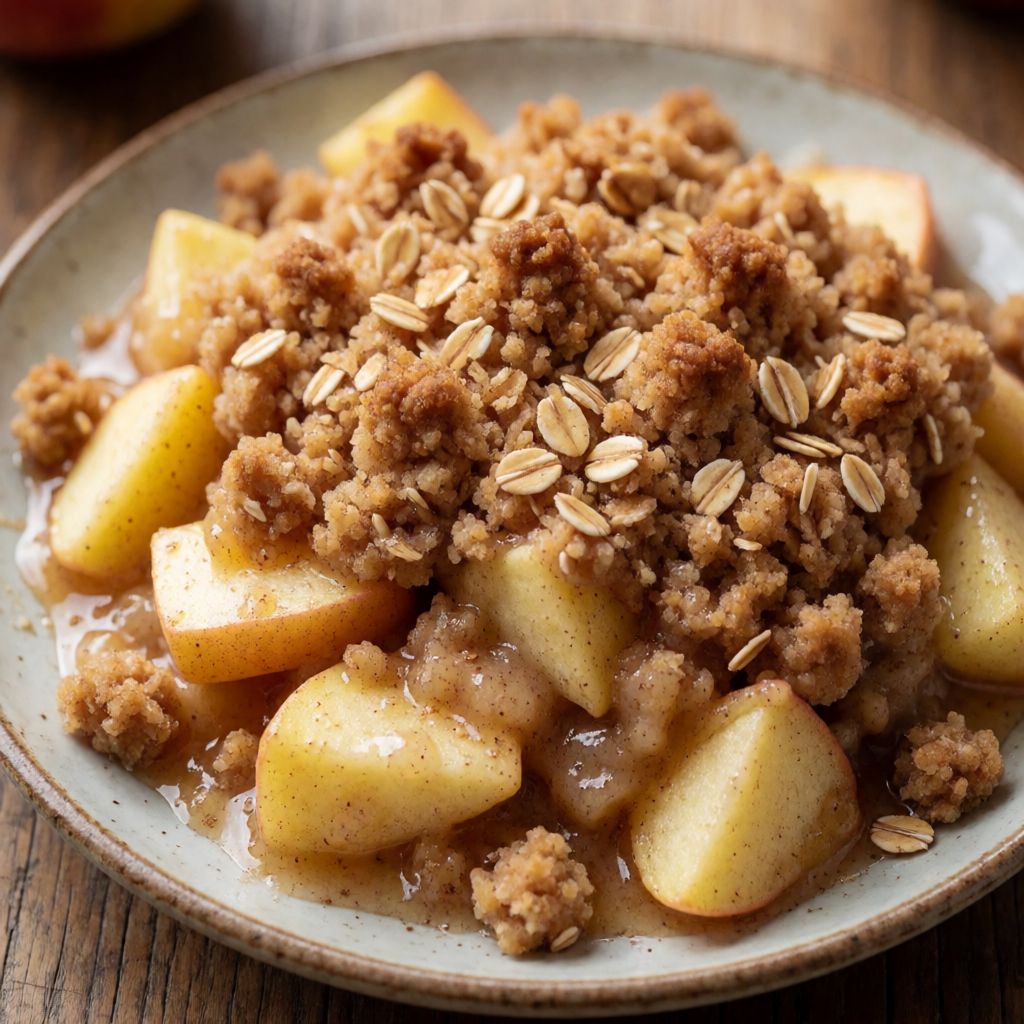
Apple Crumble
A warm, comforting apple crumble with cinnamon and cardamom, baked until golden and crisp on top.
Labels are worked out automatically from the ingredients and can be wrong. Check the packaging if it matters to you.
Ingredients
- 700 g Apple diced
- 2 tbsp Sugar
- 1 tbsp Cinnamon ground
- 1 tsp Cardamom ground
- ½ pcs Vanilla pod seeds only
- 150 g Oats rolled, coarse
- 100 g Plain flour
- 30 g Almonds finely chopped
- 75 g Sugar
- 1 tsp Cinnamon ground
- ½ pcs Vanilla pod seeds only
- 150 g Butter cubed
- 250 ml Crème fraîche 18%







Steps
Mix the apples with the sugar, cinnamon, cardamom and vanilla seeds, and spread into a greased, heatproof baking dish about 24-26 cm in diameter.
Mix the oats, flour, almonds, sugar, cinnamon and vanilla seeds, rub in the butter, and work into a crumbly, slightly uneven mixture.
Spread the crumble over the apples in the dish.
Bake in a preheated oven at 175°C (fan) for 30-45 minutes, until the crumble is golden and crisp.
37 minServe with crème fraîche, softly whipped cream, vanilla ice cream or whipped Greek yogurt.
A crumble is apples left to stew in their own steam under a lid of fat, flour and oats that never gets wet, because it's sitting above the fruit, not in it. That's the whole trick, and it's why the dish survived when fancier ones didn't: no pastry to blind-bake, no custard to split, one dish, one oven, done.
What decides whether it works is the ratio of juice to topping and how dry you keep that topping before it goes in the oven. Apples at 700g for six people release a fair amount of liquid once the sugar starts drawing it out — cinnamon and cardamom go in now, with the sugar, so they dissolve into that liquid rather than sitting as dry specks on the surface. If the topping is damp or over-mixed, it bakes into a biscuit lid instead of a loose, sandy crust, and the whole point of a crumble — the contrast between soft fruit and something that crunches — disappears.
Some say you need a kazan or a special "crumble dish" — no, because the only thing that matters is that the dish is wide and shallow, not deep. Deep means the middle of the apple layer stays wet and cool while the edges catch; wide means heat reaches the fruit evenly and the topping gets equal exposure to dry oven air all across its surface. A 24–26cm ovenproof dish, the kind most people already have for a gratin or a Sunday-roast side, is exactly the shape you want.
Apples: 700g, diced, is the engine of the dish — everything else just dresses it and catches the juice. Pick a variety that holds its shape under heat rather than collapsing to mush; in the UK that's Bramley if you want sharp, tart filling that needs the sugar, or Braeburn, Cox or Gala if you want the apple to keep more structure and sweetness of its own. Bramley breaks down fastest because of its chemistry, so if that's what you've got, dice it slightly bigger than you otherwise would, or it disappears into sauce before the crumble top is even brown. Dice evenly — not for looks, but because uneven pieces cook at different rates, and you'll get mush next to a piece still raw in the middle.
The spices — cinnamon, cardamom, vanilla — go into the fruit layer in two separate doses, once for the apple and once for the topping, and that's deliberate, not an error in the ingredient list: the fruit spice flavours the juice as it cooks down, the topping spice flavours the fat and sugar as they caramelise. Cardamom is the one people skip because it's unfamiliar — don't; it does something cinnamon alone can't, a sort of citrus-resin lift that stops the dish tasting only of Christmas pudding. If you genuinely have none, a little grated nutmeg is closer to it than more cinnamon would be.
Oats, flour, almonds — these three are the whole architecture of the topping, and each does a different job. Coarse rolled oats give you the texture people actually mean when they say "crumble" — small irregular lumps instead of a flat sandy layer — because oats don't fully break down and bind the way flour does. Flour is there to carry and hold the butter; without it the topping would just be a scatter of loose oats and almonds that slide off. Almonds, finely chopped, add fat and a toasted note once they catch heat, and if you've none, any other nut you can chop small works on the same logic — it just needs to be a fat-and-crunch addition, not a structural one.
Butter is rubbed in cold and cubed, not melted, because melted butter soaks the flour and oats into clumps that bake hard; cold butter stays as separate small pockets until the oven heat opens them, which is what gives you the "crumbly, slightly uneven" texture the recipe actually asks for. Any fat that's solid at room temperature and has no strong flavour of its own would do the same job — butter wins here mostly for taste, not because the mechanism demands it specifically.
Crème fraîche at the end, 18%, is not a garnish out of habit — it's acid and fat together, cutting through the sweetness of the baked sugar and cooling the first mouthful enough that you can actually taste the spice instead of just heat. Softly whipped cream or vanilla ice cream do the same cooling job with more fat and less acid; Greek yoghurt, whipped, does it with more acid and less fat. Pick by what your palate wants that evening, not by rule.
Patience here is mostly about not opening the oven to check. Every time you do, you drop the oven temperature and let steam escape that was meant to be working on the apples underneath the crust. Trust the window — 30 to 45 minutes — and judge by what you see through the door: colour going from pale to gold to the amber-brown that tells you the sugars have properly turned, not just warmed through.