
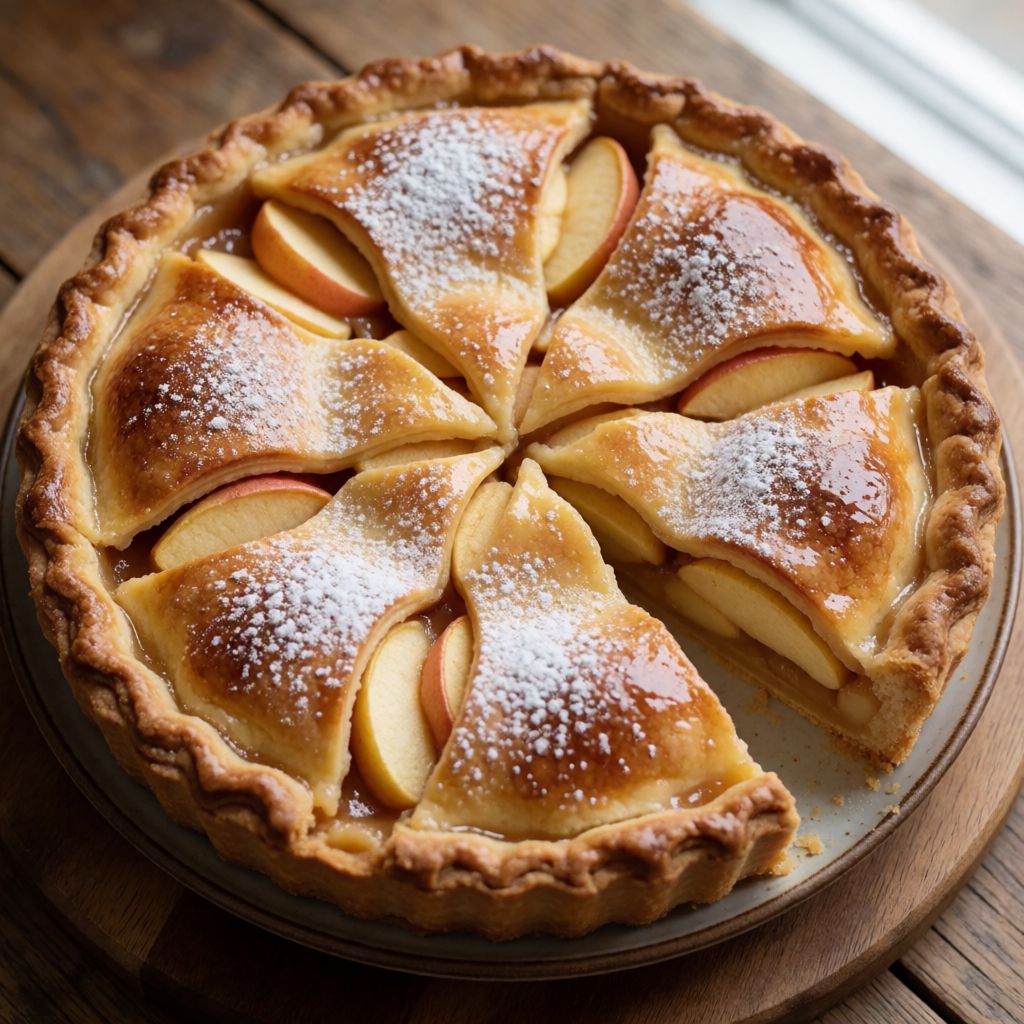
 AI photo
Apple and Marzipan Pie
A buttery pastry pie with a rich marzipan filling and thin apple slices on top.
Labels are worked out automatically from the ingredients and can be wrong. Check the packaging if it matters to you.
Ingredients
- 300 g Apple thinly sliced
- 30 g Caster sugar for sprinkling


Pastry
- 240 g Plain flour
- 50 g Icing sugar
- 1 pinch Salt
- 120 g Butter
- 1 pcs Egg beaten
- Water as needed






Marzipan filling
- 200 g Marzipan coarsely grated
- 125 g Butter room temperature
- 50 g Caster sugar
- 2 pcs Eggs
- 40 g Ground almonds
- 1 tsp Cinnamon



Steps
In a food processor, blend the plain flour, icing sugar, salt and butter until smooth.
Gather the dough in a bowl, adding the beaten egg and a little cold water as needed.
Roll out the dough between two sheets of baking paper.
Chill the dough in the fridge for 30 minutes.
30 minGrease a 24 cm pie tin and line it with the dough, pressing gently into the edges.
Trim off the excess dough, prick the base with a fork, cover with baking paper and fill with dried beans or baking beads for blind baking.
Bake the base in a fan oven preheated to 175°C for about 15 minutes.
15 minRemove the base, lift off the paper and take out the beans.
Beat the marzipan, butter and caster sugar until smooth.
Beat in the eggs one at a time, mix the ground almonds with cinnamon and fold into the marzipan mixture.
Spread the marzipan mixture over the baked pie base.
Arrange the apple slices neatly in a pattern, pressing them lightly into the filling.
Sprinkle with sugar and bake the pie in a fan oven preheated to 175°C for 30-35 minutes, until the marzipan filling is firm.
33 minServe the apple pie with soured cream, vanilla ice cream or whipped cream.
This is a pie built on a trick: you let marzipan do the job that frangipane usually does. Grated almond paste, butter and sugar beaten together behave almost exactly like a classic almond cream, but you skip the step of making almond cream from scratch — someone else already cooked the sugar into the almonds when they made the marzipan block. So the filling is fast, and it's also forgiving: marzipan has enough sugar and fat in it already that it won't split the way a nervous frangipane sometimes does.
What decides whether this works is the base, not the filling. An unbaked pastry case under a wet apple-and-egg filling for half an hour will not cook through underneath — it steams instead of baking, because the filling sits on top like a wet blanket and the heat has to fight through it before it even reaches the dough. That's why the base is blind-baked first, on its own, with nothing holding it back. Skip that and you get a biscuit-coloured top and a pale, slightly gummy ring at the base where the pastry met the tin. Everyone blames the oven. It's rarely the oven.
Some say shortcrust pastry needs to rest only to stop it shrinking. That's half of it. The other half is that cold butter in cold dough bakes in distinct flakes instead of melting into the flour and turning greasy; rest it warm, straight after rolling, and the butter softens, the structure blurs, and you get a short, sandy crumb instead of a crisp one. Thirty minutes in the fridge isn't superstition, it's bringing the butter back down to a temperature where it holds its shape until the oven sets it.
The pastry itself is a standard pâte sucrée logic, not a fussy one: flour for structure, icing sugar because it dissolves into the fat without leaving grit (caster sugar here would show up as tiny hard specks once baked), salt to wake up the sweetness rather than fight it, and butter rubbed in until you can't see separate pieces of either — that's what "until smooth" means in a food processor, and it's the point at which the flour is coated in fat and water can't get to it easily, which is exactly why the crust won't go tough. The egg binds; the water is there only as a last nudge, added in drops, because too much water develops gluten and gluten is what makes pastry chewy instead of short. If you don't own a food processor, do it by hand, fingertips only, lifting the mixture to keep it cool — warm hands are the enemy here, same reason as the fridge rest.
Butter, in both pastry and filling, wants no substitute stronger-tasting than itself — that's the real criterion, not "use butter because the recipe says butter." Any firm fat with a mild flavour and a decent melting point will behave similarly; margarine with high water content won't, it'll weep. For the filling, the butter needs to be at room temperature specifically so it creams with the sugar and marzipan into one mass rather than staying in separate greasy lumps — cold butter beaten with sugar just chips, it doesn't aerate.
The marzipan is the one ingredient worth being picky about. Grate it coarsely so it breaks down fast when beaten — a whole block thrown in whole will leave stubborn unmixed cores. Cheap marzipan is often mostly sugar with a thin wash of almond flavour; it'll still work structurally, but the filling will taste sweeter and flatter. If marzipan isn't available, you can build an equivalent from ground almonds, icing sugar and a little egg white worked into a paste — it's more labour, but it's the same three things marzipan already is, just not pre-assembled for you. Ground almonds on their own, added separately in the recipe, are there for texture and nuttiness on top of what the marzipan gives — they stop the filling being purely smooth and sweet, giving it a bit of bite.
Cinnamon is doing what cinnamon always does with apple: covering the gap between "this apple is a bit bland" and "this tastes of autumn," which is really just masking variable fruit quality — a sharp, good apple needs less help than a soft, sugary one. Use a variety that holds some shape and a bit of acidity (a Bramley will collapse into mush here, a Cox or Braeburn will hold a slice); either way, taste a piece raw before you commit, because that's the only honest test of whether it needs the full teaspoon or less.
A UK kitchen note: you don't need a kazan or anything dramatic for this, just an ordinary 24cm tin and a domestic fan oven, which runs fairly even but can still have one side that colours faster — turn the tin halfway if you notice it. Baking beads are the proper tool for blind baking, but dried chickpeas or rice from the cupboard do exactly the same job: they're just weight, holding the base down so it doesn't puff and tent away from itself while it sets. Six people is a reasonable claim on this pie, maybe five if nobody's sharing. Serve it the way you'd serve crumble — cold soured cream cuts the sweetness better than cream does, if you want a contrast rather than more richness on richness.