
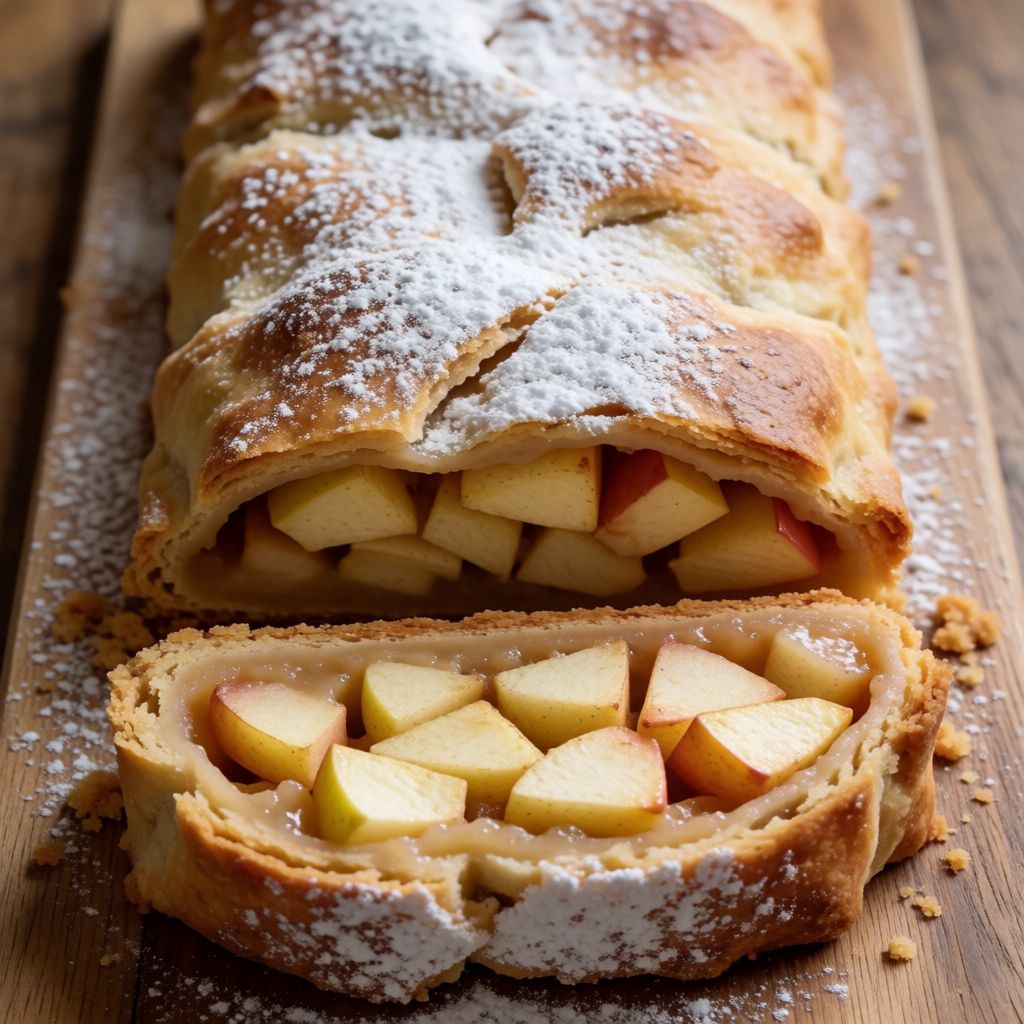
 AI photo
Apple Strudel with Shortcrust Pastry
A buttery shortcrust pastry filled with spiced apples, raisins and pine nuts, finished with a dusting of icing sugar.
Labels are worked out automatically from the ingredients and can be wrong. Check the packaging if it matters to you.
Ingredients
- 250 g Plain flour
- 125 g Butter softened
- 125 g Caster sugar
- 1 pcs Egg
- 1 tbsp Milk
- 8 g Baking powder
- 1 pcs Lemon zest
- pinch Salt a pinch
- 500 g Apples
- 100 g Caster sugar
- 50 g Breadcrumbs dried
- 50 g Raisins
- 30 g Pine nuts
- pinch Cinnamon to taste
- 1 tbsp Milk
- pinch Icing sugar to taste











Steps
Take the butter out of the fridge 30 minutes beforehand and soak the raisins in water so they swell.
30 minIn a bowl, cut the butter into cubes, add the flour and baking powder, and rub together by hand until sandy in texture.
Add the egg, lemon zest, sugar, milk and a pinch of salt, and knead until you have a smooth, firm dough.
Shape into a ball, cover with cling film and rest in the fridge for at least 30 minutes.
30 minPrepare the filling: peel and chop the apples, add the sugar, drained raisins, breadcrumbs, cinnamon, pine nuts and lemon zest. Mix well.
Roll out the dough on baking paper into a rectangle about 38x26 cm, a few millimetres thick.
Spread the filling evenly down the centre and fold the side edges of the dough over to enclose it.
Fold in the ends, pressing the edges firmly to seal the strudel.
Preheat the oven to 180°C.
Brush the strudel with beaten egg mixed with milk and bake for about 30-35 minutes.
32 minRemove the strudel from the oven and leave to cool to room temperature.
Before serving, dust generously with icing sugar.
What was changed
Only the bell pepper was removed, as it did not belong in the filling.
This isn't the strudel you think you know — the one made with paper-thin stretched dough that you can read a newspaper through. That's the Viennese version, built on a yeast-free, egg-free dough stretched by hand until it's translucent, because that dough has the elasticity to take it. This recipe uses shortcrust — rubbed butter and flour, egg, sugar — which is a different animal entirely: short, crumbly, closer to a jam tart than a pastry parcel. Some say a strudel has to be that paper-thin wrapper or it isn't a strudel at all — no, because "strudel" just means "whirlpool", a reference to the rolled shape, not a patent on one dough. This is a shortcrust log with an apple filling rolled inside it, and it's a perfectly legitimate thing to bake, it just behaves differently in the oven and on the plate.
What decides whether it works is moisture control, nothing else. Apples release water as they heat — that's unavoidable, they're mostly water — and shortcrust has no gluten structure to speak of, so it can't hold a wet filling the way strudel dough or puff pastry can. The breadcrumbs in the filling aren't padding, they're there to drink up the juice before it soaks through the pastry and turns the bottom to paste. If your apples are very juicy, that's the one place you're allowed to think for yourself and add a bit more breadcrumb than the recipe says — the texture of the mixture after sitting a few minutes tells you, not the clock.
The flour and butter ratio here — flour at double the butter's weight — gives you a dough short enough to be tender but just firm enough to hold a filled log shape without collapsing when you move it onto a tray. If you rub the butter in while it's cold, you get greasy little pellets that won't bind; that's why the recipe has you take the butter out half an hour ahead. You want it soft enough to smear between your fingers and the flour, not so soft it's turned to liquid. In a UK kitchen the fridge usually runs colder than people think, so half an hour on the counter near the Sunday roast oven, rather than next to an open window in January, gets you there faster.
Baking powder in a shortcrust is unusual — most shortcrust recipes skip it, leaning on butter and gentle handling for tenderness. Here it's doing a small lift job, loosening what would otherwise be a dense tart base into something a bit more like a biscuit crumb, so the finished strudel doesn't eat like a solid brick of pastry. Any plain flour with a similar protein content works; nothing exotic required, and there's no reason to reach for a "strong" bread flour — that would just toughen it.
For the filling, use an apple that holds some shape under heat rather than collapsing to mush — a firm, slightly tart variety. Bramley, the classic British baking apple, will break down almost completely because it's bred for exactly that, which gives you a soft, almost jammy filling rather than one with bite; that's not wrong, just a different result than a firmer eating apple like Braeburn or Cox, which keeps some texture. Choose based on whether you want "apple sauce in pastry" or "chunks of apple in pastry" — both are fine, know which you're getting.
The raisins get soaked in water first because dry raisins dropped straight into a filling will pull moisture out of everything around them in the oven, leaving the pastry drier and the raisins still a bit tough at the core. A quick soak plumps them so they contribute softness instead of stealing it. Any dried vine fruit does the same job — sultanas, even chopped dried apricots if raisins aren't to your taste, as long as it's something that benefits from rehydrating.
Pine nuts bring a bit of resinous bite and fat against all that soft fruit and sugar; if you don't have them, a roughly chopped almond or hazelnut does the same structural job — something with crunch and its own flavour, not a soft nut like cashew that just disappears into the filling.
Lemon zest appears twice, once in the dough and once in the filling, and it's doing the same thing both times: cutting the flatness of plain sugar and butter with something sharp, so the whole thing doesn't taste one-note sweet. It's not optional decoration, it's balance — if you have no lemon, a little orange zest will do similar work, though the result leans sweeter rather than sharp.
At 180°C — a straightforward domestic oven setting, nothing fan-assisted or fussy required — the sugar in the dough caramelises at the surface while the butter inside melts and separates the flour layers just enough to flake a little, even without the folding techniques puff pastry relies on. Thirty to thirty-five minutes is your floor, not your deadline: look for pastry that's gone from pale to a proper gold-brown all over, including underneath if you can tip it and check, because a pale top with a soft, pallid bottom means the apple's released its water and the base never got hot enough to drive it off. That's the fridge being too generous with its shelf, or a tray too thick absorbing heat before the pastry does — nothing to panic about, just pull it and give it a few minutes more, checking by eye.
Letting it cool to room temperature before dusting with icing sugar isn't fussiness — hot pastry releases steam, and sugar dusted onto steam just dissolves into a wet patch instead of sitting as a clean white layer. Patience here is the difference between a strudel that looks finished and one that looks like it's been left out in the rain.