
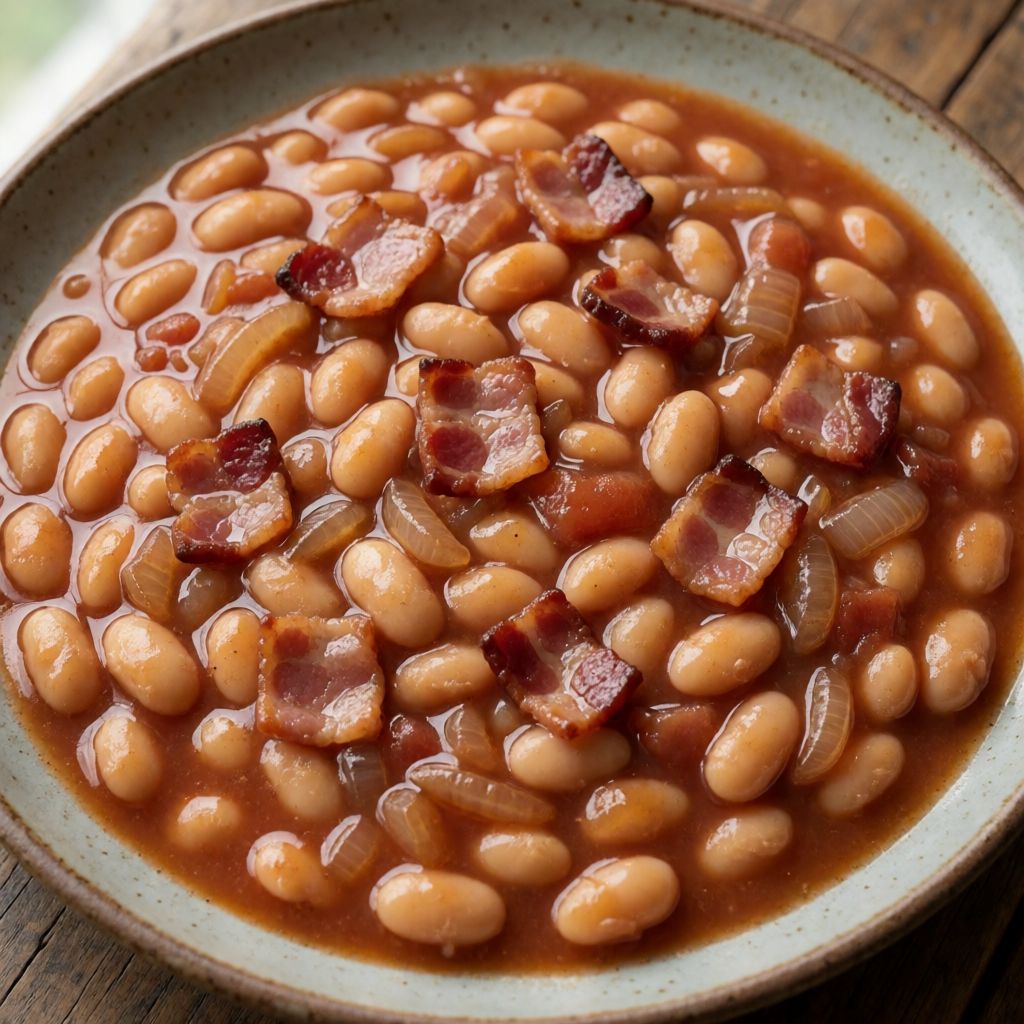
 AI photo
Baked Beans with Bacon
A hearty baked bean casserole topped with bacon, finished in the oven until bubbling.
Labels are worked out automatically from the ingredients and can be wrong. Check the packaging if it matters to you.
Ingredients
- 2 pcs Onion finely chopped
- 3 clove Garlic finely chopped
- 100 ml Brown sugar
- 100 g Tomato paste concentrated
- 200 ml Stock
- 800 g Chopped tomatoes canned
- 3 tbsp Apple cider vinegar
- 0.5 pcs Red chilli or to taste
- 1 tsp Mustard
- 1 tbsp Smoked paprika
- 1 tsp Paprika
- 1 tsp Cumin
- 1 tbsp Worcestershire sauce
- 200 g White beans soaked and cooked
- 16 pcs Bacon rashers
- 1 tbsp Butter for the dish and frying
- Salt to taste
- Black pepper to taste

















Steps
The day before cooking, soak the white beans and cook them according to the packet instructions.
Fry the onion and garlic in a pot with butter until the onion is soft.
Add the paprika, cumin, smoked paprika, brown sugar, tomato paste, chopped tomatoes, apple cider vinegar, stock, chilli, mustard and Worcestershire sauce, and stir.
Simmer uncovered for 30 minutes.
30 minAdd the white beans, season with salt and pepper to taste, and transfer to a greased baking dish.
Cover the surface with bacon and bake in a preheated oven at 175°C (fan) for 30 minutes.
30 min
This is not the tin you open with a groan and a smell of school dinners. It's the same idea — white beans drowning in sweet-sharp tomato — but built from the ground, with the sugar, the acid and the smoke tuned by hand instead of a factory. What decides whether it works is the sauce before the beans ever go near it: how far you let it reduce, and whether it ends up thick enough to cling to a spoon rather than run off it.
Think of it less as "baked beans" and more as a slow ragù that happens to be vegetarian for thirty minutes and then gets a bacon lid. The pot stage — onion, garlic, spices, tomato, sugar, vinegar, stock — is where the whole dish is decided. You're not just heating tinned tomatoes; you're boiling off water so the sugar and vinegar stop fighting each other and start agreeing. Underdo this and the oven stage just bakes a watery soup; the bacon on top goes crisp while the beans underneath stay thin and sloppy.
Some say baked beans are a tin-opener dish, nothing to get wrong. No — because the gap between "edible" and "good" here is entirely about reduction and balance, sweet against sour against smoke, and that only happens with time in the pot, not the oven.
Sixteen rashers for eight people sounds like a lot until you remember this is meant to sit next to a roast, not replace it — a side with its own protein crust, built for a tray that's already crowded with potatoes and gravy.
Onion and garlic go in first because they need the gentlest heat you'll use in this whole recipe — enough to soften without colouring hard, since any bitterness from browned garlic will sit under the sauce for the next hour and you can't cook it back out. On a domestic hob that means the smallest ring, butter rather than oil, and patience until the onion goes from sharp-smelling and opaque to sweet-smelling and see-through. That's the cue, not a clock.
The spice trio — paprika, smoked paprika, cumin — isn't decoration, it's the whole character of the dish. Plain paprika gives colour and a background warmth; smoked paprika is doing the job a real wood fire or a kazan's open flame would otherwise do for you, since your pan has no smoke to borrow. Leave it out and you've made a sweet tomato bean stew, which is a different, paler thing. Cumin cuts the sweetness so it doesn't read as jam.
Brown sugar and apple cider vinegar are a pair, not two separate ingredients — one pulls the dish sweet, the other pulls it back sour, and the thirty minutes of uncovered simmering is where they actually meet each other and the water boils away. This is the one non-negotiable time in the recipe, and it's a floor, not a ceiling: thirty minutes is where the sauce starts to coat a spoon and hold its shape rather than puddle. If it's still thin at thirty, give it longer — nothing bad happens from more reduction, plenty happens from less.
Worcestershire sauce and a splash of stock are there for savoury depth that tomato and sugar alone can't supply — if you don't have Worcestershire, any sauce built on fermented fish or soy and vinegar does the same job: salt, funk, a little sourness.
The beans themselves want to be cooked soft but holding shape — if you've soaked and boiled them yourself, bite one before they go in: it should give without turning to paste. Tinned white beans, drained, are an honest shortcut here and nobody will mark you down for it; the sauce is doing the heavy lifting of flavour anyway.
Sixteen rashers laid over the top aren't there to feed sixteen separate bites of bacon — they're a lid that bastes the beans as the fat renders, and a crust by the time 175°C fan has had thirty minutes to work on it: the surface should go from pale and limp to tight, edges curling, fat visibly rendered into the sauce below. Streaky bacon renders more and bastes better than back bacon, which stays leaner and crisps rather than melts — either works, but know which effect you're choosing. If you've no bacon at all, pancetta or a good smoked lardon does the same rendering trick, just scattered rather than laid as a sheet.