
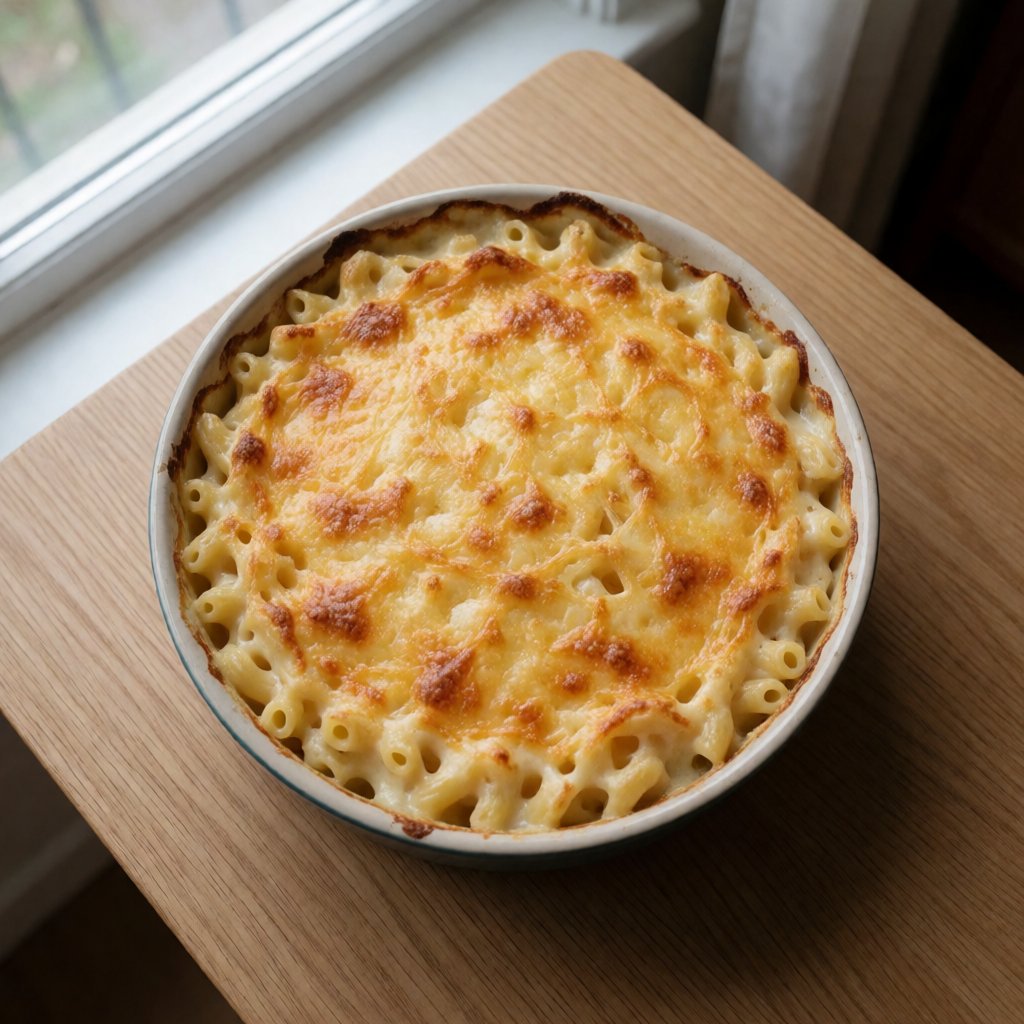
 AI photo
Baked Macaroni and Cheese
A comforting baked macaroni and cheese with a golden, crispy top.
Labels are worked out automatically from the ingredients and can be wrong. Check the packaging if it matters to you.
Ingredients
- 150 g macaroni cook for 2 minutes less than pack instructions
- 250 ml milk
- 15 g butter
- 15 g plain flour
- 100 g mature cheddar grated
- 1 pinch salt
- 1 pinch nutmeg







Steps
Cook the macaroni for 2 minutes less than stated on the pack instructions.
Make a thick sauce from the butter, flour and milk, then stir in 70g of the cheddar.
Mix the macaroni with the sauce, spoon into a baking dish, and sprinkle the remaining cheddar on top.
Bake in the oven for 20 minutes until golden brown on top.
20 minRemove the dish from the oven.
What was changed
The generic hard cheese was replaced with mature cheddar, the mature cheddar found in most UK shops.
This is a béchamel dish wearing a British coat. The whole thing hangs on one mechanism: a flour-and-butter paste that thickens milk into something that won't weep when it hits the heat of an oven. Everything else — the macaroni, the cheese, the crust — is built on top of whether that sauce behaves.
The pasta goes in two minutes short of done on purpose. Some say you should always cook pasta to the pack time, full stop — no, because here the macaroni is going back into heat twice more: once mixed hot into the sauce, once in the oven. If it's already fully cooked when it goes in, by the time it comes out it's gone past soft into mush, and mush doesn't hold a bite the way baked macaroni should. Pulling it early is a deposit you draw on later.
The sauce itself is a timing problem disguised as a recipe step. Butter and flour cooked together until they smell faintly biscuity, not raw — that's the flour's starch swelling and losing its chalky taste. Pour the milk in too fast, or cold, and you get lumps: little pockets of unswollen flour sealed inside a skin of cooked starch, impossible to break up later. Pour it in gradually, over gentle heat, stirring, and the starch has time to open evenly through the whole pot. That's the difference between a smooth sauce and a sauce with bits in it — not luck, not a special whisk.
Macaroni: 150g dry is enough for two reasonable portions here, not a family tray — the dish is small, which is partly why it works on a domestic hob and a small oven dish without anyone needing a kazan-sized pot. Any short tubular pasta that holds sauce in its hollow does the same job; shells or small shapes work, but macaroni's tube is what traps the sauce inside as well as around, so swapping to a long pasta like spaghetti changes the dish's whole texture, not just its shape.
Milk: full-fat, because the fat is what keeps the sauce from tasting thin and watery once the cheese and oven heat have both pulled moisture out of it. Semi-skimmed will thicken the same way — the starch doesn't care about fat content — but the sauce will taste leaner, more like wallpaper paste with cheese in it than something you'd want to eat with a spoon.
Butter and flour: this pair is the roux, and the ratio here — butter and flour in equal weight — is standard because equal parts means every flour grain has fat around it, which is what stops it clumping when the milk arrives. Butter specifically because it browns gently and has no competing smell; any flavourless fat with enough body to coat flour would do the same mechanical job, but you'd lose the faint nuttiness butter gives the base, which is small but real.
Cheddar: mature, not mild, and that's not snobbery, it's arithmetic. A sauce this plain — milk, butter, flour, nothing else sharp in it — needs a cheese with enough bite to stop it tasting like library glue. Mild cheddar melts the same way but brings less flavour per gram, so you'd need more of it to taste anything, and more cheese means more fat separating out under oven heat. Grate it yourself off a block rather than buying the pre-shredded bags — those are often dusted with anti-caking starch that can make the melt slightly grainy, a small thing but avoidable. Any firm, well-aged cheese that melts without turning to string — a mature Gouda, a Comté — will stand in for cheddar; a very young, wet cheese won't, because it has too much water in it and will loosen the sauce instead of thickening the top.
Salt and nutmeg: salt because milk and cheese both mute flavour until there's enough salt to carry it — taste the sauce before it goes in the dish, not after, because once it's baked you can't fix it. Nutmeg is the old trick for anything made with a milk-based sauce; it doesn't add sweetness so much as it cuts the flatness of boiled milk, a habit that goes back to when nutmeg was one of the few spices European kitchens had reliable access to and cooks leaned on it everywhere dairy needed waking up. A pinch, not a spoonful — it should be a presence you can't quite name, not a flavour you can point to.
The oven does the last job, and it's a dry one: it isn't cooking the inside of the dish any further in any meaningful way, it's driving moisture off the top layer of cheese until it browns. A domestic oven varies more than people admit, so treat the stated time as the earliest point to check, not a deadline — look for cheese that's gone from pale and shiny to blistered and gold at the edges, with the middle still slightly soft. If it's uniformly browned all over before that time's up, your oven runs hot and you'll want to check earlier next time; ovens don't lie evenly across their shelves, but they are consistent with themselves, so one bake teaches you the next.
·