
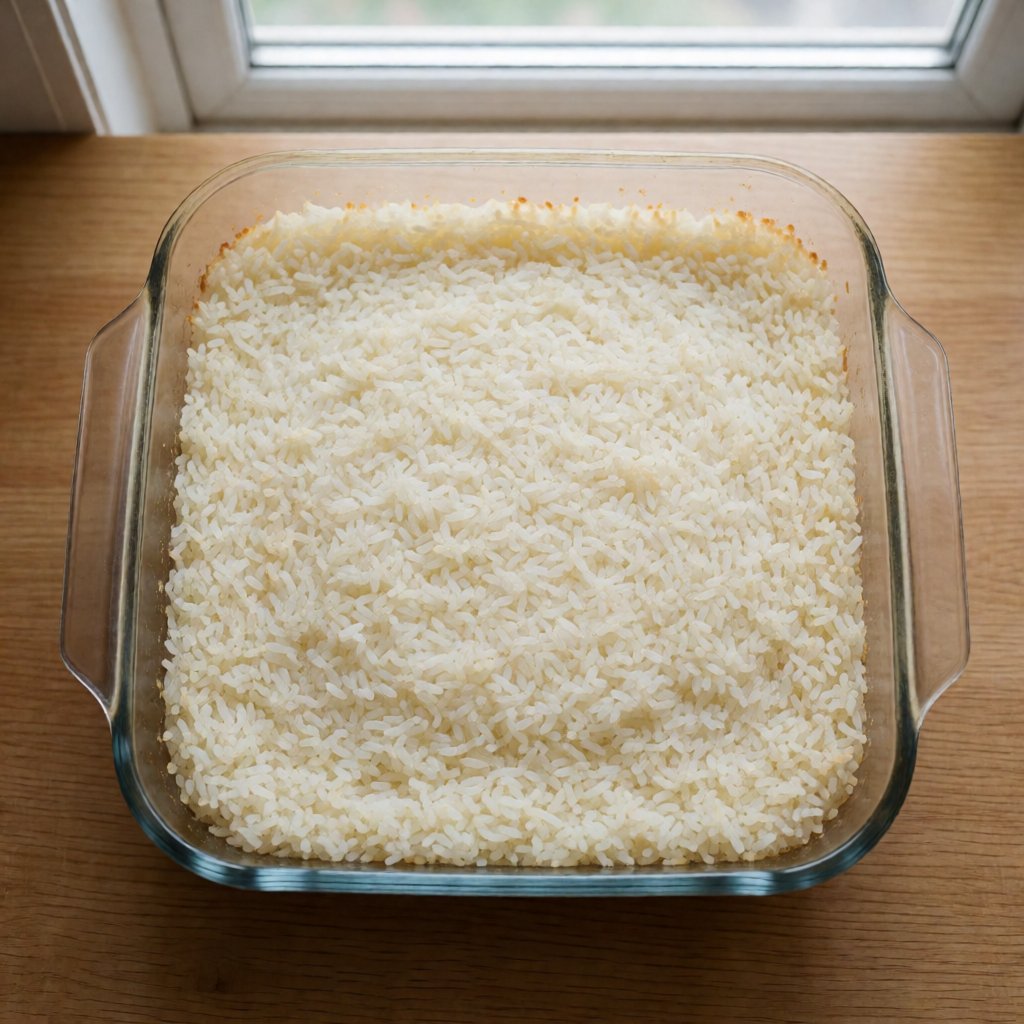
 AI photo
Oven-Baked Rice
A simple side of rice baked in the oven, covered until fluffy and fully cooked.
Labels are worked out automatically from the ingredients and can be wrong. Check the packaging if it matters to you.
Ingredients
- 160 g long-grain rice
- 250 ml boiling water 1:1.5
- 1 tbsp sunflower oil
- 0.5 tsp salt




Steps
Rinse the rice until the water runs clear, place it in a baking dish, season with salt and add the oil.
Pour in the boiling water and cover the dish tightly with foil.
Place the dish in an oven preheated to 200°C for 40 minutes.
40 minRemove the dish from the oven. Leave the foil on for a further 5 minutes.
5 min
Forget everything you know about watching a pot of rice like it might run off the stove. This is pilaf logic turned on its head: instead of you minding the heat, you seal the rice into its own little steam chamber and let the oven do the minding. No flame concentrated under one spot of metal, no hot patch where the bottom scorches while the top stays hard — the oven surrounds the dish with heat from every side, so the grains cook evenly without you stirring a thing.
What decides whether it works is the seal, not the clock. Foil pulled tight, no gaps, no steam escaping — that's the whole trick. Once you close that dish, you've built a tiny pressure cooker out of kitchen foil. Break the seal halfway through to "check on it" and you let the steam out, and steam is the only thing doing the cooking in there. Some say you must stir rice so it doesn't clump — no, not here, because stirring only matters when water's boiling away under your nose on a hob and starch is gluing itself to metal. In a sealed dish there's nothing to clump onto.
The water goes in boiling, not from the tap, for a reason: you want the grains starting to absorb and swell the second the foil goes on, not waiting for the oven to slowly warm cold water through a thick ceramic dish — that wastes ten minutes you don't have and cooks unevenly while it happens.
Rice first. The criterion is grains that stay separate rather than grains that want to become glue — that means long-grain, lower in the clingy starch (amylopectin) that short-grain and risotto rice are stuffed with. Basmati or jasmine will behave the same way at roughly the same ratio; arborio or pudding rice will not, because under steam, with no stirring to break up the starch release, they'll turn to something closer to porridge than pilaf. The rinse before cooking matters for the same reason — you're washing off the loose surface starch so it doesn't gum the grains together in that sealed, steamy environment where there's no spoon to separate them.
The water-to-rice ratio here, 1:1.5, is tighter than you'd use on an open stovetop pot, where you might go closer to 1:2 because a third of the water simply evaporates into your kitchen as steam while you watch it. Sealed under foil, almost nothing escapes — the water that goes in is the water that gets absorbed. That's the whole economy of the method: a closed system loses less, so you need less to start with.
Oil here is there to coat the grains so they separate rather than to add flavour, so the criterion is simple — any oil with no smell of its own. Sunflower is the obvious choice and what's in most British cupboards; a flavourless vegetable or rapeseed oil does exactly the same job. Butter will work too, but understand what you're trading — you gain a dairy note and lose the neutrality, so it stops being a background ingredient and starts being a flavour decision.
Salt goes in with the water at the start, not sprinkled on afterwards, for the same reason you salt pasta water — the grain absorbs seasoning as it absorbs liquid, so it's seasoned through rather than just coated on the surface. Half a teaspoon for two people is modest; taste your own water, some tap water already carries more character than others.
On the vessel — you don't need a kazan and nobody's suggesting you buy one. Any oven-proof dish you'd use for a small roast will do, as long as it has a flat enough rim for the foil to actually seal against, not just drape over. If your dish is wide and shallow, double the foil, because a bigger surface means more places for steam to find a gap and slip out — and a slipped seal is the single most common reason this goes wrong, the rice still crunchy and the water long gone as vapour into your oven.
And there's a bit of domestic sense behind why this method exists at all: it was built for the kitchen where the oven is already on. You've got a roast going in at 200°C anyway on a Sunday — slide this dish in alongside it and you've cooked your starch for free, with no second pan to watch, no second burner to mind. That's not tradition for tradition's sake, that's just not wasting heat you're already paying for.
·