
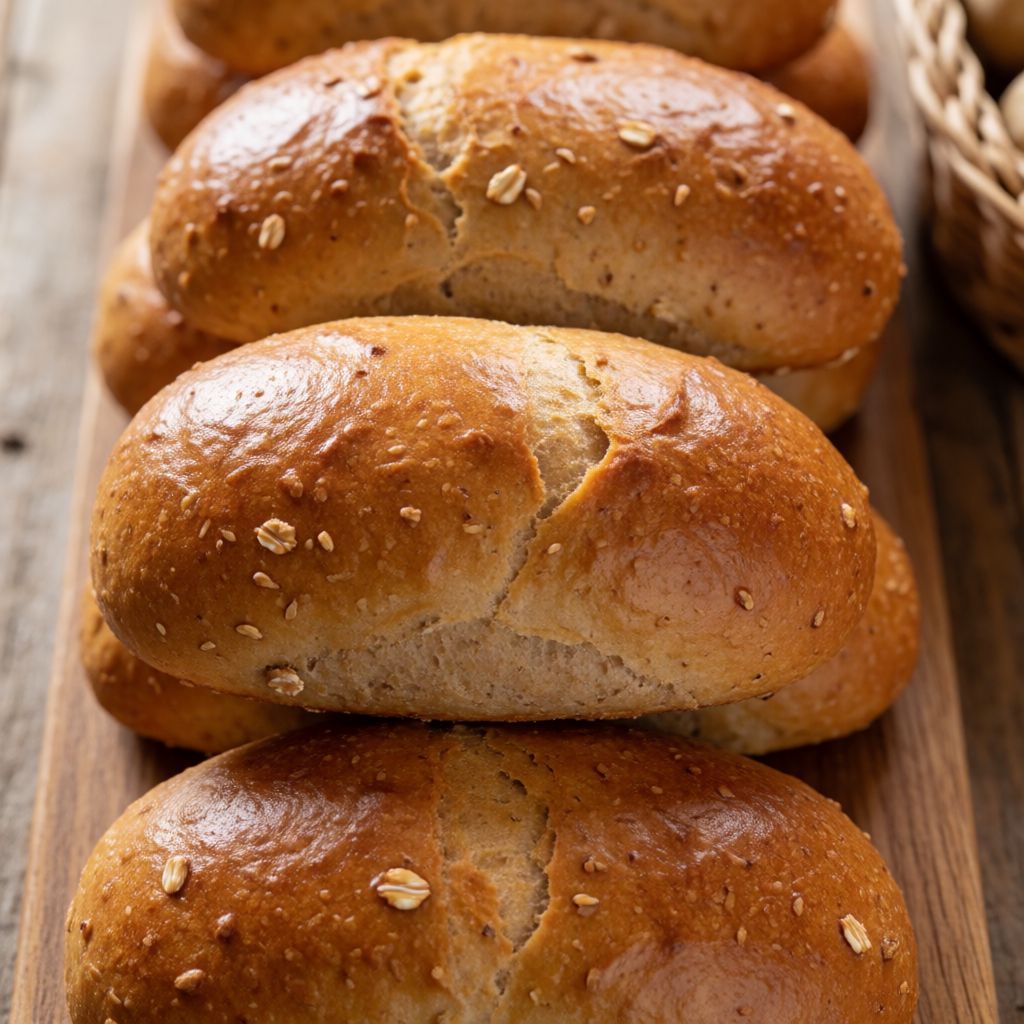
 AI photo
Calzone Rolls
Soft calzone-style bread rolls filled with tomato, cured ham, mozzarella and fresh basil.
Labels are worked out automatically from the ingredients and can be wrong. Check the packaging if it matters to you.
Ingredients
- 350 ml Water
- 25 g Yeast
- 100 ml Yogurt
- 50 g Oats
- 100 g Rye flour
- 120 g Wholemeal flour
- 1 tsp Salt
- 350 g Plain flour
- 1 pcs Egg beaten, for glazing
- 1 pinch Sesame seeds
- 70 g Tomato paste
- 1 bunch Basil fresh leaves
- 75 g Prosciutto
- 125 g Mozzarella fresh














Steps
Dissolve the yeast in a bowl with the water.
Add the yogurt, oats, rye flour, wholemeal flour and salt, and mix the dough well.
Gradually add the plain flour, mixing until the dough is ready to be kneaded on the worktop — soft and slightly sticky.
Transfer the dough to a clean bowl and leave it to rise on the worktop for 2 hours.
Divide the dough into 14 equal pieces, flatten each slightly and place a little tomato paste, mozzarella, prosciutto and a fresh basil leaf in the centre.
Gather the dough around the filling, sealing all the edges well.
Dust your hands lightly with flour and roll the rolls into balls.
Place the rolls seam-side down on a baking tray lined with baking paper.
Leave to rise for 45 minutes, covered with a clean tea towel.
Brush with beaten egg and sprinkle with sesame seeds.
Bake in a preheated oven at 175°C (fan) for 20–25 minutes.
Leave to cool slightly on a wire rack before serving.
What was changed
Serrano ham was replaced with Prosciutto, as it is the cured ham typically found in UK shops.
A calzone roll is a hand-held version of a logic that's older than pizza itself: dough as a pocket, built to carry filling to a field, a market stall, a Sunday roast table where you don't want to be carving a pizza with a knife and fork. Fourteen of these come out of this batch — think of them as bread rolls that happen to have a filling, not pizzas that happen to be folded. That distinction decides everything about how you handle the dough.
What makes or breaks this bake is moisture management in two directions. The dough itself is a mixed-grain, slightly wet dough — oats, rye, wholemeal and plain flour together, held by yogurt as well as water — and that mix will never behave like a shop-bought white roll dough. It's softer, it's tackier, and you work with it rather than against it. Then inside, you've got tomato paste and fresh mozzarella, both of which want to leak. Seal the edges badly and you get a burst roll with a scorched puddle on the tray instead of a roll with a filling. Seal them well and the dough does its job as a container.
Some say a calzone needs a thin, elastic, almost translucent dough like a pizza base stretched to breaking point. No — because this isn't pizza dough rolled thin and folded, it's enriched bread dough shaped round a filling, and a thicker, bready wall is exactly what stops the tomato paste soaking straight through and turning the base soggy before it's even baked. The rye and wholemeal aren't there for virtue — they're there because a denser crumb holds moisture better than a feathery white one.
Start with the yeast and water. 25g of yeast into 350ml of water is a fast ferment, not a slow one — this dough is designed to be ready for shaping within hours, not overnight in the fridge. If you only have dried yeast, halve the gram weight roughly, and give it a few minutes in the warm water before you trust it's alive — if it doesn't foam a little, it's dead, and no amount of kneading afterwards will fix that. That's the real cause of a roll that comes out of the oven dense and flat: not bad flour, not a cold oven, but yeast that was never going to work from the start.
The yogurt is doing two jobs. It adds a little acidity, which slows gluten development just enough to keep the crumb tender rather than chewy, and it adds fat and moisture without adding oil, which would slacken the dough differently. If you haven't got yogurt, a soft cheese like quark thinned with a splash of milk gets you close; plain soured cream works too. Don't swap it for milk alone — you'll lose the tang and the dough will rise a touch looser.
Oats, rye flour and wholemeal flour together are not a health statement, they're a texture and flavour one — oats hold water and add a faint sweetness as they cook, rye brings a mineral, slightly sour depth that plain white flour can't, and wholemeal adds body. None of them have much gluten-forming power on their own, which is exactly why the recipe brings in 350g of plain flour afterwards — that's your structure, your stretch, the thing that lets the dough hold a ball shape instead of slumping. If you're out of rye, more wholemeal covers the gap; the roll will be milder, not wrong.
The two hours of bulk rise aren't a suggestion you can shortcut by cranking the heat — a dough pushed to rise fast and hot develops big, uneven holes and a yeasty taste, because the yeast outruns the gluten's ability to trap gas evenly. A cooler kitchen table, patiently, gives you a dough that's roughly doubled, soft to the touch, slow-pushing-back when you press a finger in — that's your cue, not a clock. Patience here is doing the work that extra yeast or extra heat can't do honestly.
When you fill each piece, resist overfilling — a tablespoon's worth of tomato paste, a small piece of mozzarella, one basil leaf, a scrap of prosciutto is plenty per roll across fourteen portions. Fresh mozzarella in particular carries a lot of water; press it briefly in kitchen paper before using it, which is the UK domestic-kitchen substitute for the straining a professional kitchen would do, and it stops the filling turning into steam that blows the seam open in the oven. Sealing is the real technique here, not the folding: pinch the edges shut like you're closing a dumpling, then turn the seam to the base once it's on the tray, so gravity and the weight of the roll itself help keep it shut rather than fighting to open upward.
The second rise, 45 minutes under a tea towel, is shorter than the first because the yeast is already active and you're not asking for huge volume — you're asking the dough to relax after the stress of shaping and puff gently round the filling. A proper proving drawer is a kazan-kitchen luxury; a covered tray on top of a worktop away from a draught is what you've actually got, and it's enough.
175°C fan is hot enough to set the crust and melt the cheese before the filling has time to stew the dough from inside — a cooler oven would let the tomato paste seep further into the crumb before a crust forms to hold it back. Egg wash and sesame on top aren't decoration for its own sake: egg gives you shine and colour because sugars in the egg brown faster than the dough alone would, and it's the thing that stops the top looking pale and underdone even once it's actually cooked through. You'll know they're done by colour — a deep gold-brown, not pale — and by sound, a slightly hollow note if you tap the base, same test as any bread roll. Let them sit on a rack before anyone bites in; straight from the oven, that mozzarella is lava, and the roll itself is still finishing its structure as it cools — cut one open too early and the crumb looks gummy, not because it's underbaked but because it hasn't had the few minutes it needs to set.