
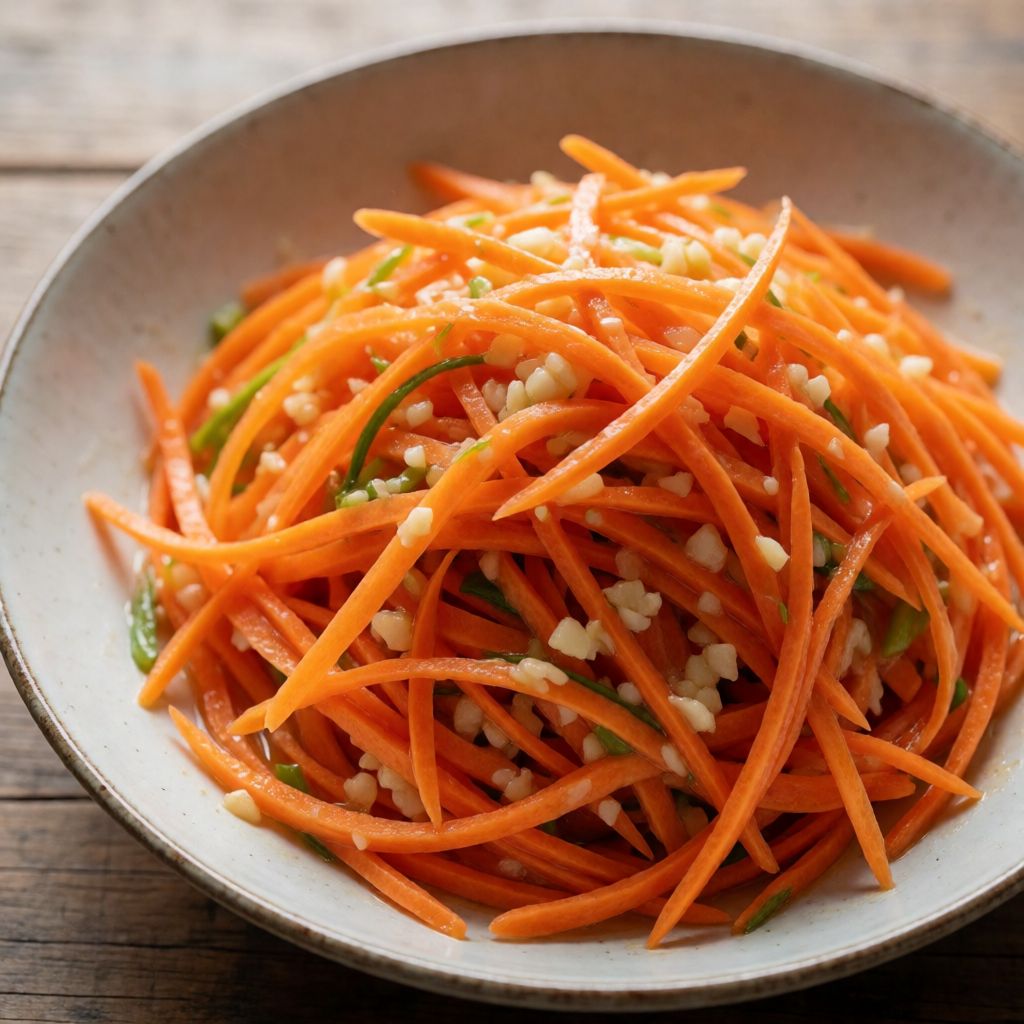
 AI photo
Asian-Style Carrot Salad
A fresh, zesty grated carrot salad with an Asian-inspired dressing.
Labels are worked out automatically from the ingredients and can be wrong. Check the packaging if it matters to you.
Ingredients
- 400 g Carrot grated
- 2 clove Garlic finely grated
- 2 tbsp Soy sauce
- 1 tbsp Rice vinegar
- ½ pcs Lime juice and finely grated zest
- 1 tbsp Sugar
- 1 tbsp Sesame oil
- 1 tsp Ginger finely grated
- ½ tsp Chilli flakes
- 1 tbsp Sesame seeds toasted
- 50 g Peanuts roughly chopped
- 1 bunch Coriander finely chopped, fresh
- 1 bunch Mint finely chopped, fresh









Steps
Place the grated carrot in a large bowl.
Mix the garlic, soy sauce, rice vinegar, lime juice and zest, sugar, sesame oil, ginger and chilli flakes.
Stir the marinade until the sugar dissolves, then taste.
Mix the marinade with the carrot.
Before serving, sprinkle with toasted sesame seeds, peanuts, coriander and mint.
This isn't the Soviet "Korean carrot" with its vinegar-and-sunflower-oil burn — that one got its name because Korean migrants in 1930s Central Asia made do with what the local markets had, and the name stuck to any shredded-carrot salad with a kick. What you've got here is a different animal: no cooking, no standing in hot oil, just a marinade built on soy, lime and sesame oil doing the work that heat usually does in a stir-fry — breaking the carrot's rawness into something you'd call seasoned rather than just grated.
What decides whether this works is the grate, not the dressing. Carrot cut into thick batons stays crunchy and sits under the sauce like gravel under rain — it never takes the flavour in. You want thin, long shreds, the kind that bruise slightly as they come off the grater, because that bruising is what lets the salt and acid actually get into the cells instead of sliding off the surface. A box grater on its finest julienne side, or a mandoline, does this properly; a food processor's shredding disc tends to cut too clean and too short, and you lose the surface area.
The second thing that decides it is time after mixing, not during. Nothing here is cooked, so "doneness" is really "seasoning-ness" — the carrot needs minutes sitting in the dressing for the salt to pull moisture out and the sugar and acid to pull flavour back in. Taste it five minutes after mixing and it tastes like carrot with sauce on it. Taste it after it's sat — the carrot's gone slightly limp at the edges, slightly glassy — and it tastes like one thing.
Carrot — 400 g, the whole dish really. Buy them firm, not the limp ones that have been in your crisper drawer arguing with the celery for a fortnight; a carrot that's lost its snap won't take a fine grate without turning to mush. No substitute here that's actually this dish — kohlrabi or daikon shredded the same way will give you a different, cooler salad, worth trying, but call it by its own name.
Garlic and ginger, both grated fine rather than chopped, because in a raw dressing you want them to dissolve into the liquid, not sit as lumps that hit you unevenly. A garlic press works if your hands don't; a fine grater (a microplane, if you've got one from zesting lemons) does ginger properly without the stringy fibres you get from a knife.
Soy sauce is your salt here, not table salt — and it's doing double duty, salt plus savoury depth, which is why this dressing doesn't taste thin the way a plain vinegar-and-oil one would. Light or regular soy, not the thick dark kind meant for colouring stews. If you're avoiding soy, fish sauce gives a similar backbone with a different, more oceanic note; tamari if it's a gluten question.
Rice vinegar and lime between them are the acid, and acid in this salad isn't decoration — it's what stops 400 g of raw carrot and sugar from just tasting like a vegetable with jam on it. Rice vinegar is mild and a little sweet already; if you only have white wine vinegar, cut it with a touch more sugar, because it bites harder. The lime adds a brightness vinegar alone can't — zest first, for the oil in the skin, then juice, and don't skip the zest thinking the juice covers it; it's a different flavour entirely, more perfume than acid.
Sugar's job is balance, not sweetness you taste as sweetness — a well-balanced sweet-sour-salty dressing shouldn't make you think "sweet," it should make you think "right." Taste the marinade before it goes on the carrot, as the recipe says, and adjust there — once it's on 400 g of carrot you're diluting it and can't easily fix it afterwards.
Sesame oil: toasted, the brown kind, not the pale cooking one — it's a flavouring here, not a cooking medium, so a teaspoon too much will dominate everything else. Chilli flakes for heat you can see and control the amount of; a fresh chilli works too, finely sliced, but you lose the ability to judge quantity by eye the way you can with flakes.
Sesame seeds and peanuts are the texture the whole salad is missing otherwise — raw grated carrot plus wet dressing is, without them, a soft dish all the way through, and a salad with no crunch is a salad you stop noticing halfway through eating it. Toast the sesame seeds yourself in a dry pan over a flame until they smell nutty and jump slightly — shop-bought toasted ones go stale faster than you'd think. Cashews or toasted peanuts both work if that's what's in the cupboard; the point is a roughly chopped, roasted nut, not a smooth one.
Coriander and mint, fresh, finely chopped, added last. If coriander isn't your thing — and plenty of people genuinely taste soap where others taste citrus, that's a real genetic quirk, not fussiness — leave it out rather than forcing it, and let the mint and lime carry the brightness alone.