
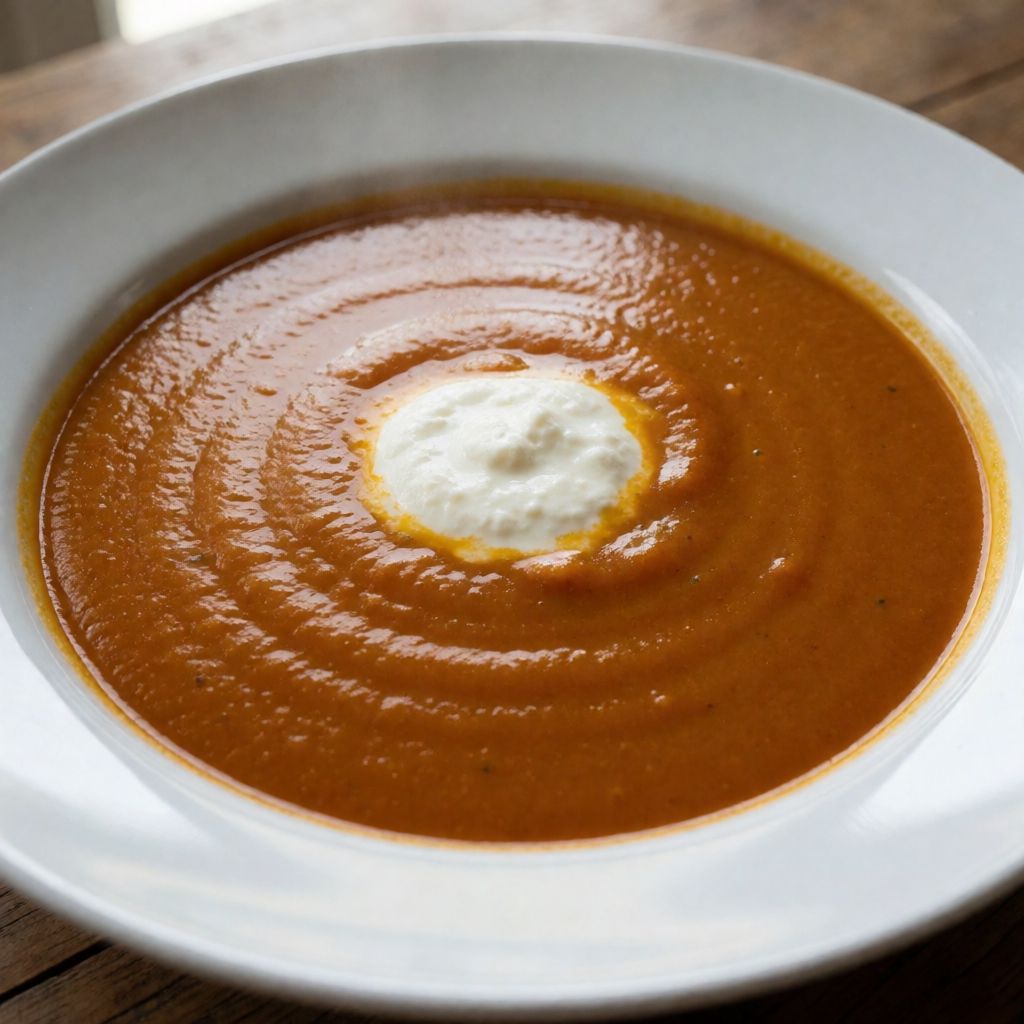
 AI photo
Caramelised Carrot Soup
A velvety caramelised carrot soup finished with a herbed ricotta quenelle.
Labels are worked out automatically from the ingredients and can be wrong. Check the packaging if it matters to you.
Ingredients
- 500 g Carrots
- 80 g Butter
- 7.5 g Salt
- 2.5 g Bicarbonate of soda
- 640 g Carrot juice
- Ricotta to taste
- Paprika to taste
- Garlic to taste
- Chilli powder to taste
- Rosemary to taste
- Thyme to taste
- Black pepper to taste
- Olive oil to taste










Steps
Peel the carrots, wash them and cut each one lengthways into four pieces, removing the core. Cut each quarter into pieces about 5 cm long.
In a pressure cooker, melt the butter, add the carrots and stir.
Add a few spoonfuls of water, the salt and the bicarbonate of soda.
Cook under pressure.
30 minCool the pressure cooker under cold running water.
Transfer the carrots to a blender, add the carrot juice and, if needed, a little water, and blend until smooth.
Strain the mixture, pour the soup into a pan, place over heat and bring to a gentle simmer.
Mix the ricotta with garlic, paprika, chilli powder, black pepper and herbs, stirring until smooth.
Using two spoons, shape small quenelles and place one in each bowl, then pour over the hot soup.
Finish the dish with a light drizzle of olive oil and a sprinkle of the mixed herbs.
What was changed
Goat's ricotta Ricotta has been swapped for ordinary ricotta, since it is easier to find in UK supermarkets.
This is a carrot soup that tastes like carrot turned up to eleven — not the thin, watery stuff you get from boiling slices in stock, but something closer to the flavour of a roasted carrot pushed through silk. The whole mechanism rests on one idea: carrots carry most of their sweetness locked inside pectin and cell walls, and the only way to get it out without burning sugar on a hob is to break those walls down fast, under pressure, with a little help.
That help is the bicarbonate of soda. On its own it sounds like a cheat — and some cooks will tell you it's only for drains and odd science-class fizz. No: alkaline conditions soften pectin and speed up the Maillard-adjacent browning reactions that happen even in a wet environment, which is why 30 minutes in a pressure cooker gets you carrots that taste like they spent an hour in a roasting tin. Skip the soda and you'll get carrots that are merely cooked, not carrots that have given everything up.
What decides whether this works is the straining. Carrot juice plus blended pressure-cooked carrot is still fibrous — blend it as fine as your machine allows, then push it through a sieve anyway, because no domestic blender, however proud its marketing, liquefies carrot fibre completely. The soup should coat a spoon and run, not sit there like baby food. If yours needs water to loosen it, that's not a failure, it means your carrots were good and concentrated.
Carrots: 500g, peeled and cored. The core is the woody central strand — leave it in and you get a soup with a faint bitter, stringy aftertaste no amount of blending fixes, because that fibre doesn't break down, it just gets smaller. Pick carrots that are firm and heavy for their size; a carrot that's gone soft and bendy has already lost moisture and some of its sugar to its own breathing, and you'll be cooking out less flavour than you think.
Butter, 80g: this isn't for taste alone, it's fat carrying the little bit of browning that happens on the pan bottom before the lid goes on, and it's what makes the final soup feel rounded rather than lean. Any neutral fat with no smell of its own will technically cook the carrots — a flavourless vegetable oil, say — but you lose that dairy roundness at the finish. If you want it dairy-free, use a mild olive oil, not a strong one that argues with the sweetness.
Bicarbonate of soda, 2.5g: already explained above, but worth saying again — don't be tempted to add more "to speed things up." Too much and the carrots turn slightly soapy and lose their orange brightness, because you've pushed the pH further than you need for softening and into the zone where it actually degrades the colour pigments too.
Carrot juice, 640g: this is what turns cooked carrot pulp into soup rather than purée. Buy it cold-pressed if you can — the bottled long-life stuff from concentrate tastes thinner and slightly metallic, and you'll taste the difference once it's the main liquid rather than a splash in a smoothie. If you can't get carrot juice, you could in theory thin the purée with vegetable stock, but then you're diluting carrot flavour with something else's flavour, which rather defeats the point of a soup that's meant to taste like nothing but carrot.
No pressure cooker, no bother: this is where a London or Manchester flat kitchen is honest about its limits. A heavy lidded pan on the lowest heat that still keeps a bubble, with the same butter, salt, soda, and a splash more water, will get you there in something like 40–50 minutes instead of 30 — the carrot pieces should go from snapping to bending, right through to falling apart at the press of a spoon. That's your real doneness test, not the clock. Patience here isn't optional; rushing the heat scorches the sugars on the pan bottom instead of coaxing them out gently.
Ricotta and the aromatics: garlic, paprika, chilli powder, rosemary, thyme, black pepper, mixed into the ricotta until smooth, then shaped into quenelles. Use fresh ricotta if you can find it near the deli counter rather than the shelf-stable tubs, which tend to be looser and won't hold a quenelle shape — they'll slump into the soup instead of floating as a spoonable island. If ricotta's not around, a well-drained cottage cheese blitzed smooth, or a soft goat's curd, does the same job: mild, slightly acidic, cold against hot.
The olive oil drizzle and final herb sprinkle at the end are not decoration you can skip for being "just garnish." A thin raw oil poured on top adds a top note of flavour that cooking fat never reaches, because heat changes olive oil's aroma — the raw oil tastes grassier, sharper, and that contrast against sweet carrot is the whole reason it's there, not just a shine for the photo.