
 AI photo
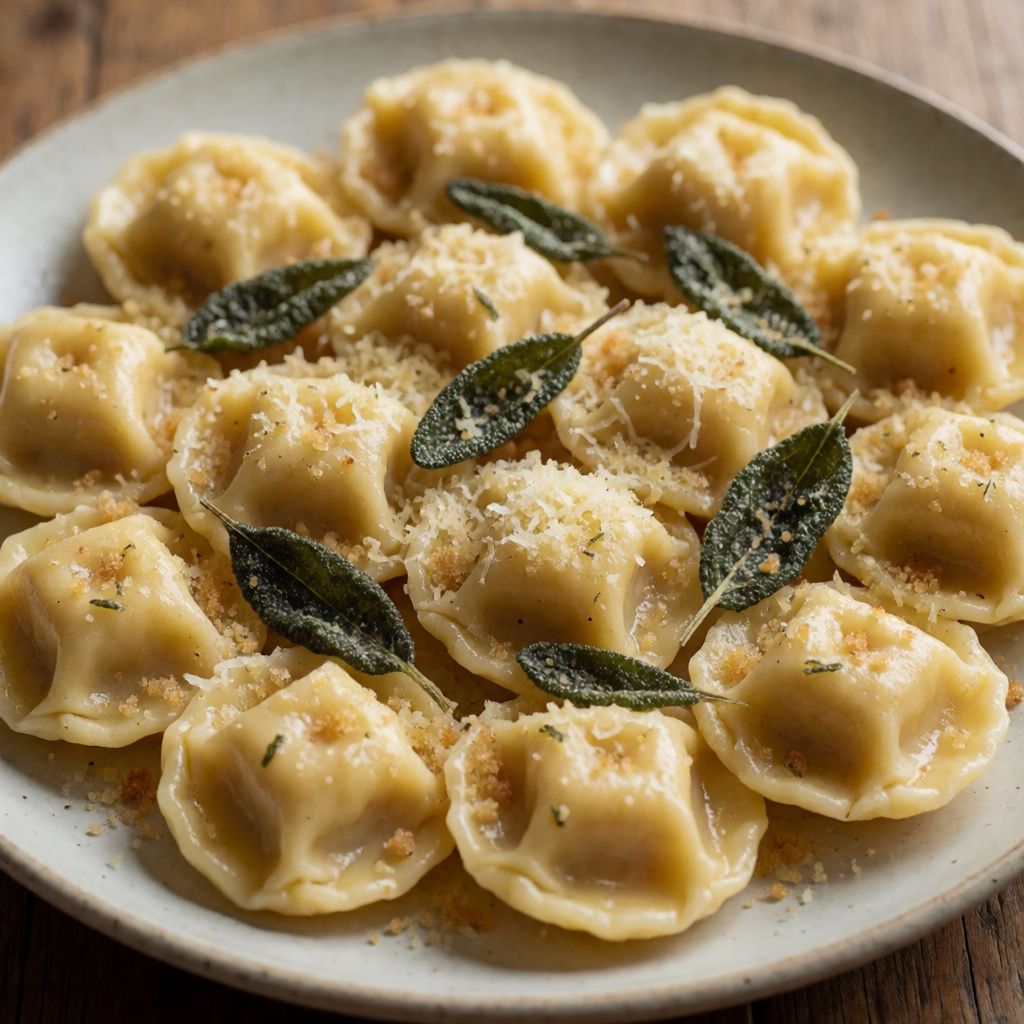
Casoncelli
Traditional stuffed pasta from Lombardy, filled with veal, pork and Swiss chard, finished with amaretti and raisins.
Labels are worked out automatically from the ingredients and can be wrong. Check the packaging if it matters to you.
Ingredients
- 300 g Plain flour
- 3 pcs Eggs
- 20 g Parmesan
- 150 g Veal minced
- 150 g Pork minced
- 40 g Breadcrumbs dried
- 5 g Parsley
- 150 g Swiss chard
- 20 g Amaretti biscuits
- 1 tbsp Olive oil
- 15 g Raisins
- pinch Salt to taste
- pinch Black pepper to taste








Steps
Pour the flour onto a work surface, make a well, add the beaten eggs and start mixing by hand.
Knead the dough vigorously for at least 10 minutes, until it becomes elastic. Shape into a ball and wrap in cling film.
10 minLeave the dough to rest for at least 30 minutes so it becomes elastic.
30 minSoak the raisins in hot water for about 10 minutes.
10 minRinse the Swiss chard, remove the tough part of the stem, and slice the leaves into thin strips.
Heat the olive oil in a frying pan and sauté the Swiss chard over low heat for 5–10 minutes.
7 minIn a food processor, combine the veal, pork, Swiss chard, Parmesan, breadcrumbs and amaretti biscuits.
Add the raisins and parsley. Season with salt and pepper to taste, mix well and transfer the filling to a piping bag.
Roll out the dough to about 1 mm thick using a pasta machine. Cut the sheets into strips about 5–6 cm wide.
Pipe the filling onto the strips of dough, and brush water around the filling.
Fold the dough in half and press gently with your fingers around the mounds of filling.
Cut out half-moons with a 6 cm fluted cutter. Fold the ravioli in half, pressing in the centre.
Place the casoncelli on a tray, dust with flour and leave to rest for about 30 minutes.
30 minCook the casoncelli in boiling water for 5–6 minutes. Drain and dress to taste.
6 min
Casoncelli is Bergamo's way of not wasting anything — a stuffed pasta that grew out of leftover roast meat, stale bread, and whatever sweet-savoury scraps were in the larder: raisins, amaretti biscuits, a crumble of Parmesan. It looks like a tortellino's country cousin, a half-moon pinched twice, but the filling is the whole point, and it's built on a contradiction that only works if you get the balance right: meat and sugar, savoury and sweet, sitting in the same bite without either one shouting over the other.
What decides whether it works is the filling's texture and the dough's thinness. The mix has to be dry enough to pipe and hold its shape, not wet and loose — that's what the breadcrumbs and amaretti are for, they're not flavour, they're structure, soaking up the moisture that chard and raisins bring in. And the dough has to go thin, properly thin, because this is a pasta you fold twice: once around the filling, once again into the half-moon. Two layers meeting at the seam means if your sheet is thick there, you get a tough, chewy ridge instead of something that dissolves against your tongue.
Some say stuffed pasta is a restaurant job, too fiddly for a home kitchen — no, because the fiddliness is just repetition, and repetition is patience, not skill. The first ten casoncelli will be ugly. The twentieth will look right. That's not failure, that's the learning curve of any pleat-and-fold job, piementi or dumpling or casoncelli, and nobody tells you that part.
The flour-and-egg dough is standard egg pasta, nothing exotic, but the ten minutes of kneading is not decoration — it's what builds the gluten network that lets you roll the sheet down to a millimetre without it tearing or springing back. Skip the kneading, or skimp on it, and the dough fights you at the pasta machine, shrinking back every time you think it's thin enough. The rest afterwards — thirty minutes, covered — lets that gluten relax, so when you do roll it, it stays rolled. This is why you can't rush straight from kneading to rolling: a dough with tension in it behaves like elastic, not like silk.
The meat: veal and pork together, because pork alone can be a bit one-note and fatty for a filling this rich already, and veal alone is dry and bland. Together they balance — pork brings the fat that keeps the filling moist through cooking, veal brings a cleaner meat flavour that doesn't fight the amaretti and raisins. If you can't get veal, a mild beef mince works as an understudy, just look for something lean, since the pork is covering the fat side of things.
Swiss chard is there for moisture and a faint mineral bitterness that cuts the sweetness of the raisins — cooked down slowly in oil first so its own water evaporates before it ever meets the raw meat, otherwise you're diluting the filling right when you need it dry enough to pipe. Any sturdy leafy green with a mild flavour does the same job if chard isn't to hand — spinach, well wrung out, is the obvious stand-in.
The amaretti biscuits are the detail people argue about, and that argument is really about history, not taste. Bergamo's cucina povera used bread and biscuit crumbs the way thriftier kitchens everywhere used stale bread — to stretch expensive meat and to bind it. Amaretti just happened to be the local stale biscuit, almond-bitter, and it stuck because it works: a faint sweetness and almond note against the meat, not a dessert flavour, just a counterweight. If you've none, crushed digestives with a few drops of almond extract gets you close enough for a weeknight version, though a purist will tell you it's not the same — they're right, but it's still good.
The raisins, soaked in hot water first, aren't for flavour alone — dry raisins dropped straight into the mix would pull moisture out of everything around them and leave gritty little hard knots in the finished filling. Ten minutes in hot water plumps them so they release sweetness into the mix instead of stealing moisture from it.
Olive oil for the chard: anything with no smell of its own that can take a gentle heat works just as well — a neutral vegetable or sunflower oil, say — you're not looking for the oil's flavour here, you're using it as a cooking medium, so don't spend your good peppery oil on this step.
In your kitchen, you won't have a pasta machine's twin rollers producing an even one-millimetre sheet without thinking about it — a rolling pin will get you close if you roll in sections, checking the thickness by holding it up to the window: you should see shapes through it, faintly, not read newsprint. And don't panic that this is a two-hour project — most of that time is the dough and the pasta resting untouched in the fridge or on the counter, which means you can get the filling made, have a cup of tea, and come back to it. That resting is not wasted time, it's doing the work of relaxing the gluten for you; don't try to skip it by rolling the dough the moment it's kneaded, you'll only be fighting it the whole way through.