
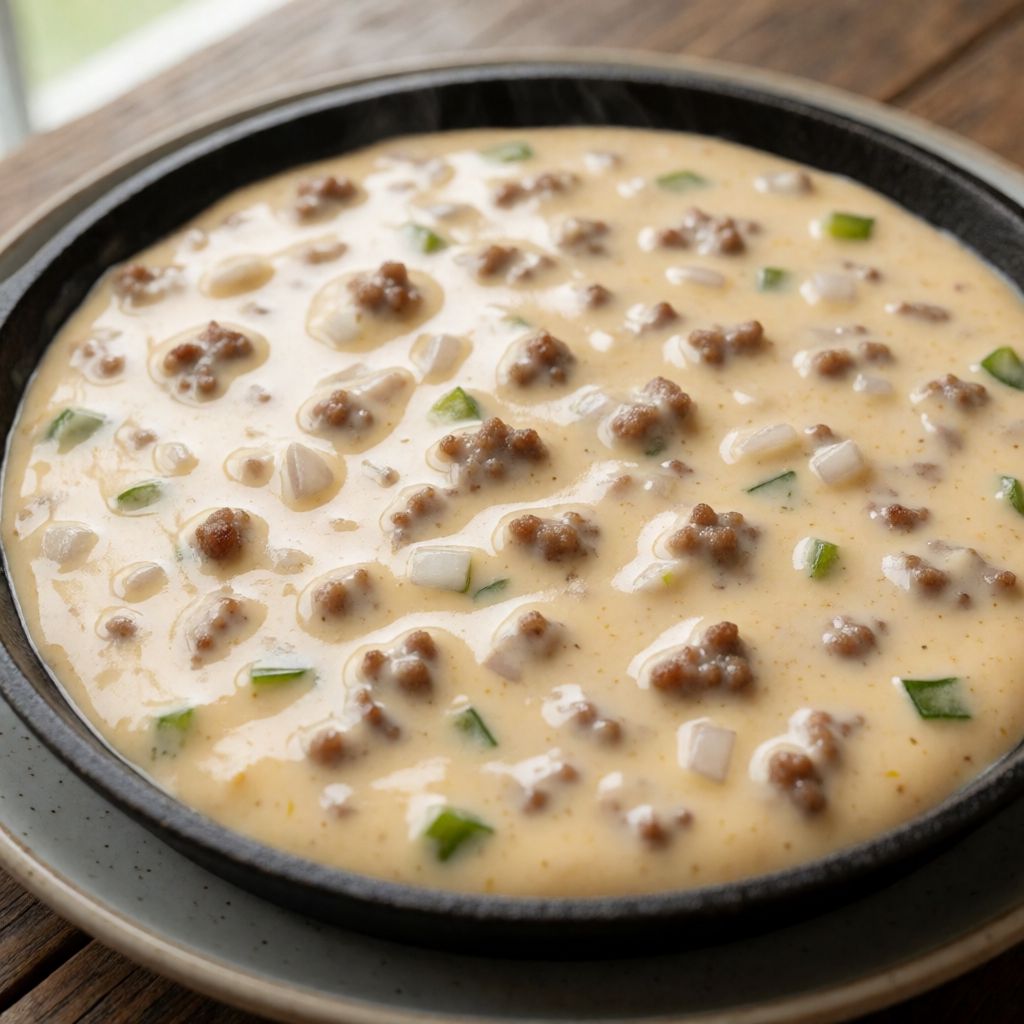
 AI photo
Cheesy Dip with Tomato Salsa
A warm, cheesy dip with chorizo and jalapeño, served with a fresh pico de gallo salsa and nachos.
Labels are worked out automatically from the ingredients and can be wrong. Check the packaging if it matters to you.
Ingredients
- 75 g Chorizo cut into small cubes
- ½ pcs Onion finely chopped
- 1 tsp Cumin dried
- 1 clove Garlic crushed
- 50 ml Jalapeño finely chopped, pickled, plus a little brine
- 1 tbsp Corn Starch
- 150 ml Milk
- 200 g Mature Cheddar cut into small cubes
- 10 g Butter
- 1 tbsp Olive Oil
- Salt to taste
- Black Pepper to taste, freshly ground
- 200 g Tortilla Chips






Pico de gallo

Steps
Fry the chorizo in a pan with the olive oil for a few minutes.
5 minAdd the chopped onion and sauté until soft.
5 minSet the chorizo and onion aside in a bowl.
In the same pan, add the butter, cumin, garlic and jalapeño and stir well over low-medium heat until fragrant.
3 minMix the milk with the corn starch and add to the pan, stirring.
Slowly bring to a gentle simmer and cook the sauce for a few minutes.
5 minAdd the cubed cheddar and stir until the cheese has melted.
3 minSeason with salt and freshly ground black pepper and keep on a low heat.
For the pico de gallo, put all the ingredients in a large bowl, adding only half the chilli at first, and mix well.
Add the remaining chilli, lime juice and zest, salt and pepper to taste.
Spoon the hot cheese dip into a warmed cast-iron dish and top with half the pico de gallo.
Put the rest of the pico de gallo in a separate bowl.
Serve with tortilla chips and lime wedges.
This is a pan of melted cheese with fried chorizo fat running through it, sat next to a bowl of raw chopped tomato doing the opposite job — cold, sharp, acidic. The whole plate works on contrast. If you served the cheese alone it would sit heavy after three chips. The pico de gallo cuts through it every time, like mustard with a fatty cut of beef. Neither half is the point; the switching between them is.
What decides whether it works isn't the cheese — it's the corn starch. Cheddar, heated hard on its own, splits: the fat weeps out, the protein seizes into rubbery threads, and you get a greasy puddle with lumps in it, not a sauce. The starch coats those protein strands and holds the fat in suspension so the whole thing stays glossy and pourable. Some people blame "bad cheese" for a split dip — no, it's usually a dip with no starch in it, pushed too hot too fast.
The second thing that decides it: the chorizo oil. British chorizo, the pre-cooked ring kind from the supermarket, releases a rust-coloured fat as soon as it hits a hot pan — that's paprika oil, and it's doing half the seasoning for you before the cheese even arrives. Fry it too gently and it just warms through without bleeding that fat out, and you lose a layer of flavour you never get back later.
The tomato side needs the opposite discipline: nothing cooked, nothing rushed, salted and juiced close to serving so it stays crisp rather than turning to tomato soup in the bowl.
Chorizo first, dry pan, no need to add fat before it — a tablespoon of olive oil is there as insurance against sticking, not as the main fat. You want the edges catching colour and the oil in the pan going a deep orange-red, not just pink. That colour change is your doneness marker, not a clock. Onion goes in after, into that already-flavoured fat, and you're watching for it to go soft and translucent — a raw, stinging onion bite anywhere in the finished dip means it didn't get enough time here, not that you need more onion.
Cumin and garlic go into butter next, over a heat gentle enough that you can hold your hand near the pan without flinching — hot enough to toast the spice, not hot enough to scorch the garlic bitter. Burnt garlic is one of the few flavours you cannot cook your way back out of, so this is the one moment in the whole dish where "low and careful" actually matters more than anywhere else. The jalapeño brine you're told to add isn't an afterthought — it's acid and salt arriving early, seasoning the fat itself rather than just the final dish.
Milk and corn starch: mix them together before they meet heat, always, because starch dropped straight into hot milk clumps into little gluey balls that never fully dissolve — that's a kitchen myth in reverse, people think stirring harder fixes it, but by then it's structural, not a stirring problem. Whisked into cold or cool milk first, it disperses evenly and the sauce comes out smooth. Bring it up slowly — a "gentle simmer," meaning small bubbles breaking at the edge of the pan, not a rolling boil — because starch needs sustained gentle heat to actually thicken, and a hard boil will break it down again almost as fast as it set.
The cheese goes in off a slightly reduced heat, cut small so it melts evenly rather than sitting in the middle as a hot core surrounded by melted cheese at the edges — size here is about surface area, not neatness. Any firm, well-aged cheese with good melt and real flavour will do this job; mature cheddar earns its place because it's sharp enough to stand up to chorizo fat and lime, where a mild cheese would just disappear into blandness. A Comté or a good Gruyère does the same mechanical job if that's what's in the fridge, though the flavour note shifts nuttier and the dish stops being quite so British-Tex-Mex.
For the pico de gallo, chop the tomato finely enough that each spoonful carries all the components, and don't salt it until close to serving — salt pulls water out of tomato and onion by osmosis, and that water is exactly what turns your crisp salsa into a watery one sitting under the chips. Splitting the chilli, half in early and half added at the end, is a real technique, not fussiness: the early half mellows and spreads its heat through the whole bowl as it sits, the late half keeps its raw bite, so you get background warmth and a sharper top note in the same mouthful.
Any neutral oil with no smell of its own — sunflower, a mild rapeseed — stands in for olive oil in the salsa if you want the lime and coriander to carry the dressing unchallenged; olive oil's own flavour is fine here but not essential the way it is in the pan with the chorizo, where it's mostly there to stop sticking rather than to taste of anything. This isn't a dish that rewards rushing at any stage — the starch needs its slow simmer, the garlic needs patience in the butter, the tomato needs to sit untouched by salt until the end — and the fifteen minutes of prep on the card undersells how much of this is about waiting for the right visual cue rather than watching a timer. Four people, a bowl of chips between them, lime wedges on the side: it's built for sharing straight from the dish, not for plating up neatly.