
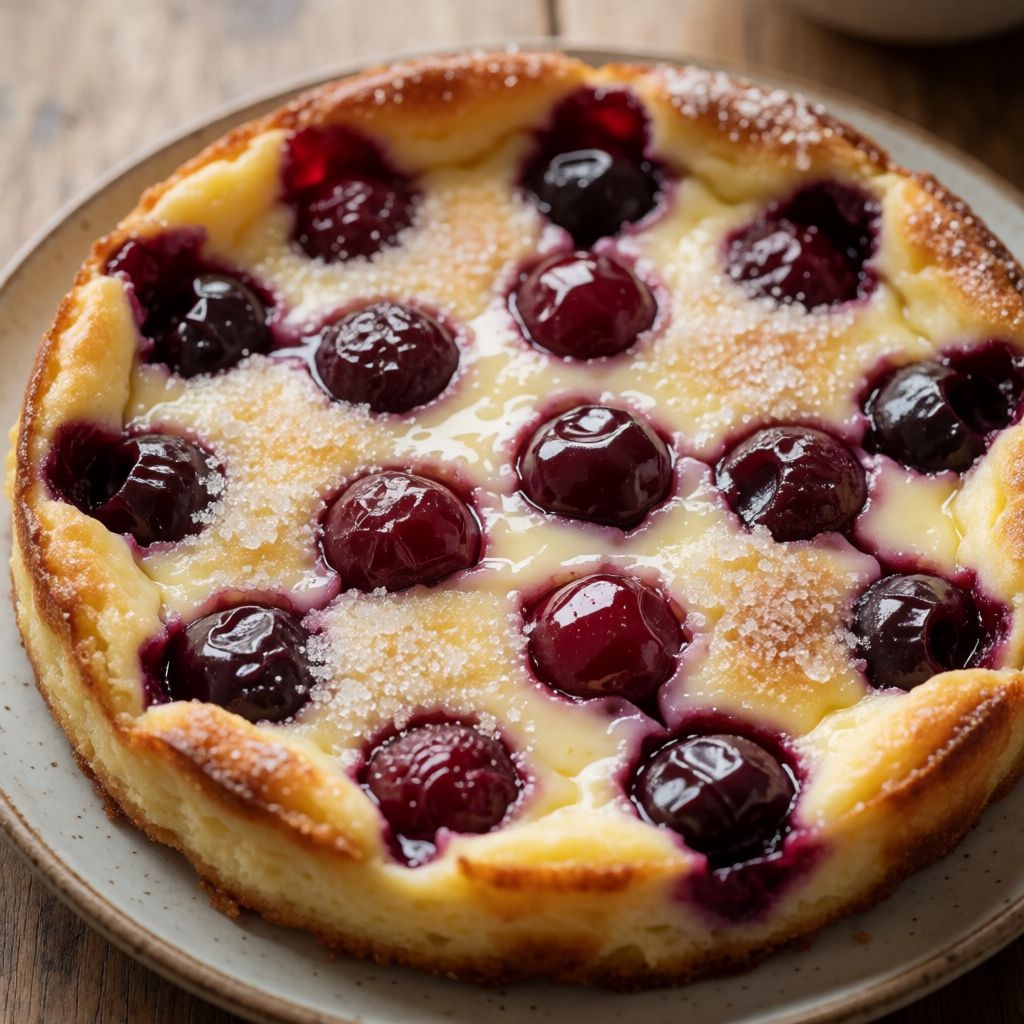
 AI photo
Cherry Clafoutis
A classic French-style baked cherry clafoutis, with a soft custard batter poured over whole cherries.
Labels are worked out automatically from the ingredients and can be wrong. Check the packaging if it matters to you.
Ingredients
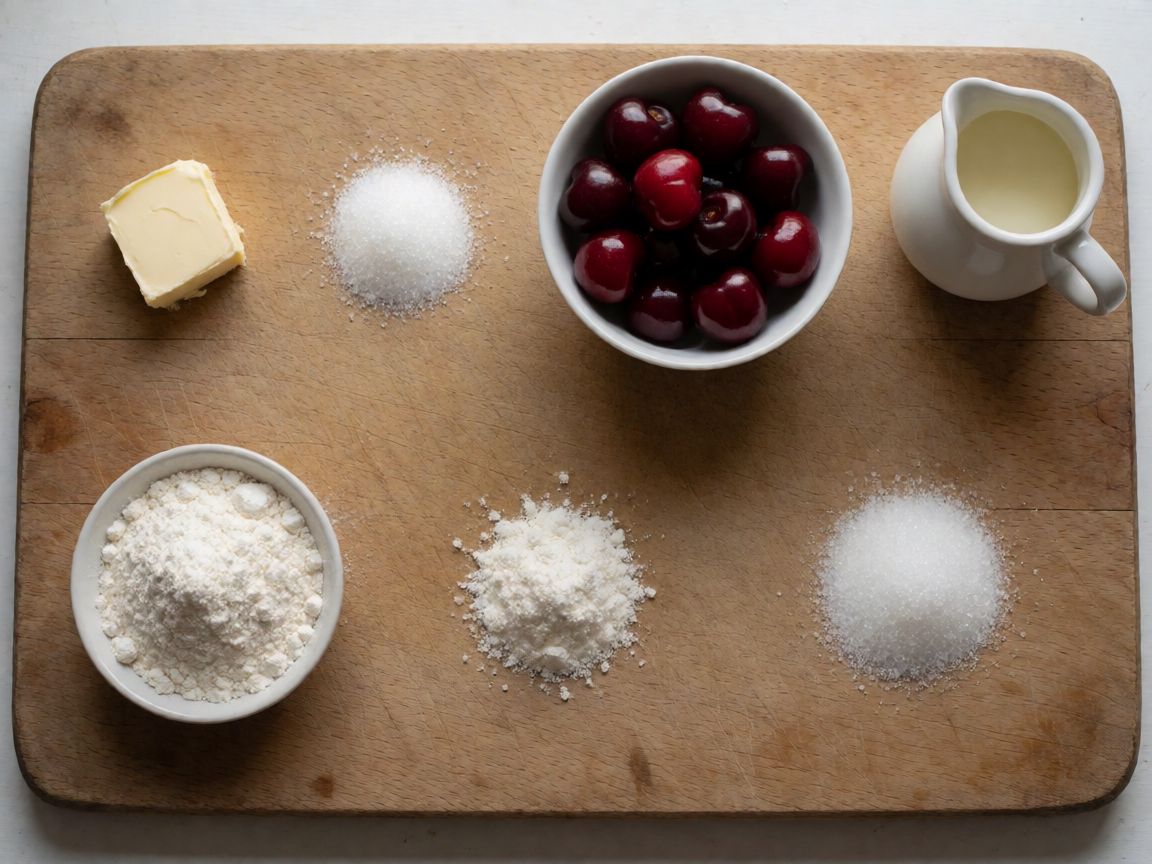
- Butter to taste
- 2 tbsp Sugar
- 450 g Cherries weight with stones, stems removed
- 80 g Plain flour
- 70 g Sugar
- 1 pinch Salt
- 100 ml Milk
- 100 ml Double cream
- 1 tbsp Vanilla extract or vanillin, optional
- 2 tbsp Brandy optional
- 3 pcs Eggs
- Icing sugar to taste










Steps
Generously grease a 22 cm baking dish with butter and dust with a little sugar.
Wash and dry the cherries, leaving the stones in, and arrange them over the bottom of the dish to fully cover it.
Preheat the oven to 210°C.
In a bowl, mix the flour, sugar and salt.
Add the milk, cream, vanilla extract and brandy, and whisk together.
Add the eggs, one at a time, whisking well after each.
Pour the batter over the cherries in the dish and bake for 10 minutes.
10 minReduce the temperature to 170°C and bake for a further 30 minutes.
30 minServe the clafoutis warm or at room temperature, dusted with icing sugar.
Clafoutis is not a cake and it is not a custard — it sits in the gap between the two, and that gap is exactly why it keeps confusing people who try to bake it like a sponge. You're pouring a thin, barely-set batter over fruit and baking it until the edges puff and the centre still trembles a little. If it rises evenly like a Victoria sponge, you've overbaked it into an omelette. The whole point is a custard that just barely remembers it has flour in it.
What decides whether it works is the two-stage heat. The dish goes in hot — 210°C — for ten minutes so the outside of the batter seizes fast, trapping the cherries' juice before it can weep out and turn the base soggy. Then you drop it to 170°C for the real cooking, because a custard-based batter set slowly stays silky; set it all at once at high heat and it curdles into something rubbery at the edges and watery in the middle, the classic clafoutis disaster. Low and unhurried is what gives you something that wobbles rather than bounces.
Some say you must leave the stones in because they "add flavour" — no, not magic almond-bitterness leaching into the batter in forty minutes, that's romantic talk. The real reason is structural: a stoned cherry collapses and bleeds its juice the moment it's cut, and that juice would thin your batter and sink to the bottom as a wet layer under a dry top. The stone holds the fruit's shape and keeps the juice locked inside until a bite releases it. Warn whoever's eating, though — pitting is traditional, but biting down on a stone unannounced is not a tradition anyone enjoys.
Butter and the sugar dusting aren't decoration — the butter stops the custard welding itself to the dish (clafoutis has no fat-rich crust to protect it, unlike a cake batter, so it clings), and the sugar on top of the butter gives the first contact surface something to caramelise against instead of just sticking and tearing when you try to serve it.
Flour here is a thickener, not a structure-builder — 80 g against three eggs and 200 ml of milk and cream is a custard ratio, borrowed from clafoutis's cousin, the baked flan. If you want a reliable substitute, anything that thickens on heat without much flavour of its own works: a light gluten-free flour blend behaves fine; cornflour at roughly half the weight will thicken similarly but gives a slightly tighter, less bready bite, which some people actually prefer.
The milk-and-cream split is doing a balancing act: all milk and the custard is thin and can split under heat; all cream and it turns heavy, almost like a cheesecake. Half and half gives you richness without weight. If you're using whatever's in a British fridge for Sunday tea, standard double cream and whole milk are exactly right — skimmed milk alone will give you a thinner, slightly more rubbery set because there's less fat to carry the eggs smoothly.
Eggs are the actual setting agent, added one at a time so each yolk's fat emulsifies into the liquid rather than sitting as a separate slick that would show up as greasy patches once baked. Three eggs to this volume of liquid is a soft-set ratio — go lower and it won't hold together when sliced, go higher and you've made a quiche in disguise.
Vanilla and brandy are both there to perfume, not to perform — the alcohol cooks off almost entirely in forty minutes at these temperatures, so it's not "boozy," it's rounding the cherry flavour the way a splash of something sharp rounds a stew. Skip it entirely with no structural consequence; use a cheap brandy or even a dark rum if that's what's open, the quantity is too small for quality to matter.
Cherries are non-negotiable in the sense that this is what clafoutis is built around, but frozen cherries work if fresh ones aren't in season — just don't thaw them first, or you'll flood the batter with meltwater before it's even in the oven; tip them in frozen and expect to add a few minutes to the second bake. Fresh British cherries in late summer are the honest version of this dish; most of the year you're working around what's actually available, and that's fine — nobody in a Lyon kitchen in winter waits for June either.