
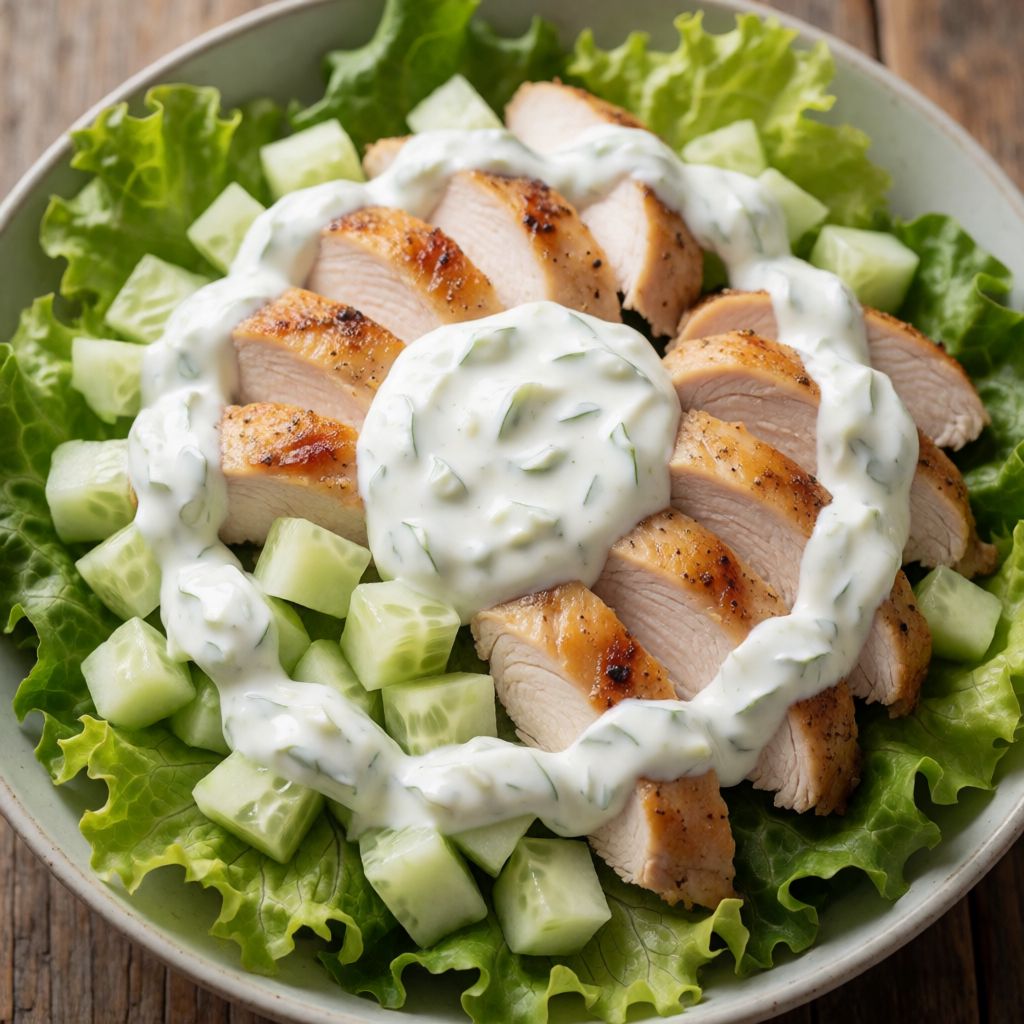
 AI photo
Chicken and Tzatziki Salad
A fresh salad with grilled chicken breast, crisp lettuce and a cooling tzatziki sauce of Greek yogurt and cucumber.
Labels are worked out automatically from the ingredients and can be wrong. Check the packaging if it matters to you.
Ingredients
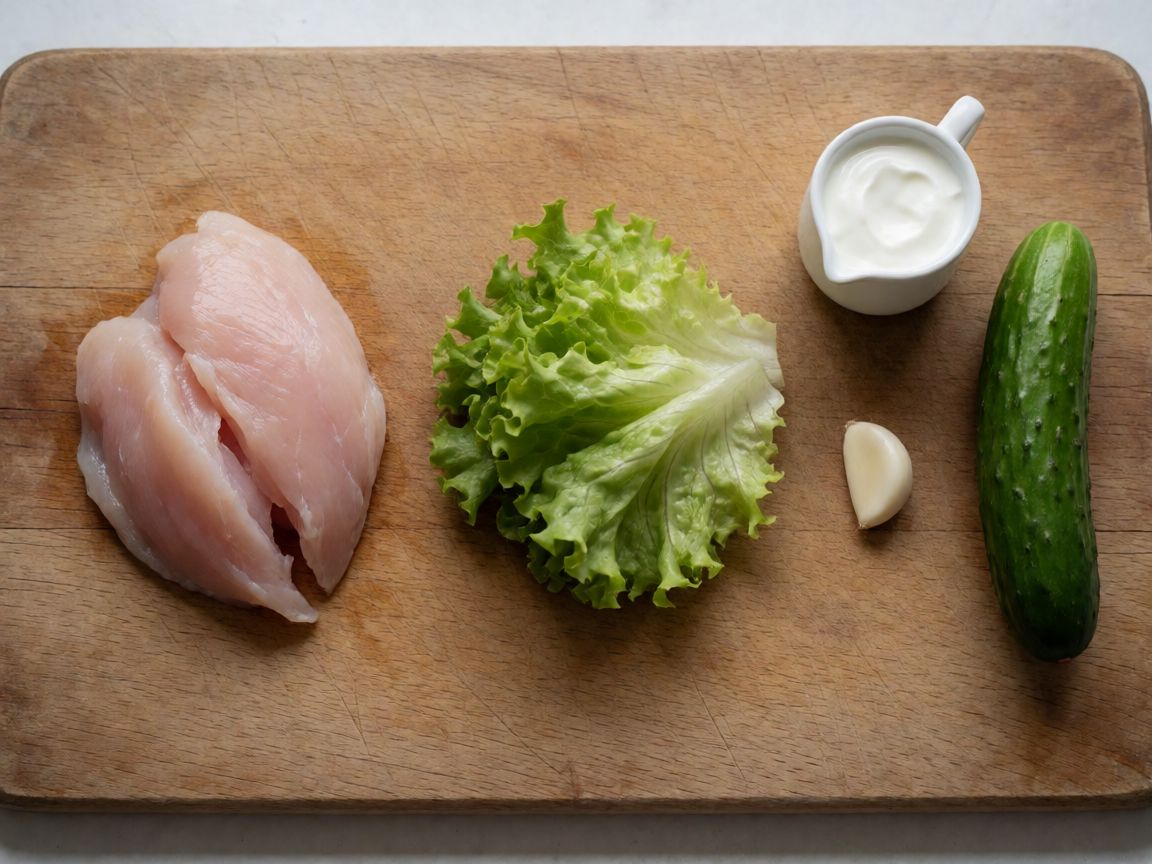
- 300 g Chicken breast
- 300 g Lettuce
- 1 pcs Cucumber
- 170 g Greek yogurt
- 1 clove Garlic
- Salt to taste
- Black pepper to taste
- Olive oil to taste







Steps
Wash the cucumber, peel it, halve it lengthways and remove the seeds. Grate on the coarse side of a grater.
5 minMake the tzatziki sauce: mix the grated cucumber with the Greek yogurt, finely chopped garlic and olive oil. Season with salt and pepper. Cover and chill in the fridge.
10 minHeat a grill or griddle pan, add the chicken breast and cook until lightly browned on both sides. It is ready when the inside reaches 74°C.
10 minSeason the chicken with salt to taste and leave it to cool.
5 minSlice the cooled chicken breast into thin strips.
3 minIn a large bowl, dress the lettuce with salt and olive oil, then add the sliced chicken.
2 minDivide the salad between serving plates and spoon over the tzatziki sauce.
2 min
This is a lean-chicken salad built on a cheat version of tzatziki — the Greek cucumber-yogurt sauce that normally wants hours of draining and here gets ten minutes in a fridge. That compression is the whole point: four people, twenty minutes of knife work, nothing that needs a kazan or an afternoon.
What decides if it works is water, twice over. First in the cucumber — if you don't seed it and squeeze the grated flesh, the sauce turns to cucumber soup by the time it reaches the plate, because a cucumber is basically water held together by hope. Second in the chicken — breast has almost no fat to protect it, so the line between juicy and cardboard is a few degrees, not a few minutes, and once you've crossed it no sauce saves you.
Some say chicken breast should be cooked until it's grey and firm all the way through, 'to be safe.' No — because the thing that actually kills salmonella is the core hitting 74°C, a protein reaching its own breaking point, not the colour of the meat. Once it's there, it's done. Cooking past that out of nervousness is how perfectly good chicken ends up tasting like string.
The resting and slicing matter too. Cut a hot breast and the juice runs out onto the board instead of staying in the meat; let it sit, even five minutes, and the muscle fibres relax and hold onto what's inside. That's the whole trick behind 'slice when cool' — it's not a flavour step, it's a plumbing step.
Chicken breast: buy it, don't brine it or marinate it for this — the dish depends on the clean, almost bland base of plain grilled chicken against a sharp sauce. On a British electric hob you won't get the char of an open flame, and that's fine; a ridged griddle pan still gives you contact stripes and a bit of Maillard browning, which is flavour, not just decoration. If you've got cold leftover chicken from Sunday's roast, use it — skip the browning entirely, you've already paid that cost once this week.
Lettuce: the job here is crunch against soft sauce, so pick a leaf that holds its shape when you press it — romaine, little gem, iceberg. Soft butterhead or baby spinach wilt the moment oil and salt touch them, and you'll be eating a puddle, not a salad, within minutes of plating.
Cucumber: seed it because the seeds and the jelly around them are where most of the water lives — leave them in and you're adding a spoonful of liquid straight into the yogurt. Grate on the coarse side so you get texture, not purée, and if you have time, salt the grated flesh for five minutes and squeeze it in your fist before mixing — more insurance against the same water problem.
Greek yogurt: you want the kind thick enough to stand a spoon upright in, which is Greek yogurt proper — strained, not just labelled 'Greek style,' which in a lot of UK supermarkets is thinner and will undo all your work on the cucumber. No luck finding it? Strain ordinary natural yogurt through a piece of muslin or even a paper towel in a sieve for half an hour; you're doing by hand what the dairy already did for the real thing.
Garlic: one clove, raw, chopped fine — not crushed to paste, or it turns the sauce bitter and one-note. The ten-minute chill in step 2 isn't just for temperature; cold mellows raw garlic's sharpest edge, the same way it would in a vinaigrette left to sit. Skip the chill and the garlic will shout over everything else.
Olive oil: here it isn't a neutral carrier, it's a flavour in its own right, because the whole dish has four main components and nowhere to hide a bad one. Use an oil you'd be happy to taste on bread. Any oil with no smell of its own — sunflower, a light rapeseed — would do the job mechanically but would leave the salad tasting of nothing in particular, which is the opposite of what you want from the only fat in the dish.
Salt and pepper: season the chicken after it's cooked, as the recipe says, not before. Salt on raw lean meat starts pulling moisture out by osmosis before it ever meets heat — you'd be drying it out twice. Salt the lettuce only right before serving, for the same reason it wilts: salt draws water out of leaves the way it does out of meat, just faster, because a leaf has far less structure to resist it.