
 AI photo
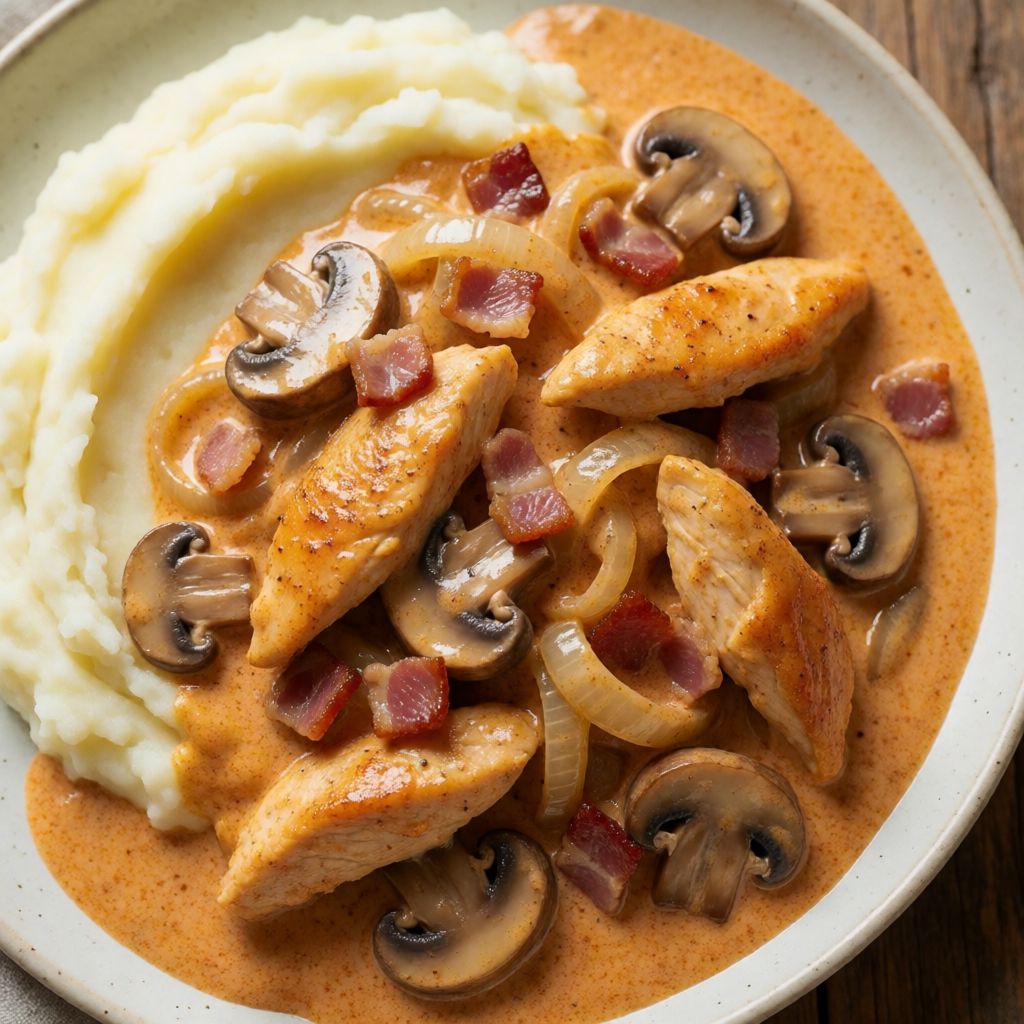
Chicken Stroganoff with Mashed Potatoes
A creamy chicken stroganoff with mushrooms and bacon, served with smooth mashed potatoes.
Labels are worked out automatically from the ingredients and can be wrong. Check the packaging if it matters to you.
Ingredients
- 400 g Chicken breast
- 1 tbsp Paprika
- 2 tbsp Plain flour
- 75 g Bacon
- 250 g Mushrooms quartered
- 4 pcs Onion finely chopped
- 2 tbsp Tomato purée
- 3 pcs Bay leaf
- 200 ml Stock
- 100 ml Double cream
- Salt
- Black pepper freshly ground
- 1 bunch Parsley finely chopped
- 1.5 kg Potatoes
- 75 g Butter
- 200 ml Milk
- 1 pinch Nutmeg














Steps
Pat the chicken dry with paper towel and coat it in a mixture of paprika, flour, salt and pepper.
3 minFry the bacon in a pan with a little oil over medium heat, then transfer it to a plate lined with paper towel. Fry the mushrooms in the bacon fat over high heat, stirring, adding olive oil if needed.
Once the mushrooms are golden, add the chicken and fry it. Then add the onion, tomato purée, chopped bacon, fried mushrooms, bay leaf and half the stock.
15 minCover with a lid and simmer for 15 minutes, adding a little more stock if needed. At the end, stir in the cream and season with salt and pepper.
15 minFor the mash, boil the potatoes in unsalted water until tender.
18 minFirst mash the potatoes with butter, then whip the mash with a mixer on the lowest speed, adding milk a little at a time, until the mash is creamy and velvety. Season with salt, pepper and freshly grated nutmeg.
3 minServe the chicken stroganoff with mashed potatoes, sprinkled with fresh parsley.
Chicken stroganoff is a misnomer dressed up for comfort: there's no beef, and the Russian original, beef Stroganov, was a dish for people with a cook and no time to wait for a proper braise — thin strips, quick sear, sour cream stirred in off the heat. This chicken version keeps the logic but swaps the meat and sweetens the sauce with tomato and bacon smoke. What decides whether it works is almost entirely about fat and sequence: you fry bacon to render its fat, then you fry mushrooms in that fat, and only then the chicken. Do it in the wrong order and you get boiled-tasting chicken and rubbery mushrooms sitting in their own water instead of browning.
The mushrooms need real heat and room to spread, because mushrooms are mostly water and if the pan is crowded or lukewarm, they steam each other instead of browning. That's the whole "why did my mushrooms go slimy" complaint, and it has nothing to do with washing them under a tap (that old rule that mushrooms "drink water" and must only be brushed — no, a rinse and a quick pat dry does nothing a few seconds in a hot pan won't undo; what ruins them is crowding and tepid oil).
For four people this feeds four generous plates with mash alongside, and the mash is not a side thought here — it's doing a job the sauce can't: soaking it up. The sauce itself is deliberately loose and savoury rather than rich; cream goes in at the very end, off any real boil, because cream split over high heat separates into fat and watery curds — that's the texture fault people blame on "bad cream" when it's actually bad timing.
Chicken breast here is coated in flour and paprika before it ever meets the pan, and that's not seasoning for its own sake — the flour gives the meat a dry surface to brown against and later helps thicken the sauce as it cooks out into the stock. Paprika is sweet-smoky, not heat; if you reach for a hot paprika or cayenne instead you'll get a different, sharper dish, which is fine, just know you've changed the character, not just the spice jar. Pat the chicken properly dry first — any surface moisture turns to steam the second it hits hot fat, and steam cooks the meat grey before it ever browns it.
Bacon is there for fat and smoke, not bulk. You render it first specifically so the mushrooms fry in bacon fat rather than plain oil — this is the one bit of flavour-layering in the whole dish, each ingredient leaving something behind in the fat for the next one to pick up. If you've no bacon, a splash of smoked oil or even a pinch of smoked paprika added with the sweet paprika gets you partway there, though you lose the little crisp pieces scattered through at the end.
Mushrooms, quartered rather than sliced thin, hold their shape and don't disappear into the sauce — button or chestnut mushrooms both work; anything with enough structure to survive a long simmer. Onion, finely chopped, is cooked long enough to soften and sweeten rather than browned hard; tomato purée adds a concentrated sourish depth that stands in for the soured cream of the original recipe's Russian cousin, and bay leaf is there purely for background bitterness — pull it out before serving, it's not meant to be eaten.
Stock should taste of something before it goes in; a cube dissolved in water is fine, but taste it first, because you can't fix a thin, flat sauce later except by boiling it down hard, which just concentrates the saltiness instead of the flavour. Double cream, stirred in at the end and off any rolling boil, is what makes this "stroganoff" rather than "chicken stew with mushrooms" — a lower-fat cream will split more readily under heat, so if you're substituting, go gentler with the heat, not just the cream.
The mash is built in stages for a reason: butter goes into the hot, dry mashed potato first so it melts into fat-coated starch rather than diluting into liquid, and milk goes in afterwards, a little at a time, with the mixer on its lowest setting — this is what gives you "velvety" rather than "gluey." Overwork potato starch with milk added too fast or beaten too hard and you get wallpaper paste; it's a structural fault, not a seasoning one. Boil the potatoes unsalted, because salted water seasons unevenly and you lose control of it versus seasoning the finished mash directly. A floury potato (Maris Piper, King Edward) breaks down properly; a waxy salad potato will stay stubborn and lumpy no matter how long you beat it.
Nutmeg at the end is a whisper, not a flavour you should taste as itself — grate it fresh if you can, because pre-ground nutmeg loses its oils fast and mostly just tastes of dust after a few months in the cupboard. Parsley scattered at serving isn't decoration — it's the one raw, green, slightly bitter note in a dish that's otherwise all soft browns, and it cuts the richness enough that the last few forkfuls still taste like something.