
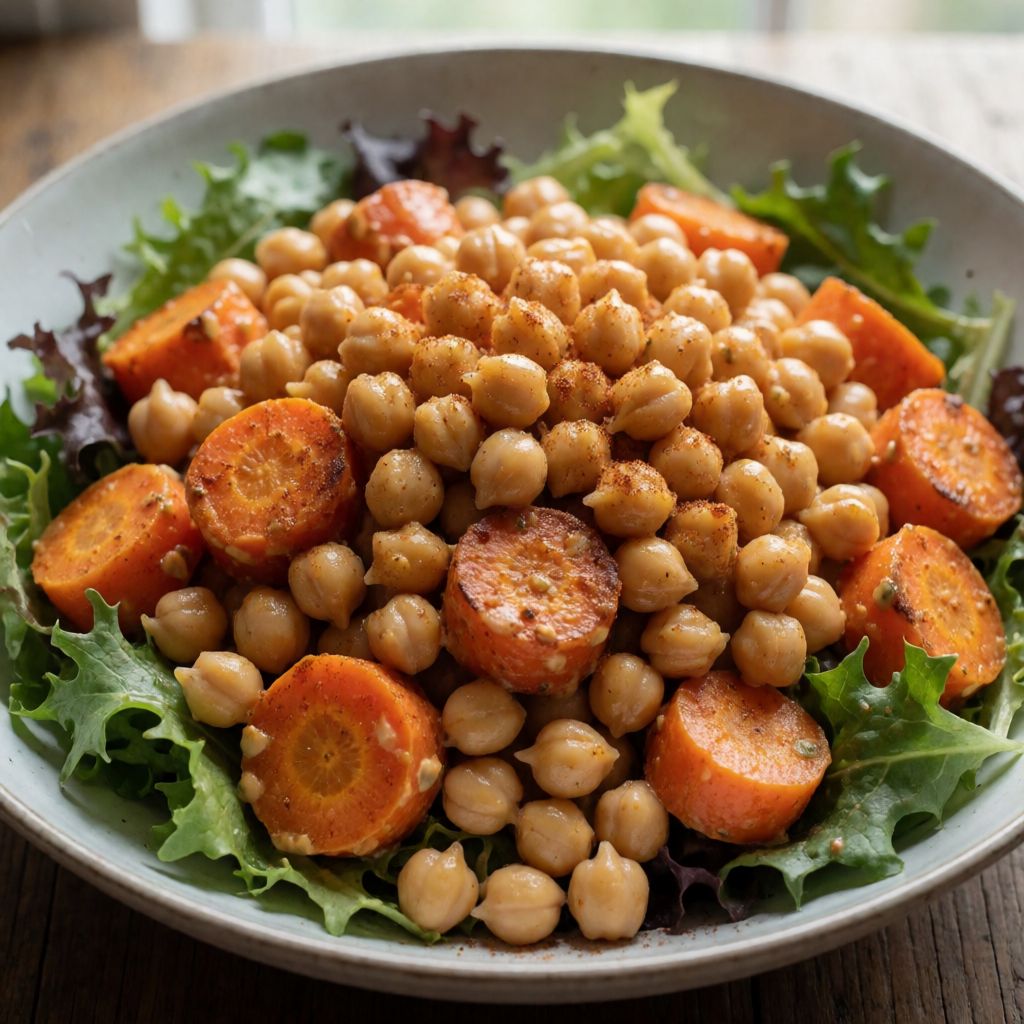
 AI photo
Chickpea Salad with Roasted Carrots
A warm, spiced chickpea salad with roasted carrots, feta and fresh herbs.
Labels are worked out automatically from the ingredients and can be wrong. Check the packaging if it matters to you.
Ingredients
- 1 tsp Cumin ground
- 0.5 tsp Ground coriander
- 0.5 tsp Cinnamon
- 1 tsp Paprika
- 3 pcs Carrots cut into cubes
- 2 clove Garlic crushed
- 1 pcs Red onion cut into wedges
- 1 can Chickpeas
- 125 g Salad leaves
- 50 g Feta crumbled
- 1 bunch Coriander fresh
- 1 bunch Mint fresh
- 0.5 pcs Lemon juiced
- 2 tbsp Almonds chopped
- 1 tbsp Olive oil
- Salt
- Black pepper freshly ground







Steps
Put the cumin, ground coriander, cinnamon and paprika into a dry pan and toast the spices over medium heat for a few minutes.
3 minLower the heat, add the olive oil, carrots, garlic and red onion, stir a few times and raise the heat slightly again.
Fry the carrots and onion, stirring, for about 5 minutes.
5 minAdd the chickpeas to the pan, heat through well and season with freshly squeezed lemon juice, salt and pepper.
2 minServe over the salad leaves, sprinkled with crumbled feta, almonds, finely chopped coriander and mint.
This is a warm salad built backwards from how most people make salads — you cook the vegetables and the spice first, then throw cold, raw things on top. The carrots and onion get fried in a dry pan that's already perfumed with toasted cumin, coriander, cinnamon and paprika, so the oil carries the spice into the vegetable instead of sitting on top of it. What decides whether this works is the toasting of the spices before any liquid goes in — dry heat on a bare pan blooms their oils in a way that oil alone never quite does.
Some say spices should always go in with the oil at the start. No — because ground spices scorch the second oil hits a hot pan and oil is above their scorch point, you get a bitter, flat edge instead of the round, warm smell you're after. Toasting them dry first, with nothing to carry heat into them too fast, lets the oils release gently. You'll smell it change: flat and dusty, then suddenly warm and round, almost toasted-nut. That's the cue, not a stopwatch.
The carrots carry the whole dish, so cut them close to the same size — a cube that bends slightly under a fork but still has resistance in the middle, not one that collapses. A carrot that snaps is raw in the middle; one that goes to mush has lost the point of frying it rather than boiling it. The red onion wedges are there to go from sharp purple-white to a softened, slightly ginger edge — that's the sugars starting to catch, and it's what gives sweetness against the lemon and feta later.
The spice mix itself is not fixed by any rule of nature — cumin and coriander for warmth, cinnamon for a background sweetness you're not meant to identify outright, paprika for colour and a mild smoky edge. Use what you have in similar proportion rather than hunting a shop for the exact list; a pinch more cumin won't ruin anything, it's the toasting that matters, not the precise ratio.
Carrots: pick ones that still have some snap raw, because a carrot that's gone soft in the fridge drawer will never develop the right bend-not-snap texture in the pan — it just goes straight to mush. Cut the cubes roughly the size of a chickpea so they cook at the same rate as everything else going in later.
Garlic crushed, not sliced, because you want it to dissolve into the oil and spice coating rather than sit as separate pieces that can burn. A burnt garlic edge turns bitter fast and that bitterness won't cook out — if your pan runs hot on your hob, add the garlic a beat later than the recipe implies rather than risk it catching before the carrots are even started.
The chickpeas from a tin are already cooked — they're in the pan only to warm through and pick up the spiced oil, not to fry. If you only have dried chickpeas, cook and drain them first; tinned exists precisely so this step takes two minutes, not two hours, which is the whole economic point of using a tin here rather than a point against it.
Feta: a firm, salty, crumbly cheese is the job description, not the brand — feta does it cheaply and reliably in a UK supermarket, but any firm salted curd cheese that crumbles rather than melts will stand in. Fresh coriander and mint go in raw and chopped at the end because their aromatic oils are the opposite of the toasted spice oils — you want one warm and cooked, one bright and raw, in the same mouthful.
Patience here is short but real: don't rush the dry-toasting past the point where you can smell the change, and don't rush the onion off the heat before it's actually softened at the edge. Five minutes in a pan on a domestic hob is a lower bound, not a deadline — your ring runs cooler than a restaurant burner, so watch the onion's colour and the carrot's give, not the clock.