
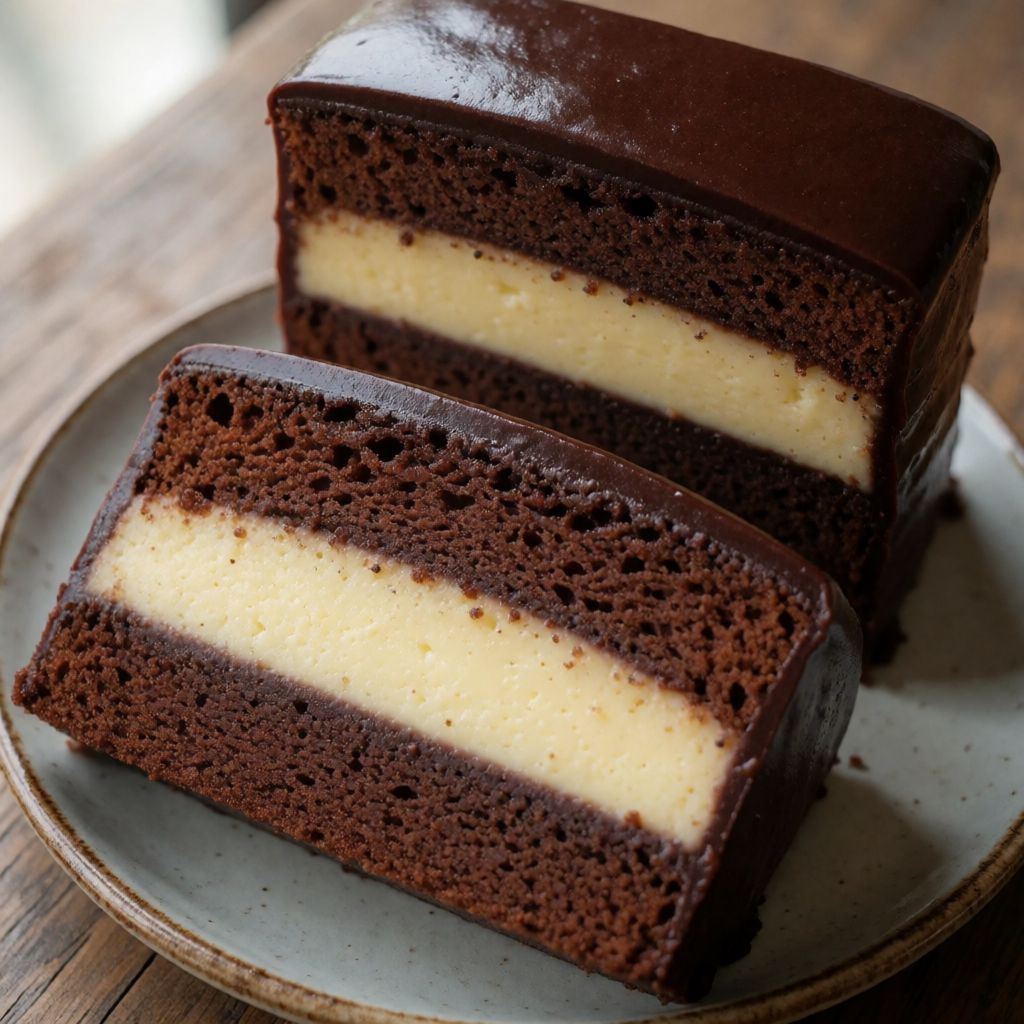
 AI photo
Chocolate Cake with Custard Filling
A soft cocoa sponge filled with a silky vanilla custard, baked in one tin for a cosy family dessert.
Labels are worked out automatically from the ingredients and can be wrong. Check the packaging if it matters to you.
Ingredients
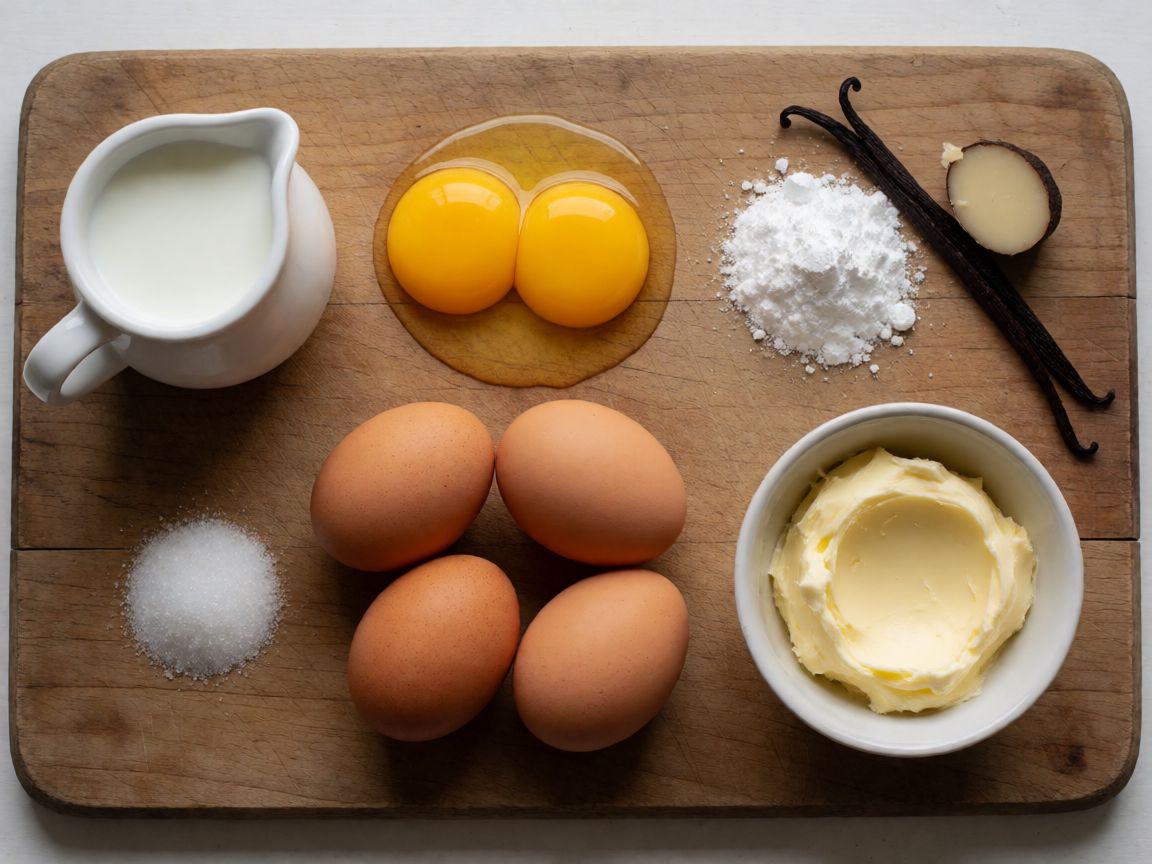
- 250 ml Milk
- 2 pcs Egg yolks
- 50 g Caster sugar
- 30 g Potato starch
- 1/2 pcs Vanilla pod
- 4 pcs Eggs
- 180 g Caster sugar
- 100 g Butter softened
- 130 ml Milk
- 300 g Plain flour
- 8 g Baking powder
- 40 g Cocoa powder
- 1 pcs Lemon zest








Steps
Bring the milk to the boil with half a vanilla pod.
In a separate bowl, whisk the egg yolks with the sugar.
Add the potato starch to the yolks and mix well.
Remove the vanilla pod from the milk and pour the yolk mixture into the hot milk.
Cook over low heat, stirring, until the custard thickens.
Pour the custard into a bowl, cover with cling film and leave to cool.
Combine the eggs and sugar in a large bowl and whisk with a mixer until pale.
Add the lemon zest while still whisking, then fold in the softened butter and milk.
Sift the flour into the mixture, add the baking powder and cocoa powder, and mix well.
Pour the batter into a 24 cm tin, greased and dusted with flour.
Spoon the cooled custard on top.
Bake in a preheated oven at 180°C for 40–45 minutes.
43 min
This is a cake that cheats a little, and knows it. You pour a loose chocolate batter into the tin, spoon a cooled custard on top, and into the oven it goes. No layering, no spreading custard between two baked sponges, no waiting for anything to cool before assembling. The custard sinks, settles, bakes into a soft seam somewhere in the middle, and the cake comes out with that seam intact — a chocolate crumb above and below, a pale, faintly set custard band running through it.
What decides whether it works is the custard's thickness before it ever meets the batter. Too thin, and it won't hold its shape as a layer — it'll disperse straight into the batter and you'll lose the seam, ending up with a cake that's merely damp in the middle rather than distinctly marbled. Too thick, and it sits as a stodgy disc that never quite marries with the sponge around it, leaving a dry ring where the two meet. You're after something that holds a ribbon off a spoon but still falls — thick enough to be spooned in dollops, loose enough to spread itself slightly as it bakes.
Some say a custard filling means baking two sponges and sandwiching them cold, Victoria-sponge style. No — because the whole point here is that custard and batter cook together, and the custard's structure comes from its own egg-and-starch set, not from gravity pressing two cakes onto it. Bake it in, not between.
Start with the custard, because it's the part people rush. Milk goes on with half a vanilla pod — not whole, because a whole pod in 250 ml would overpower rather than perfume, and you want to taste chocolate and custard both, not a vanilla slab. Bring it to a proper boil; a lazy simmer won't pull enough flavour out of the pod in the time you give it. Meanwhile the yolks and sugar get whisked together — this isn't decoration, it's protection. Sugar coats the yolk proteins and keeps them from seizing into scrambled bits the instant hot milk hits them. Add the starch to the yolks before the milk goes in, not after — starch needs to be dispersed in a cool liquid first, or it clumps the second it meets heat, and no amount of stirring saves a lumpy custard once that's happened.
Here's the step people get wrong without knowing it: you pour the yolk mixture into the hot milk, not the other way round, and you do it steadily, not in one dump. A splash of hot milk whisked into the yolks first — tempering — would be the textbook caution, but with starch in the mix you have more room; the starch firms the proteins before they can scramble. Still, cook it over low heat. High heat cooks the outside of the custard before the inside catches up, and you get a custard with scrambled streaks through a thin sauce. Low and stirred, it thickens evenly, and you'll feel it change under the spoon — from milk that slides off cleanly to something that coats the back of it and holds a line if you drag a finger through.
Potato starch, not cornflour, is the ingredient as written, and it's worth keeping that distinction: potato starch thickens at a slightly lower temperature and gives a glossier, less cloudy set, which matters here because you want the custard band visible against the dark crumb, not muddy. Cornflour will work as a substitute — same ratio, roughly — but expect a slightly duller, more opaque filling.
For the batter, the method is the whisked-sponge method, not the creamed one, and the eggs-and-sugar stage is where that decision gets made. Whisking eggs and sugar until pale isn't about colour for its own sake — it's trapping air into a foam that will later carry the weight of flour and cocoa without collapsing. Cocoa has no gluten and no fat to speak of; it's dead weight in the batter, structurally. The foam does the lifting the cocoa can't. That's also why the butter and milk get folded in gently after the zest, not beaten — beating now would knock the air straight back out.
The lemon zest is easy to dismiss as decorative, but it's doing real work against chocolate's flatness. Chocolate cake without acidity can taste one-note — rich but dull. A little citrus oil in the zest brightens it the way a pinch of salt brightens caramel; you won't taste lemon, you'll taste chocolate that seems to have more to say. No zest to hand — orange zest does the same job.
On oven heat: 180°C is a temperature where the batter sets from the outside in slowly enough for the custard layer to firm alongside it rather than ahead of or behind it. Push it hotter and the crumb round the edges will set and even scorch before the custard in the centre has had time to firm, leaving a raw seam under a cooked top. An ordinary domestic oven runs hotter or cooler than its dial by a worrying margin, so treat 40–45 minutes as the floor, not the finish line — check by feel. A skewer in the chocolate crumb away from the custard should come out clean; near the custard band it will come out damp, and that's correct, that's the filling, not underbaking. Judge the cake by whether the top has stopped wobbling when you nudge the tin, not by the clock.