
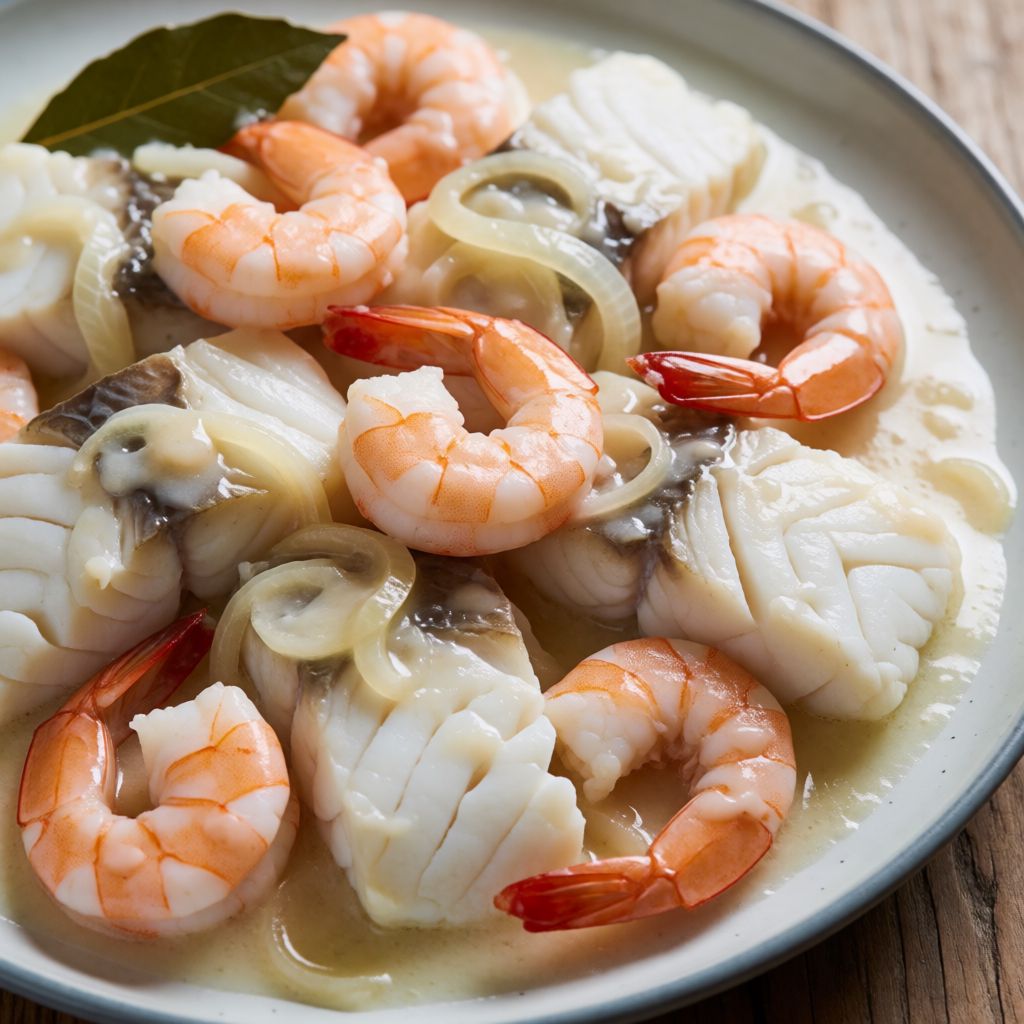
 AI photo
Cod and Prawns with Seafood Sauce
A chilled dish of poached cod, prawns and eggs with a creamy tomato-seafood sauce.
Labels are worked out automatically from the ingredients and can be wrong. Check the packaging if it matters to you.
Ingredients
- 500 g Cod
- 700 ml Water
- 1 pcs Onion cut into quarters
- 1 tbsp Apple cider vinegar
- 2 tsp Salt
- 2 pcs Bay leaf
- Black pepper freshly ground
- 250 ml Crème fraîche
- 1 tsp Caster sugar
- 1 tbsp Tomato purée
- 2 tbsp Ketchup
- ½ pcs Lemon finely grated zest and a little juice
- 1 tsp Paprika sweet
- 100 ml Double cream
- 4 pcs Eggs soft- or hard-boiled
- 200 g Prawns
- 75 g Lamb's lettuce
- 1 bunch Dill fresh
- 1 bunch Watercress
- 100 g Lumpfish roe
- Salt flaky
- Black pepper freshly ground
- 1 pcs Baguette sliced
- ½ pcs Lemon cut into wedges




















Steps
Bring the water, onion, apple cider vinegar, bay leaves, salt and pepper to the boil.
Add the cod, cover and simmer for about 3 minutes.
3 minLet the fish rest in the stock for 10 minutes.
10 minChill the cod in the fridge.
Mix the crème fraîche, sugar, tomato purée, ketchup, lemon zest, lemon juice, paprika, salt and pepper.
Whip the double cream until soft peaks form and fold it into the sauce.
Arrange the lamb's lettuce on a platter and top with the cod, eggs, prawns and sauce.
Sprinkle with dill, watercress, lumpfish roe, pepper and flaky salt.
Serve with lemon wedges and baguette.
What was changed
The steinbidder roe has been swapped for Lumpfish roe, since the original is not available to local shoppers.
This is a cold fish platter dressed up as a sauce — the kind of thing you'd put out on a table and let people pick at with their hands and a bit of bread, not a plated "dish" in the restaurant sense. Cod, poached gently and then left alone, sits next to boiled eggs and prawns, and the whole thing is held together by a pink, slightly sweet-sharp sauce that's really just crème fraîche doing the job mayonnaise usually does, lightened with whipped cream so it doesn't sit heavy on the fish.
What decides whether it works is restraint in two places: how you cook the cod, and how long you leave the sauce to just be a mix of good shop-bought things rather than something you've fussed over. The cod wants barely any heat at all — the water should be at a bare shiver, not a rolling boil, because cod is almost pure protein held together by very little connective tissue, and a hard boil turns those protein strands tight and dry in minutes, pushing the moisture straight out into your poaching liquid instead of staying in the flesh. Some say you simmer fish the same way you simmer potatoes — no, because fish has nothing like a potato's starch structure to protect it; it has only water and fragile muscle fibre, and it punishes impatience instantly.
Start with the cod itself. You want a thick loin piece, not a thin tail fillet, because the whole poach-then-rest method depends on the fish having enough mass to carry residual heat for ten minutes without overcooking at the edges while the centre catches up. If your fishmonger only has thin fillets, cut your simmer time right down — a thin piece can go from raw to chalky in under a minute once it's actually submerged in moving water, you're not waiting for three minutes regardless of what the clock says, you're waiting for the flesh to go from translucent grey to opaque white and just starting to flake if you press it with a finger. Haddock works as a straight swap; it's the same family of lean, flaky white fish and nobody at the table will complain. Don't use anything oily like salmon here — the whole point of this poach is a clean, neutral fish that becomes a vehicle for the sauce, and an oily fish fights the sauce instead of carrying it.
The poaching liquid — water, onion, vinegar, bay, salt — is not seasoning the fish so much as protecting it. The vinegar does a real job: a mild acid firms up the surface proteins of the fish just slightly before the heat properly gets to them, which is why court-bouillon recipes the world over include some acid, wine or vinegar or lemon. Without it the cod is a touch more likely to break apart into flakes in the pan rather than lift out whole. You don't need good vinegar for this — cheap apple cider vinegar from the baking aisle is exactly the vinegar this recipe wants, it's purely functional at this point in the process.
The crème fraîche is the backbone of the sauce because it's already thick and already slightly soured, which means it won't need reducing or thickening and it brings its own gentle tang that balances the ketchup's sweetness. If you can't get it, full-fat soured cream is the nearest thing — same bacterial culture, similar fat content, slightly looser texture, which is fine here. Do not reach for low-fat versions of either; a low-fat cultured cream splits more readily and tastes thin once it's mixed with acidic tomato and lemon. The double cream you whip in afterwards needs to be properly cold from the fridge and you're only taking it to soft peaks — just past liquid, holding its shape loosely on a spoon — because whipping it stiff and then folding it into a sauce makes a sauce that looks aerated for ten minutes and then deflates and weeps on the plate.
Tomato purée and ketchup are doing two different jobs and that's why both are in there rather than one standing in for the other. Purée is concentrated, cooked-down tomato with almost no sugar and no vinegar of its own — it gives colour and a deep savoury tomato note. Ketchup brings the sugar, the vinegar sharpness and a rounder, more familiar flavour that purée alone can't. Leave out the ketchup and swap in more purée plus a pinch of sugar and vinegar if you want to make this from what's actually in your cupboard, but understand you're reconstructing ketchup by hand, not avoiding it.
The eggs and prawns are there for texture and bulk rather than flavour complexity — soft-boiled if you want a slight give and a paler yolk colour against the pink sauce, hard-boiled if you want something that holds its shape when sliced and sits better on a buffet table for longer. Raw king or tiger prawns, cooked briefly and chilled, have more bite than the ready-cooked bag from the chiller cabinet, but the ready-cooked bag is honestly fine here and is what most people reaching for this recipe will actually use — nobody's marking you down for it.
Lastly, this whole thing is built to be assembled cold and left out, which suits it to exactly the kind of spread the British table already knows well — a cold buffet alongside a Sunday roast's leftovers, or a starter you put out before people have properly sat down. It feeds four generously as a starter, less so as a main; if it's the only thing on the table, think in terms of two per person rather than four.