
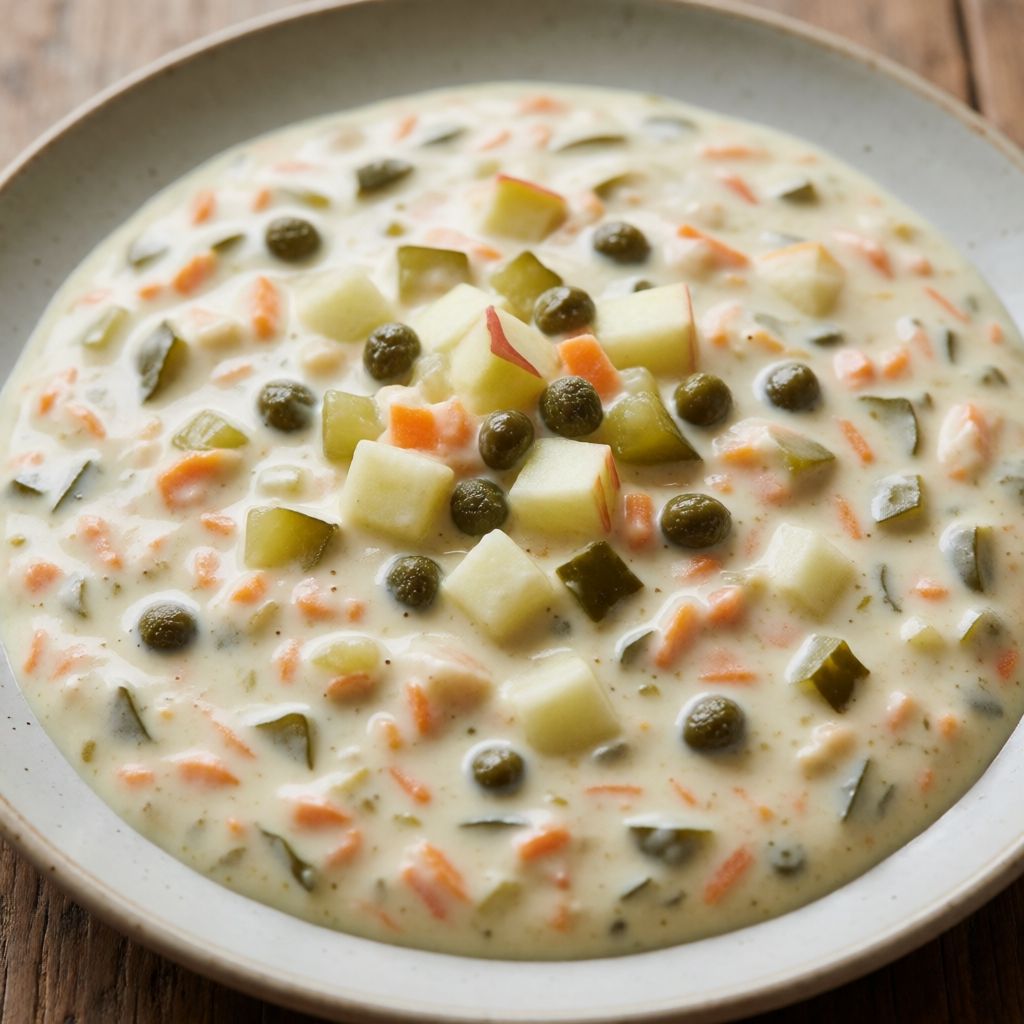
 AI photo
Cold Pickled Gherkin Sauce
A quick, no-cook sauce of pickled gherkins, apple and carrot, finished with crème fraîche and mayonnaise.
Labels are worked out automatically from the ingredients and can be wrong. Check the packaging if it matters to you.
Ingredients
- 100 ml Pickled Gherkins finely chopped
- 1 pcs Apple coarsely grated
- 1 pcs Carrot finely chopped
- 200 ml Crème Fraîche
- 2 tbsp Mayonnaise
- 25 g Capers finely chopped
- 1 tsp Sugar
- 1 tsp Turmeric
- 1 pinch Curry Powder medium hot
- 1 pinch Cumin
- Salt to taste
- Black Pepper freshly ground









Steps
Place the pickled gherkins, apple and carrot in a food processor and blitz until finely chopped. Transfer the mixture to a bowl, add the crème fraîche and mayonnaise, mix well, then stir in the spices at the end.
10 minThe recipe makes about 300 ml.
This is not a cooked sauce — it is an assembly, built cold and eaten cold, and that single fact decides everything about how you handle it. Think of it as a cousin of tartare sauce that took a detour through a British pickle jar: crème fraîche and mayonnaise for body, gherkins and capers for the sharp, briny backbone, apple and carrot to bring in sweetness and a bit of crunch so the whole thing doesn't collapse into paste.
What decides whether it works is texture, not seasoning. Blitz too long in the processor and you get a smooth, single-coloured sludge — pulse it instead, in short bursts, so you still see distinct flecks of gherkin, apple and carrot when you spoon it out. A sauce like this earns its keep on contrast: smooth cream against something that still bites back.
The second thing that decides it is salt, and here patience matters more than any timer. Gherkins and capers are already salted and vinegared from their own brining — taste the mix before you reach for the salt pot, because oversalting is the most common way to ruin this, and you cannot easily take it back out.
One myth worth naming: people see curry powder in a cold British sauce and assume it is trying to be a curry. It isn't. Curry powder here is doing what it has done in British kitchens for well over a century — working as a general-purpose spice blend, a legacy of the colonial spice trade repackaged as pantry seasoning, not a reference to any one dish. A pinch of it here is seasoning, full stop.
Go through what each ingredient is actually doing and the substitutions make themselves obvious. The gherkins must be the vinegar-pickled kind — cornichons or dill pickles — not the sweet bread-and-butter style some supermarkets sell as "pickles." The job here is sourness and salt; a sweet pickle fights the apple instead of balancing it. If you have no gherkins, a few tablespoons of chopped green olives plus a dash of pickle brine will do roughly the same job: something briny and sharp, in small pieces, is the criterion — the exact jar is not.
The apple wants to be firm and tart — a Bramley, a Granny Smith, something with bite and acid, not a soft eating apple that turns to mush under the grater. Grate it coarse, not fine, because fine shreds will dissolve into the cream and you lose the point of having it there at all. The carrot, by contrast, you chop rather than grate — finely, with a knife or a quick pulse — so it keeps its own separate crunch instead of turning into the same texture as the apple. Two textures, not one, is the actual reason the recipe tells you to treat them differently.
Crème fraîche and mayonnaise are doing two different jobs, which is why neither replaces the other outright. Crème fraîche brings tang and a looser body; mayonnaise brings cling and stability, the glossiness that makes the sauce sit on a slice of cold ham instead of running off it. If you're out of crème fraîche, a thick natural yoghurt or soured cream covers the tang-and-body role — the criterion is a soured dairy thick enough to hold a spoon upright, not a pouring consistency. Any plain, unsweetened mayonnaise stands in for the branded kind; sweet or flavoured mayo will throw off the balance you're trying to build.
The spices go in last, stirred through the finished cream, and that order is not fussy ritual — turmeric, curry powder and cumin are largely fat-soluble, meaning they need the fat already in the mayonnaise and crème fraîche to actually carry their flavour and colour through the sauce. Since nothing here gets heated to bloom them in oil, folding them into the fat at the end is the only blooming they get. Mix until the colour is even, pale yellow-green with flecks, not streaky — streaks mean the turmeric hasn't been worked through properly.
This sauce improves if you leave it to sit, covered, in the fridge for half an hour or more before you serve it — the raw carrot softens very slightly, the vinegar from the gherkins spreads into the cream, and the sugar and acid stop sitting at odds with each other and start to agree. That half hour is as much an ingredient as the capers are; don't skip it if you can help it.
Keep the bowl in the fridge once it's made and treat it the way you'd treat any mayonnaise-based sauce — cold, and eaten within a few days, not left out on the table through a long Sunday lunch. It earns its place next to cold roast beef, a glazed ham, poached or fried fish instead of tartare sauce, or spooned onto a jacket potato where its sharpness cuts through the starch.