
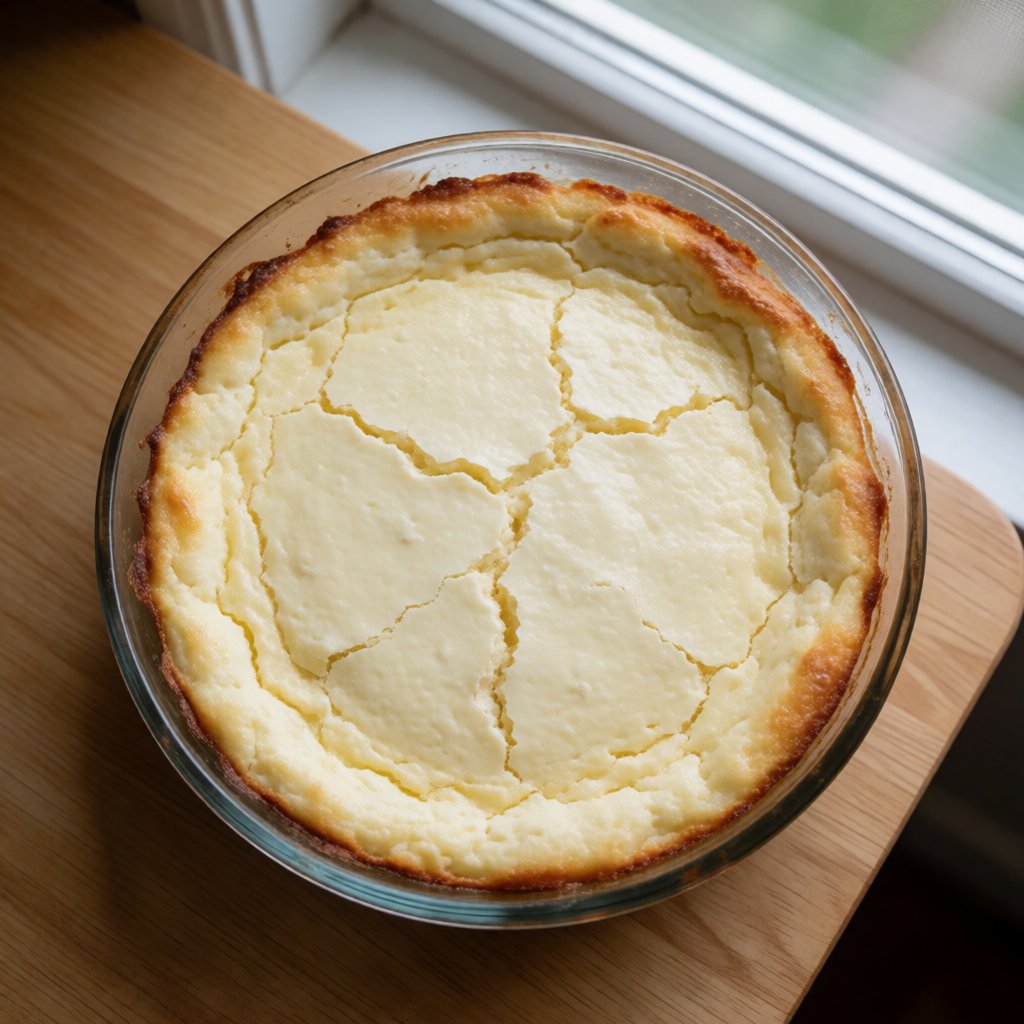
 AI photo
Baked Cottage Cheese Pudding
A simple baked curd cheese pudding, light and comforting, perfect as a quick home dessert.
Labels are worked out automatically from the ingredients and can be wrong. Check the packaging if it matters to you.
Ingredients
- 400 g curd cheese (dry cottage cheese, 5% fat) use the firmer, drier curd style sold for baking, not the loose creamy kind
- 2 pcs eggs
- 2 tbsp semolina or rice flour
- 1.5 tbsp caster sugar
- 0.25 tsp vanilla extract
- 1 tbsp sunflower oil for greasing the tin






Steps
Mix everything together until smooth, then spoon into the greased tin.
Place the tin in an oven preheated to 200°C and bake for 35 minutes, until golden on top.
35 minRemove the tin from the oven.
What was changed
Vanillin was swapped for vanilla extract, the flavouring British bakers typically use.
This is not a cheesecake, though it looks like one's poorer cousin. There is no biscuit base, no cream, no gelatin. What holds this pudding together is egg protein that sets under heat and semolina that swells and soaks up whatever water the curd still carries. That is the whole engineering of it — a dense curd custard baked hard enough to stand on a fork.
So the dish lives or dies on how much water is in your cheese before it goes near the oven. Loose, creamy cottage cheese — the kind sold in UK supermarkets as a spoonable pot for salads — carries far more whey than this recipe can absorb. Bake that, and the whey has nowhere to go but out: it pools under the pudding, the bottom turns soggy and grainy, the top sets into something closer to rubber because the surface dries out while the inside stays wet. The firmer, drier curd this recipe asks for isn't fussiness — it's the one variable you actually control.
Some say dairy desserts need a gentle oven, a water bath, coddling — because dairy "splits" under heat. No, because there's almost no free fat or cream here to split; this is mostly protein and starch, and protein wants a decisive heat to set cleanly rather than ooze. Two hundred degrees for thirty-five minutes isn't harsh for this mixture — it's what turns the top gold and firms the inside at roughly the same rate, instead of leaving you with a pale, wet-centred disc.
Take the two eggs as your actual binder, not a flavouring. Their proteins are what turn a bowl of wet curd into something sliceable — they coagulate under heat and trap the curd particles and starch in a net. Too few eggs for the amount of curd, and the net is too loose; it won't fall apart with this ratio, but it's worth knowing why eggs are non-negotiable here even though the recipe reads like they're just "mixed in."
Semolina does a quieter job: it swells as it absorbs moisture and gives the crumb some backbone without making it dense, the way plain flour would. Flour gums up when wet and baked — you'd get something closer to bread. Semolina (or rice flour, as the recipe already allows) stays granular enough to add structure without heaviness. The criterion for a substitute is simple: a fine starch that swells in liquid and has no taste of its own strong enough to compete with the curd — ground rice, fine polenta sieved finer, even a spoon of cornflour in a pinch, though cornflour sets more gel-like and less crumbly.
Caster sugar is chosen over granulated for one practical reason: smaller crystals dissolve into a thick, lumpy mixture far faster, so you don't end up biting into undissolved grit near the edges where the mix is coolest. Vanilla extract is pure flavour, doing nothing structural — swap it for a few drops of almond or a scrape of lemon zest and the pudding behaves exactly the same.
The oil is there to grease the tin, and the reason it's oil and not butter is the smoke point: butter at 200°C browns fast and can catch at the edges where the tin gets hottest first, adding a bitter note you didn't ask for. Oil with no smell of its own — sunflower, rapeseed, a neutral vegetable oil — just lets the pudding release cleanly. There's no kazan needed here and no lid trickery either: this is straightforward oven work, the kind any kitchen that's seen a Sunday roast already knows how to handle. A small cake tin or two greased ramekins for the stated two servings is enough; just mind that your oven's hot spots (most domestic ovens have one side that runs fiercer) might cook one edge gold before the other.
Historically this is a thrift dish, not a showpiece — the same logic that turns ageing bread into bread pudding turns curd that's gone a bit dry and unspreadable into something worth baking rather than wasting. That's also why it rewards patience rather than fuss: there's no technique here to master, only the discipline of waiting for the right cheese, the right gold, and the few minutes of rest before the knife goes in.
·