
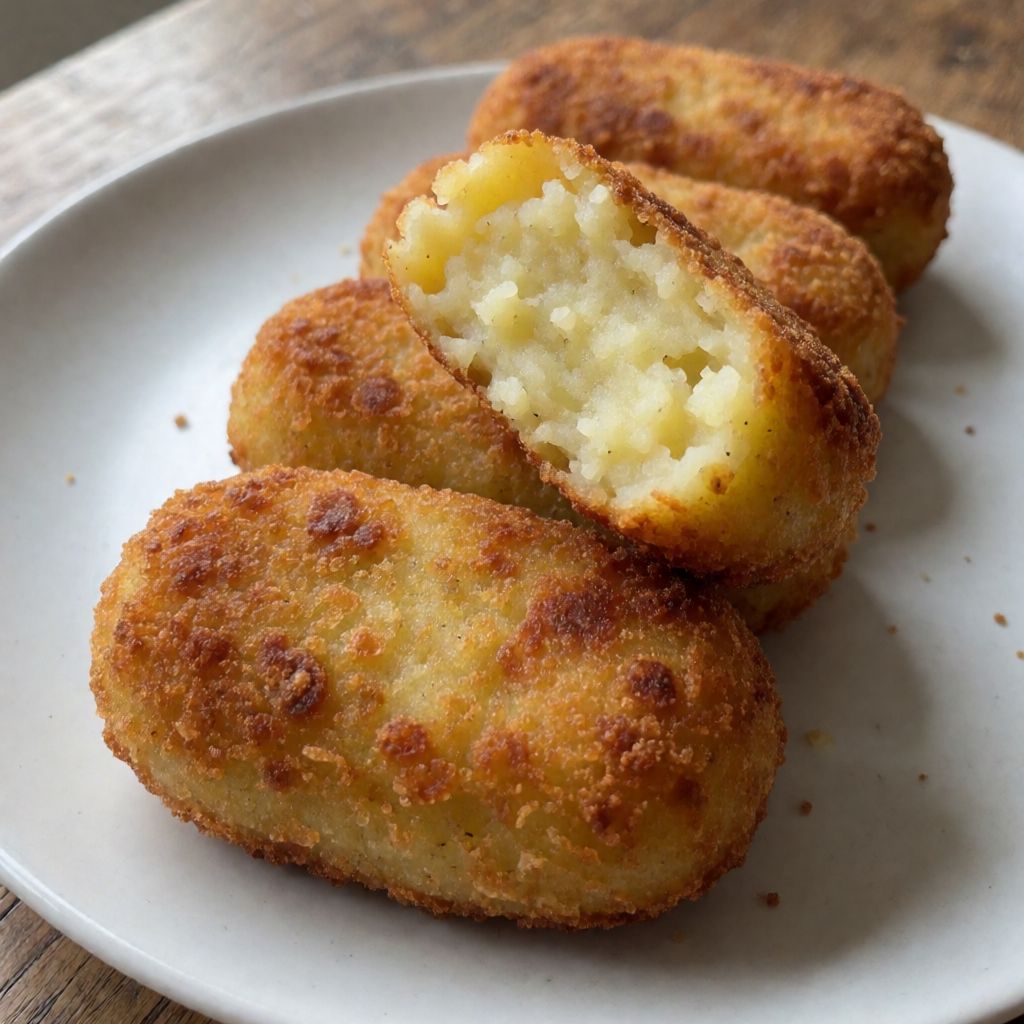
 AI photo
Crocchè — Neapolitan Potato Croquette
A large Neapolitan potato croquette, crisp outside and soft inside, filled like a sandwich with ham, provolone and lettuce.
Labels are worked out automatically from the ingredients and can be wrong. Check the packaging if it matters to you.
Ingredients
- 1 kg Potatoes
- 4 pcs Eggs
- 40 g Parmesan
- Salt to taste
- Black pepper to taste
- Plain flour as needed
- Breadcrumbs as needed, dried
- Peanut oil for deep-frying
- 200 g Ham
- 100 g Provolone
- Lettuce to taste, or tomatoes








Steps
Boil the potatoes in plenty of water for about 30 minutes from when it comes to the boil.
30 minDrain, peel the potatoes and mash them with a potato masher into a large bowl.
Once the mash has cooled slightly, add the eggs, grated Parmesan, salt and freshly ground black pepper, and mix until smooth and soft.
Shape about a quarter of the mixture into one large, smooth, even croquette by hand, then shape the rest the same way.
Coat the croquette first in flour, then in beaten egg, and finally in breadcrumbs, repeating the last two steps if you like.
Chill the croquette in the fridge for at least 1 hour so it firms up.
60 minHeat plenty of peanut oil in a tall, narrow pan, fully submerge the croquette and fry, turning, until evenly golden all over.
Lift the croquette onto a paper towel to drain, and let it cool slightly.
Cut the croquette in half lengthways and, if you like, fill it like a sandwich with ham, provolone and lettuce.
Crocchè is Naples feeding its leftover mash a second life — not a snack invented from scratch but a solution to the question "what do we do with yesterday's potatoes." It's a potato croquette the size of a large sausage roll, cased in crumb, fried until the shell is a shield, then split open and stuffed like a sandwich with ham and provolone. What decides whether it works isn't the frying — it's everything that happens before the oil ever gets hot.
The mash has to be dry. Boiled potato is mostly water held in starch cells, and if you mash it while it's wet and warm, you get glue, not dough — a mixture that won't hold a shape and weeps through the crumb coating in the fryer. Mash it, let it sit until the steam's gone and it's merely warm, then bind it with egg and Parmesan. The egg sets on contact with heat and gives you structure; the Parmesan gives salt and savour you don't have to chase with more seasoning.
Some say you shape and fry straight away — no, because the croquette needs the fridge first. An hour of cold isn't laziness built into the recipe, it's physics: cold firms the fat and starch enough that the shape survives the violence of frying — the turning, the bubbling, the first contact with hot oil that would otherwise blow a soft shape apart from inside. Skip the chill and you fry a croquette that slumps.
On the potatoes themselves: go for a starchy, floury variety — the kind that falls apart when boiled rather than holding its shape in cubes. In the UK that's Maris Piper or King Edward, not a waxy salad potato, because waxy spuds mash into something closer to wallpaper paste — low starch, high water retention, no structure. Boil them whole in their skins if you can; peeling after cooking keeps water out of the flesh, which is the whole battle here. If you've only got waxy ones, dry the mash harder over low heat before anything else goes in, to drive off the extra moisture you didn't choose to have.
Eggs do two jobs and you use them twice. Inside the mash, egg is the binder that turns loose mash into something that holds a shape under its own weight. In the coating, beaten egg is glue, not seasoning — it exists purely to make the breadcrumbs stick to the flour layer. Four eggs for a kilo of potato sounds generous until you remember some go into the mash and some go into the egg wash; don't shortcut by reusing the same bowl without noticing how much you've used where.
Parmesan is there for salt-with-flavour, not just cheese for cheese's sake — it's concentrated, dry, and doesn't add moisture the way a soft cheese would. If you're out, a hard, aged, grating cheese with a similarly sharp, salty character works — the criterion is "hard, dry, savoury," not "Italian." A soft cheese stirred into the mash will only bring back the water problem you just solved.
The filling — ham, provolone, lettuce or tomato — turns the croquette from a side dish into something you could eat standing up, which is exactly how it started life: street food in Naples, cheap and filling, a way to stretch potato and a little meat into a meal that felt substantial. Provolone melts gently from the residual heat of the just-fried croquette rather than needing any cooking of its own, so slice it thin. Any firm, mild-ish cheese that softens without turning to liquid will do if provolone isn't to hand.
Peanut oil is specified because it has a high smoke point and almost no flavour of its own, which matters enormously here — any oil with no smell of its own and a high smoke point will do, sunflower or a flavourless vegetable oil included. What you want to avoid is an oil that smokes before it's hot enough to seal the crumb fast, because that's the second cause of a greasy croquette: a crust that forms slowly lets oil seep in rather than being repelled by an instantly-crisped shell.
On the UK kitchen reality: you won't have a kazan or a deep traditional fryer, and you don't need one — a tall, narrow saucepan does the job precisely because it lets you use less oil while still fully submerging the croquette, which is the point, not the shape of the pot. Keep a plate lined with kitchen paper ready for draining, since a wire rack isn't essential — it's about letting excess oil run off, not about equipment you may not own. And give the chilling step its due: this is a dish that punishes impatience specifically at that one point, so treat the hour in the fridge as non-negotiable thinking time, not dead time.