
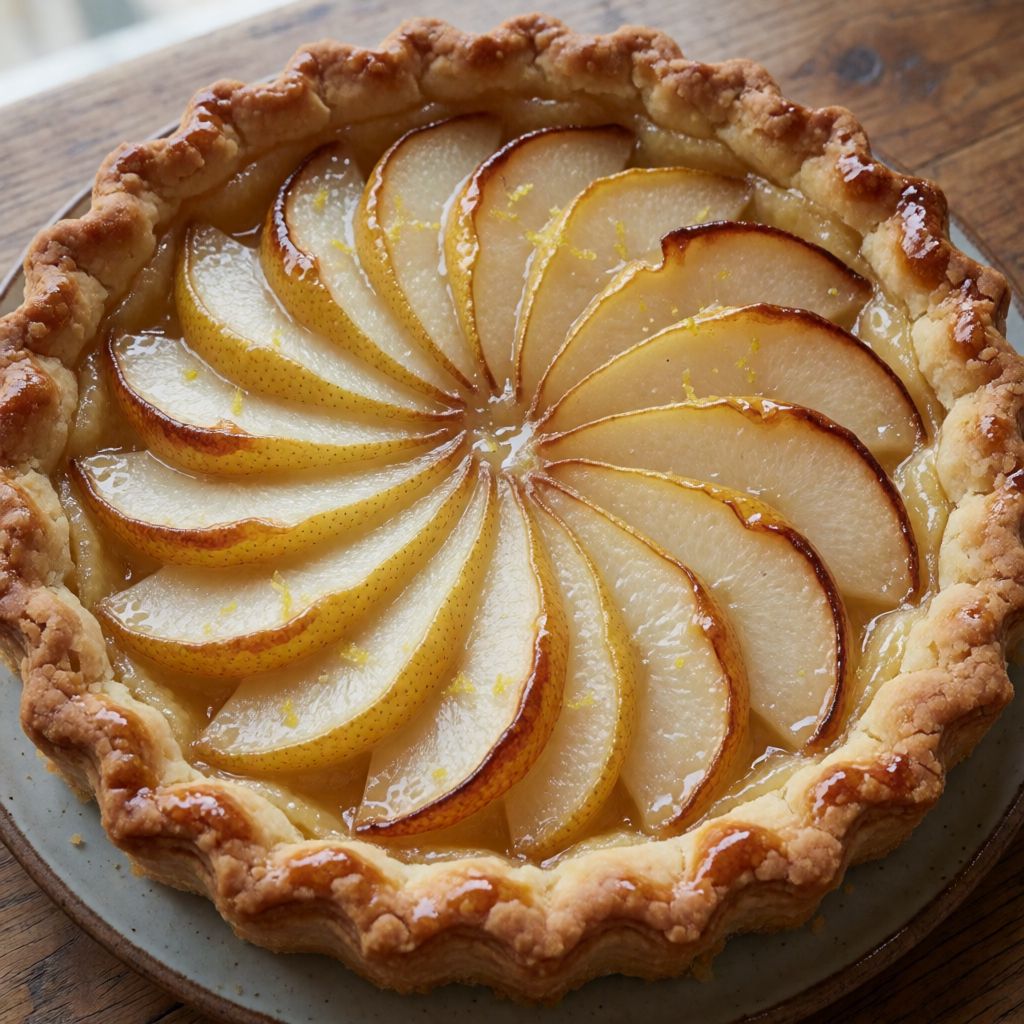
 AI photo
Pear Crostata
A classic shortcrust tart filled with jam and topped with sliced pear.
Labels are worked out automatically from the ingredients and can be wrong. Check the packaging if it matters to you.
Ingredients
- 300 g Plain flour
- 180 g Butter
- 150 g Caster sugar
- 4 pcs Egg yolk
- 1 tsp Vanilla extract
- 1 pcs Lemon zest
- 1 pinch Salt
- 250 g Jam cooked
- 3 pcs Pear
- Icing sugar to taste









Steps
Tip the flour onto the worktop in a mound, make a well in the centre and add the butter, caster sugar, egg yolks and vanilla extract. Add the lemon zest and a pinch of salt.
Work all the ingredients together until you have a smooth ball of dough.
Cover the shortcrust pastry with cling film and leave it in the fridge.
40 minRoll out the dough on a lightly floured surface with a rolling pin to a thickness of about 1/2 cm.
Butter and flour a 24 cm tin, line it with the pastry, pressing it firmly against the sides, and trim off the excess.
Prick the base of the pastry all over with a fork.
Spread the jam in an even layer.
Decorate with pear slices and dust with icing sugar.
Bake in a preheated oven at 180°C.
What was changed
Vanillin sachet was swapped for Vanilla extract, since powdered vanillin is not commonly sold in British shops.
A crostata is, structurally, just a tart that was never asked to be fancy. Shortcrust, jam, fruit on top, open-faced — Italian home baking, not patisserie. The whole thing stands or falls on the pastry: pasta frolla, the butter-and-egg-yolk dough, has to be short, meaning it crumbles rather than snaps, and that depends on how little you work it and how cold it stays before it meets the oven.
What decides success here is the fridge rest. Forty minutes is a lower bound, not a target to race. The gluten you developed by pushing flour and butter together on the worktop needs that time to relax, and the butter needs it to firm back up — otherwise the dough shrinks and slumps as it bakes, and you get a tart with no walls. Some say you can skip the rest if you're in a hurry — no, because warm dough stretched into a tin springs back the second it hits heat, and you lose the shape you just built.
No lid, no kazan logic here, just a tin and an oven you trust. "Preheated oven at 180°C" is doing real work: you want the base to set and the butter to melt into the flour fast, before the jam underneath has a chance to seep through and make the base soggy. That's also why the base gets pricked with a fork — tiny vents so steam escapes instead of ballooning the pastry up away from the tin.
The pears on top are decoration with a job: they shed moisture as they bake, and jam underneath is there partly as a barrier so that moisture doesn't turn your crust to paste. Dust with icing sugar at the end — not before baking, or it just melts into syrup and does nothing for the look.
Flour: plain, nothing stronger. This isn't bread, you don't want gluten strength — a high-protein flour makes the crust tough and chewy instead of short. If you only have self-raising, it will still work but the base puffs slightly and loses some crispness; not a disaster, just not the same.
Butter: cold, and the reason you mound the flour and work from the centre is to keep the butter coated in flour as long as possible, so it stays in cool little pieces rather than warming into a greasy smear under your palms. Any fat with a clean, neutral set like this will do in theory, but butter also brings flavour the dough needs — this isn't a case for "any fat with no smell of its own," because here the smell is the point.
Egg yolks, no whites: whites bring water and protein that would toughen the dough and make it elastic instead of short. Four yolks for 300 g flour is a rich ratio — this pastry is closer to a biscuit than to a pie crust, which is exactly why you can press it into the tin with your fingers rather than fighting it with a rolling pin at every edge.
Caster sugar, not icing sugar, in the dough: caster still has enough grain to help the butter aerate slightly as you work it, and dissolves cleanly without the cornflour that icing sugar often carries, which would dull the shortness.
Lemon zest and vanilla are there to cut the flatness of butter and sugar — not a decoration, a correction. Leave the zest off and the pastry tastes one-note sweet; leave it on and the sugar tastes brighter without being more sugar.
Jam: cooked, meaning set and thick, not a runny one — a loose jam will boil, bubble up over the pear slices, and burn at the edges before the pastry's done. Any firm-set fruit preserve works; apricot is the classic pairing with pear because its sharpness balances the pear's blandness, but use what's dense enough to stay put.
Pears: ripe but still firm enough to hold a slice — a pear that's gone soft collapses into mush in the oven and leaks water you don't want near your crust. If pears aren't good that week, apples cut thin do the same structural job; they're firmer and more forgiving if you're new to this.
A 24 cm tin feeds eight only in the Italian sense of "a slice with coffee," not a British dessert-course slice — plan smaller wedges, or stretch the dough slightly thinner and call it ten.