
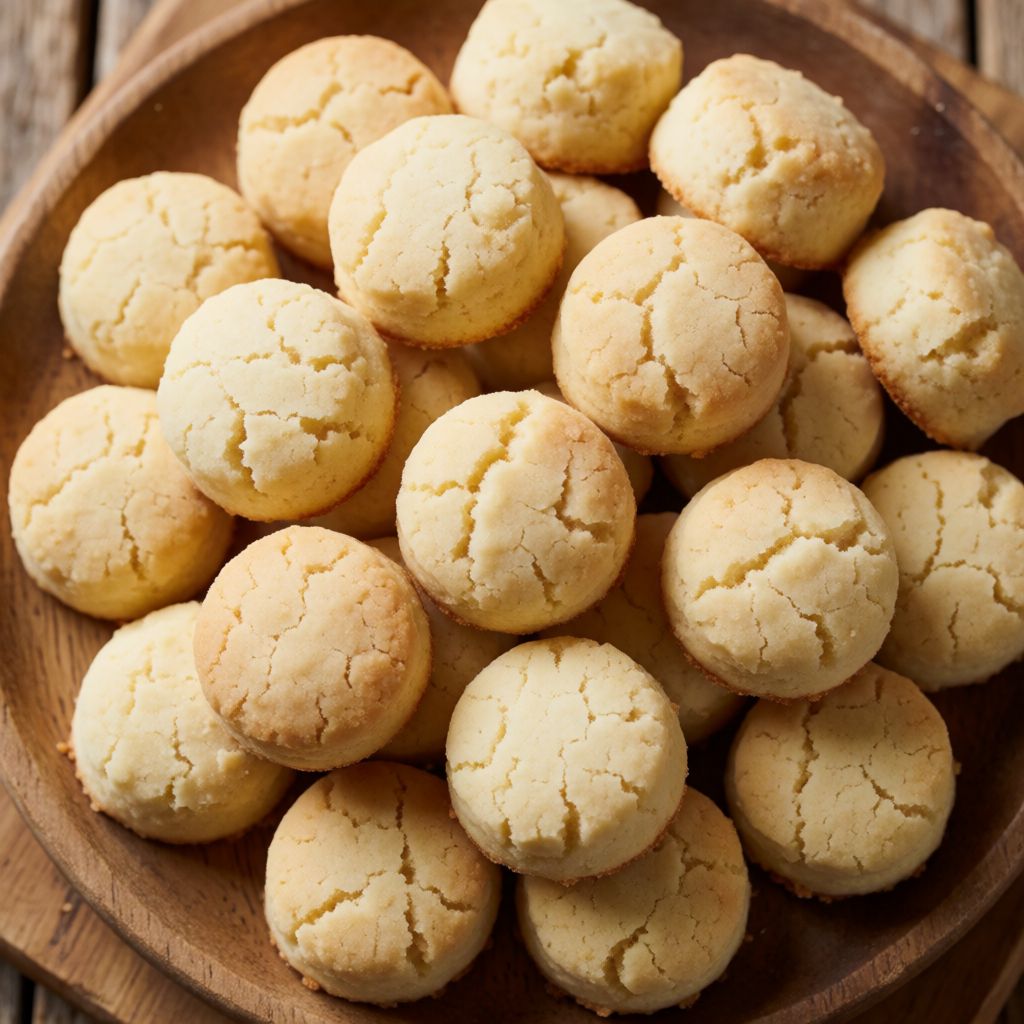
 AI photo
Pebernødder (Danish Spiced Biscuits)
Little Danish spiced biscuits flavoured with ginger, cinnamon, black pepper, cardamom and orange zest, perfect for the festive season.
Labels are worked out automatically from the ingredients and can be wrong. Check the packaging if it matters to you.
Ingredients
- 125 g Butter at room temperature
- 125 g Caster sugar
- 50 ml Whipping cream
- 250 g Plain flour
- 1 tsp Baking powder
- 0.5 tsp Ground ginger
- 0.5 tsp Ground cinnamon
- 0.5 tsp Black pepper freshly ground
- 0.5 tsp Ground cardamom
- 0.5 pcs Orange organic, zested
- 1 tsp Orange zest finely grated











Steps
Quickly beat the butter with the sugar, then pour in the whipping cream and mix.
2 minIn a separate bowl, combine the dry ingredients with the grated orange zest, then fold into the wet mixture.
1 minQuickly knead the dough, just until it becomes firm and easy to shape.
1 minRoll the dough into long sausages and cut into small pieces about 1×1 cm.
Roll into small round balls and place them on a baking tray lined with baking paper, spaced slightly apart.
3 minBake at 180°C in a fan oven for 7-10 minutes, until the edges turn lightly golden. Let cool on a wire rack.
9 min
What was changed
The oven temperature was rounded to suit the dial increments on UK ovens.
Pebernødder are not a cookie you eat one of. They're the kind you eat by the handful out of a tin while the tea goes cold — little hard spiced nuggets the size of a dice, which Danish children traditionally thread onto a string before anyone's allowed to eat them at Christmas. The name says pepper, and that's the first thing people get wrong.
Some say the dish should taste of pepper — no, because half a teaspoon in a batch that fills a jar barely registers as heat. Pepper was once the status spice, the one that cost a sailor's wage per sack, brought up through Hamburg and Lübeck by the Hanseatic traders. Any spiced biscuit in that world got called 'pepper' something, the way we still say 'china' for a plate that's never seen Jingdezhen. The flavour here comes from the cardamom and the orange oil sitting on top — the pepper is a label, not a seasoning you're meant to taste.
What decides whether these work is not the spice mix, it's size and heat. Cut them small and roll them even, because a tray of mismatched balls bakes into some biscuits burnt at the edge while others are still pale and soft in the middle — small mass, short bake, no room for error in uniformity. And doneness here is a colour at the rim, not a clock: when the edge turns from butter-pale to light gold and the centre stays a shade lighter, that's the moment, because the biscuit keeps firming up off the heat, on a rack, as it cools. Pull it when it already looks fully done and you'll bite stone by the time it's cold.
Beat the butter and sugar quickly, not long — this isn't a sponge you're trying to lighten with air, it's a dense little biscuit that needs to hold its round shape in the oven, not spread. Two minutes is enough to marry the sugar crystals with the fat; any longer and you're whipping air in that the dough doesn't need, and air pockets in a 1 cm ball don't do good things to it. Butter at room temperature means you can press a dent in it with a finger — too cold and it won't combine, and leaves grit of unmelted fat that shows up later as spots in the baked biscuit.
The cream does the job an egg usually does in this kind of continental biscuit: it binds without loosening the dough, without making it elastic. An egg would add protein that toughens as it bakes; cream just adds fat and a little water, keeping the crumb short. Any cream with enough fat will do the same job — double cream, or in a pinch full-fat milk with an extra knob of butter worked in, though the dough is then slightly less forgiving to shape.
Fold the dry ingredients in and stop. The kneading here is misleadingly named — you're not developing gluten, you're just bringing a dough together until it's firm enough to roll into ropes without sticking to your palms. Some say more kneading makes dough easier to shape — no, because the more you work wheat flour, the more gluten strands form, and gluten shrinks dough back when you try to roll it round, fighting you at every ball you shape. A minute, by hand, is the ceiling here, not the floor.
Ginger, cinnamon, cardamom, pepper — this is the standing Nordic Christmas spice kit, the same one that turns up in Swedish pepparkakor and German Lebkuchen, all descended from the same trade routes and the same reason: spices kept, and a cook with a stocked spice box used it up around the one feast of the year that called for showing off. Grind your own pepper if you can — pre-ground loses its sharper aromatic oils within weeks and leaves flat heat with no scent, which defeats the point of putting it in at all. The orange zest cuts through all that warmth with something sharp and cold-weather-fresh — use organic or unwaxed fruit, because you're eating the skin, not just squeezing the juice out of it; a waxed, sprayed peel brings its coating straight into the dough with it. No orange on hand — lemon zest works on the same logic, something citrus and sharp, though the result tilts brighter and less festive.
A fan oven suits this better than a conventional one — small biscuits crowded on one tray need even heat moving around them, or the ones near the back colour before the front ones do. Line the tray with paper, not out of ritual, but because the sugar in the dough catches on bare metal at this heat, and scraping burnt sugar off a tray is worse than washing paper into the bin. Space the balls apart — they barely spread, but crowding traps steam between them and you get pale, slightly damp sides instead of an even colour all round.
The rack after baking isn't decoration. Set hot biscuits flat on a tray and the steam from the bottom has nowhere to go, so they sit in their own damp and soften unevenly; on a rack, air gets underneath, and that's what lets them finish crisp instead of turning leathery as they sit. The hundred in the yield isn't a hundred portions — it's a hundred biscuits the size of a sugar cube, enough to fill a tin and feed a tea table of four or five people across several sittings, the way they're actually eaten in Denmark, not in one go. And the real patience in this recipe isn't in the oven, which only runs about nine minutes — it's in rolling a hundred even little balls by hand before any of it goes in.