
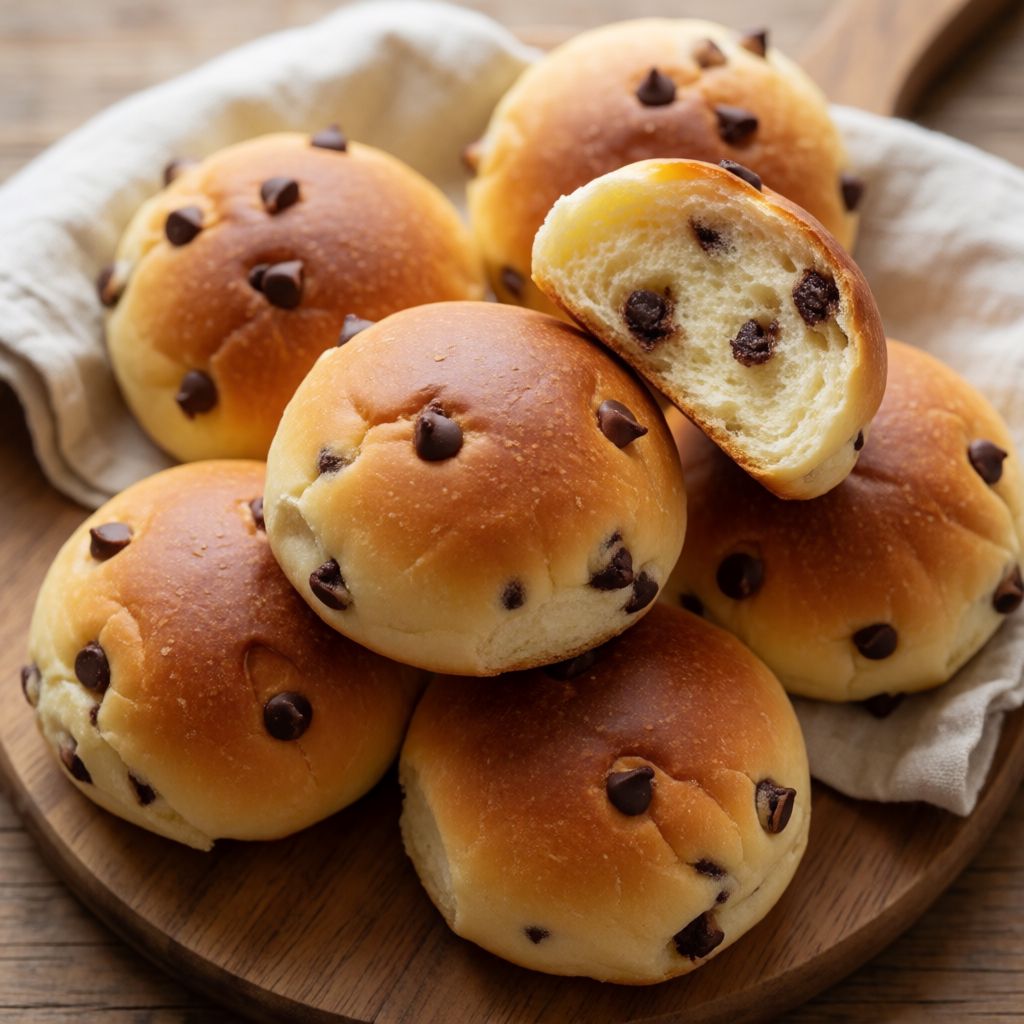
 AI photo
Homemade Chocolate Chip Buns
Soft homemade buns studded with chocolate chips, enriched with butter, milk and vanilla.
Labels are worked out automatically from the ingredients and can be wrong. Check the packaging if it matters to you.
Ingredients
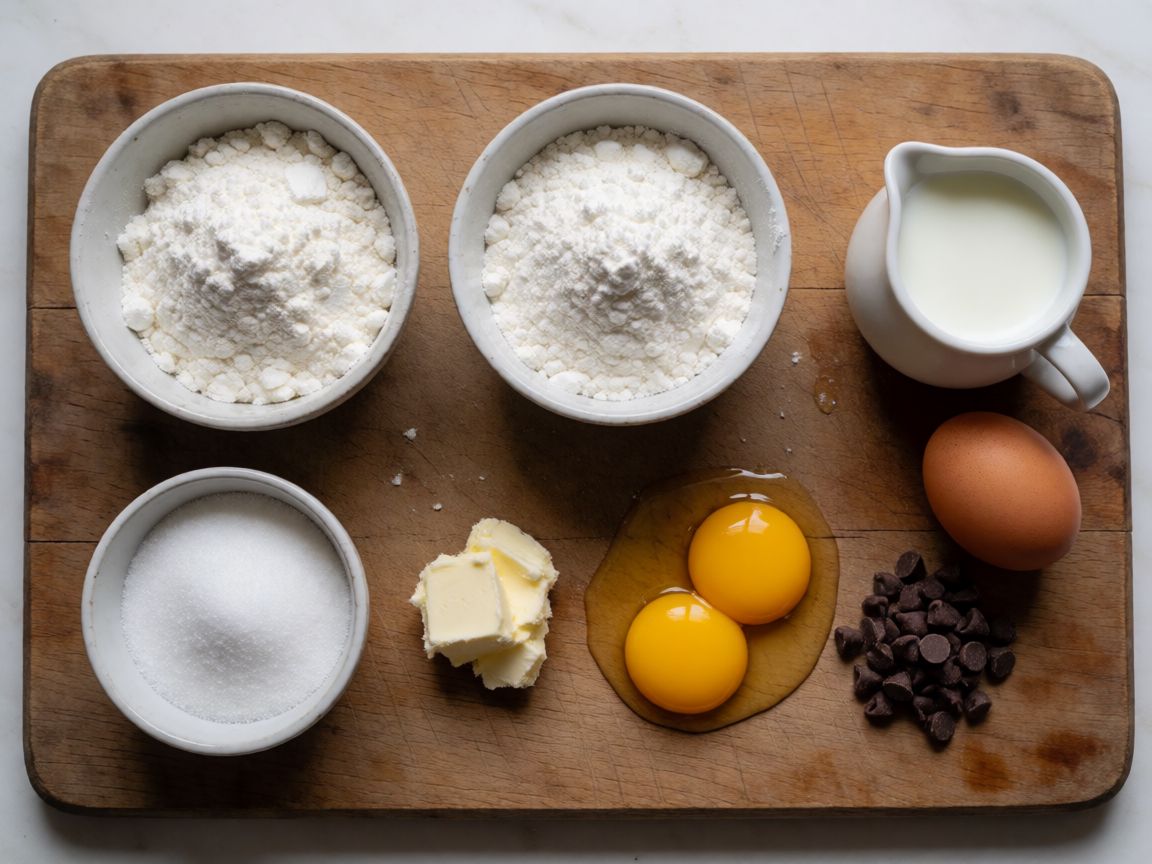
- 300 g Strong flour or Manitoba flour
- 200 g Plain flour
- 120 g Caster sugar
- 80 g Butter
- 225 ml Milk
- 1 pcs Eggs
- 2 pcs Egg yolks
- 140 g Chocolate chips
- 7 g Dried yeast dried
- 1 tsp Salt
- 1 tsp Honey
- 0.5 pcs Vanilla pod






Steps
Put the chocolate chips in a bowl, cover with cling film and place in the freezer.
Sift the strong flour and plain flour, mix with a spoon and add the dried yeast.
Add the sugar, egg and egg yolk, and start mixing the dough in a stand mixer with the paddle attachment.
Split the vanilla pod lengthways, scrape out the seeds and add them to the dough.
Pour in the milk in a thin stream and add the honey, then switch to the dough hook attachment.
Gradually add the butter, cut into small pieces, continuing to knead.
Add the salt and knead the dough until smooth and even.
Transfer the dough to a bowl, cover with a tea towel and leave to rise in a warm place.
180 minAdd the chilled chocolate chips to the dough, which should have doubled in size.
Knead the dough on a work surface and divide into 20 buns.
Place the buns on a baking tray lined with parchment, cover with a tea towel and leave to rise.
60 minBrush the buns with a mixture of milk and egg yolk.
Bake the buns in an oven preheated to 180°C.
15 minCheck they are done using a wooden skewer, then remove the buns.
What you're making here is an enriched dough — bread that's been bribed with butter, egg and sugar until it stops behaving like bread and starts behaving like cake that can still hold its shape. That bribery is the whole story. Flour and water alone give you chew; add fat and egg yolk and you get something soft, almost sliceable, that tears in strands rather than crumbs. The two flours are doing a job too — strong flour brings the gluten that gives the dough a skeleton, plain flour softens that skeleton down so the bun stays tender rather than going chewy like a bread roll. Get that balance wrong — all strong flour — and you've made a slightly sweet dinner roll, not a bun.
What decides whether this works isn't the oven, it's the first rise. Three hours is not a fussy, decorative number — enriched dough is heavy with fat and sugar, both of which slow the yeast down, so it simply needs longer than a plain loaf to double. Some say you can rush this with a hotter spot or more yeast — no, because fast fermentation on a rich dough gives you a tight, dense crumb with a boozy, yeasty edge to the taste; the dough hasn't had time to develop flavour, only to inflate.
On the flours: strong flour (sometimes sold as Canadian or "bread" flour, Manitoba is the posher cousin) has more protein, which means more gluten, which means structure. Plain flour has less, and dilutes that structure. If you've only got one flour in the cupboard, use strong and accept a slightly chewier bun — that's the honest trade-off, not a ruined recipe. Going the other way, all plain flour, risks a dough too slack to hold the chips in place.
The yeast is dried, and the honey in the dough isn't there for flavour you'll ever taste — it's food. A teaspoon of sugar does the same job: it feeds the yeast fast at the start so fermentation gets going, while the much larger 120g of caster sugar in the dough itself is mostly working against the yeast, slowing it, which is exactly why this needs a long first rise and not a short hot one.
Butter goes in gradually, in small pieces, after the gluten's already started forming with the dough hook — not before. Fat coats flour and blocks gluten strands from linking up, so if you dump it in too early you get a dough that never develops any chew at all, just a soft mush that won't hold air. Added bit by bit once there's already some structure, the butter works its way in without strangling the gluten completely — you still want some backbone left, just a tender one. The egg and two extra yolks are doing something similar but gentler: whole egg for structure and a bit of lift, the extra yolks purely for fat and colour, which is why the crumb of a good enriched bun looks faintly yellow, not white.
Salt goes in last, after the sugar and fat are already incorporated, for a practical reason: salt tightens gluten and can slow yeast activity if it meets the flour too early and in the wrong order, so holding it back until the dough's mostly together avoids fighting the yeast on two fronts at once. It's a small thing, but in a dough already handicapped by sugar and fat, every bit of sequencing matters.
The vanilla pod is a nicety, not a must — scrape the seeds in if you have the pod, and if you don't, a teaspoon of vanilla extract does the job; it's flavour, not chemistry, so nothing here depends on it structurally.
On your hob and oven at home: you won't have a proving drawer, so "a warm place" means somewhere draughtless and a bit above room temperature — near a radiator, inside a switched-off oven with just the bulb on, or on top of the fridge where the motor runs warm. Don't put it in a hot airing cupboard thinking faster is better; see above about rushed proves giving you dense, yeasty buns. The tea towel over the bowl isn't tradition for its own sake, it's just stopping the surface of the dough drying out and forming a skin that then tears and scars the crust once it's baked — cling film loosely draped does the same job if that's what's in your drawer.
For doneness, the oven thermometer and the fifteen minutes are a starting point, not a verdict — ovens run hot or cold by 10-15 degrees without telling you, so check with a skewer through the centre of a bun: it should come out clean, no wet dough clinging to it. If it's still tacky at fifteen minutes, give it more, in short bursts, checking each time — better that than cutting one open at the table to find a raw middle. And once they're out, leave them to sit a few minutes before anyone touches one; straight from the oven the crumb is still setting, and a bun torn too early just collapses in your hand instead of pulling apart in strands.