
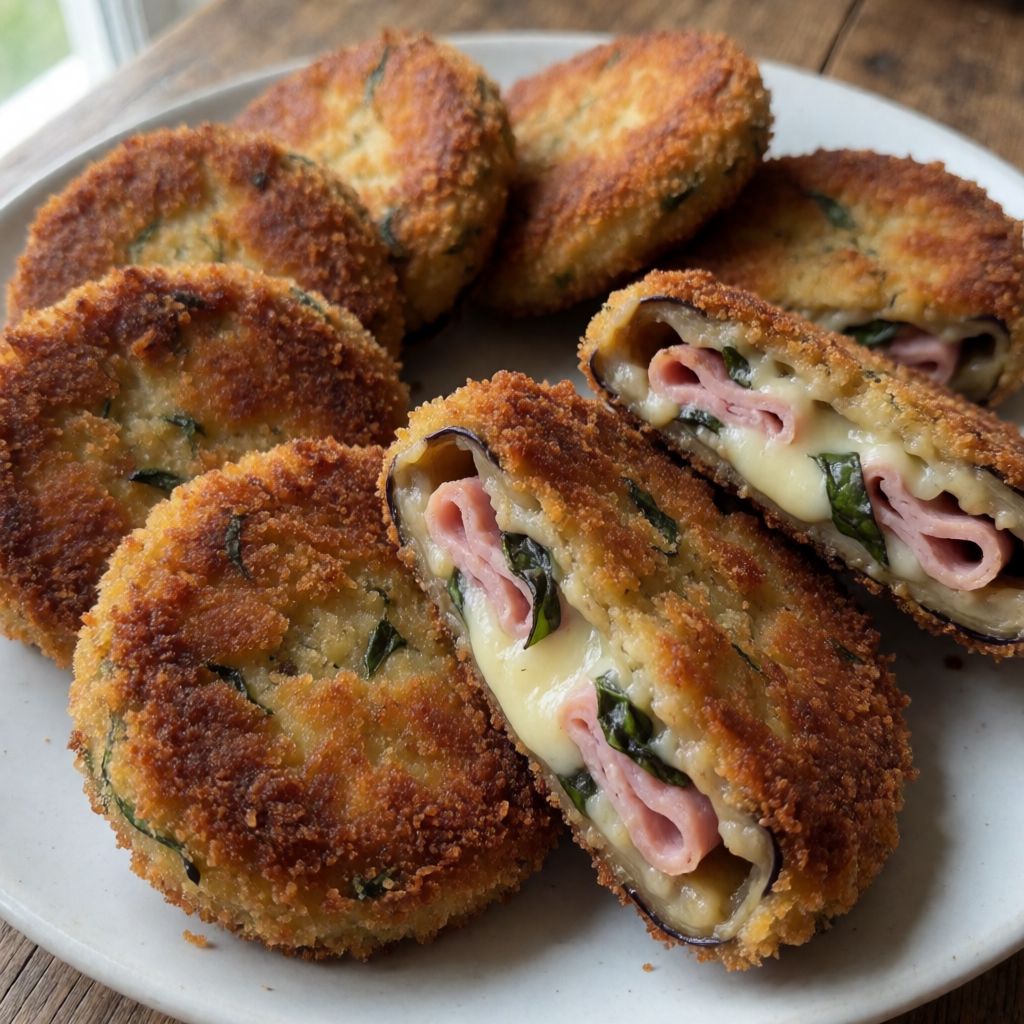
 AI photo
Aubergine Cutlets Stuffed with Ham and Cheese
Tender aubergine slices filled with ham, melting cheese and basil, then coated and cooked until golden.
Labels are worked out automatically from the ingredients and can be wrong. Check the packaging if it matters to you.
Ingredients
- 1 pcs Aubergine
- 100 g Ham
- 100 g Provolone
- 1 bunch Basil
- Salt to taste
- Black pepper to taste
- 2 pcs Eggs
- Plain flour to taste
- Breadcrumbs to taste
- Peanut oil to taste
- Olive oil to taste








Steps
Wash and dry the aubergine. Cut it crosswise into slices 4-5 mm thick.
Pair up the slices and fill each pair with ham, provolone and a basil leaf. Cover with the second aubergine slice.
Season with salt and black pepper to taste.
Coat each cutlet first in flour, then in beaten egg, and finally in breadcrumbs.
To bake, place the cutlets on a baking tray and drizzle with olive oil. Bake at 180°C until golden.
20 minAlternatively, heat peanut oil in a frying pan and fry the cutlets on both sides until golden.
Place the cooked cutlets on a paper towel, salt to taste and serve hot.
This is a schnitzel wearing an aubergine instead of veal — two slices of vegetable sandwiching ham and cheese, breaded and fried or baked until the crust sets. What decides whether it works isn't the filling, it's the thickness of the slice. Cut it thinner than 4-5mm and it collapses into mush before the cheese melts; thicker, and the middle stays raw and bitter while the crust burns. The slice has to be thick enough to hold its own weight once it's soft, and that's a mechanical fact, not a taste preference.
The breading does one job: it's a barrier. Aubergine is mostly water held in a loose sponge of flesh, and once heat hits it, that water wants out, straight into your frying oil, where it spits and turns everything greasy and sad. Flour first seals the surface, egg glues the crumb on, crumb insulates the surface so the heat cooks rather than steams. Skip a layer and you don't get a lighter dish, you get a wetter one.
Some say aubergine must be salted and left to weep for an hour before cooking, to pull out bitterness. No — that bitterness lived in old, overripe aubergines with big loose seeds. The ones sold now, firm and glossy, barely carry it. What salting really does here is dry the surface a little, which helps the flour stick. If your aubergine is young and firm, skip the wait; pat it dry instead and move on.
Choose the aubergine for size, not variety: you want one wide enough that a slice gives you a decent-sized cutlet, about 7-8cm across, so the filling doesn't just spill out the sides. Skin on is fine — it holds the slice together once it softens, which matters more than you'd think, since a skinless slice tends to fold in on itself in the pan.
Ham here isn't flavour, it's a salty buffer layer between the aubergine and the cheese, stopping the two from fusing into a single soggy mass. Any thin sliced cooked ham works; a smoked one adds something, but it's not required. Provolone is chosen for how it melts — stretchy, not watery — so if you can't get it, go for something in the same family: a young, firm melting cheese, not a crumbly or very wet one, which will just leak out under heat. Mozzarella works if you pat it dry first; feta or ricotta will not, they'll turn the filling into soup.
Basil is doing the one thing a filling this rich needs — a green, sharp note cutting through the fat of cheese and ham and frying oil. If you've no basil, use something with a similarly clean bite — parsley even, though it's blunter — rather than skip it, because without it the dish tastes heavy in a single flat direction.
Flour, egg, breadcrumbs — the classic three-stage coat, and the order matters because each stage exists to let the next one stick. Flour alone won't hold egg; egg alone drips off instead of gripping crumb. Use plain flour, nothing self-raising — you're not after lift, you're after a dry film. For the crumb, dry breadcrumbs crisp better than fresh, which steam before they brown; if you only have fresh bread, dry it in a low oven first rather than use it damp.
Peanut oil for frying is chosen for one real reason: it tolerates higher heat before it smokes and turns bitter, which matters in a British kitchen where you're frying on a hob that runs hotter than it looks, in a flat with no extractor doing you favours. Any neutral oil with a high smoke point and no character of its own will do — sunflower, rapeseed — just not olive oil for the frying pan, it burns too soon and tastes of it. Olive oil earns its place only in the baking version, drizzled cold, where it's there for flavour, not heat tolerance — a different job entirely.
Have a plate lined with paper towels or napkins ready before you fry, not after — the crust is at its most fragile straight out of the oil, and letting it sit on a wire rack or just blot briefly stops it going soggy from its own trapped steam. That minute of patience, between pan and plate, is the difference between a crisp cutlet and a tired one.