
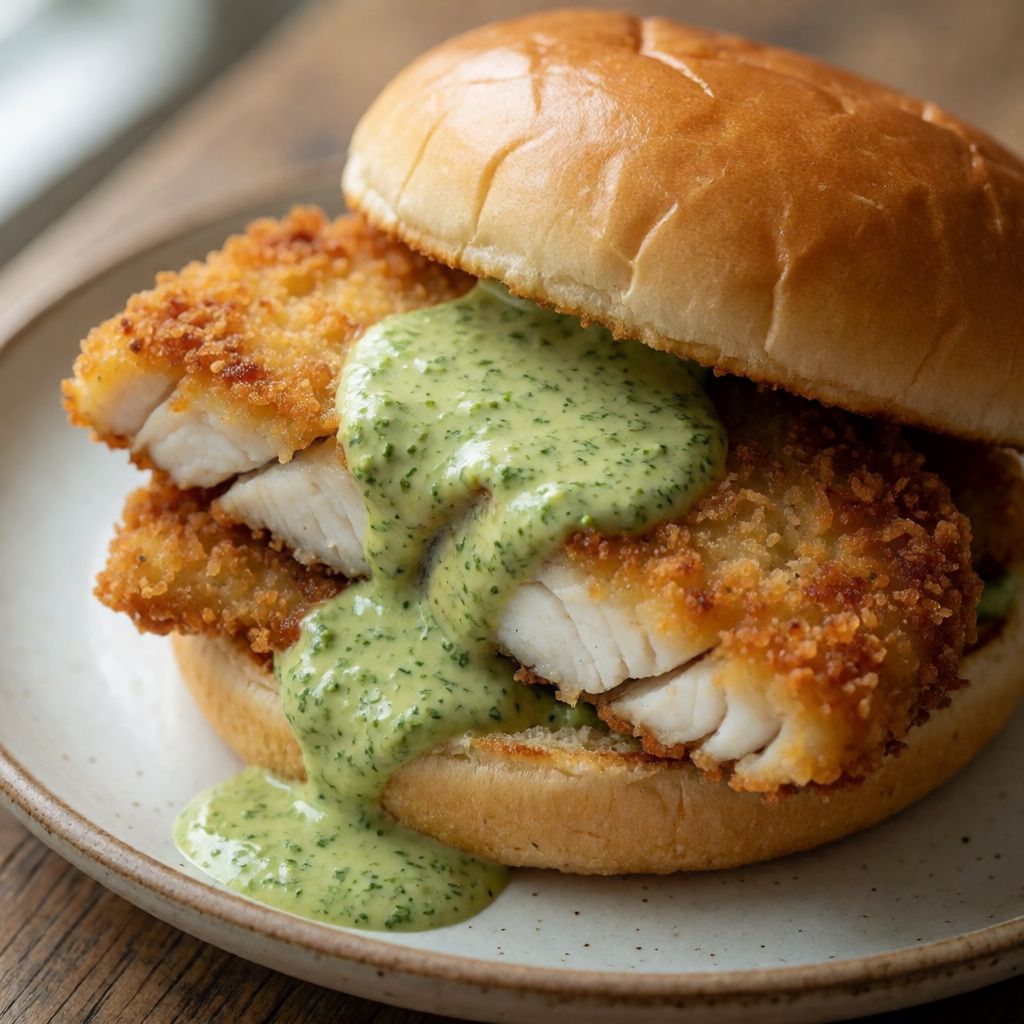
 AI photo
Fish Burgers with Green Sauce
Crispy fillet, prawns and a herby green sauce piled into a bun for a fresh, easy fish burger.
Labels are worked out automatically from the ingredients and can be wrong. Check the packaging if it matters to you.
Ingredients
- 4 pcs Plaice or lemon sole fillets or another flatfish
- 2 tbsp Plain flour
- Salt
- Black pepper freshly ground
- 100 ml Breadcrumbs dried
- 1 pcs Lemon finely grated zest
- 1 tbsp Dill finely chopped, fresh
- 1 pcs Egg beaten
- 1 tbsp Butter for frying
- 1 tbsp Olive oil for frying
- 100 g Prawns
- 2 bunch Lettuce leaves
- 1 pcs Lemon cut into wedges
- 8 pcs Cucumber slices
- 4 pcs Burger bun












For the sauce
- 150 ml Crème fraîche full-fat
- 2 tbsp Mayonnaise
- 200 ml Fresh herbs finely chopped (dill, parsley, chives, thyme)
- to taste Lemon zest to taste




Steps
Rinse the fish fillets and pat dry with paper towel. In a bowl, mix the breadcrumbs, dill, lemon zest, salt and pepper. Coat the fillets first in a little flour, then dip in the beaten egg, then coat in the breadcrumb mixture.
Fry the fillets on both sides for 5-7 minutes in a hot pan with butter and olive oil until golden and crisp.
7 minMix the crème fraîche with the mayonnaise until light and smooth. Add the chopped herbs and mix well. Season to taste with lemon zest, salt and pepper.
Assemble the burger: place the fish fillet in the burger bun, add cucumber slices, lettuce, prawns, a little fresh dill and a generous spoonful of green sauce.
Forget "burger" meaning beef. This is a flat white fish fillet, breaded and fried, propped in a bun with prawns, cucumber and a herb-green sauce. It's a fishcake that refused to be minced — the fillet stays whole, so you taste plaice, not filler.
What decides it: the crumb coat going on properly, and the pan being hot enough to set it fast. Flour first, not breadcrumbs straight onto wet fish — flour is the glue that gives the egg something to grip, egg is the glue that gives the crumbs something to grip. Skip a layer and the crust slides off in the pan, and you're left scraping burnt crumbs while the fish underneath is still pale. Dry fish, dry hands, dry fillet before any of this starts — wet fish steams its own coating soft.
The second thing is restraint with the fish itself. Plaice and lemon sole are thin, delicate fillets — a few millimetres of flesh over bone. They cook in minutes, not because a recipe says so, but because there's so little of them. The tell isn't a clock, it's the flesh: it goes from translucent grey to opaque white, and the crust goes from pale gold to the gold of an old wedding ring. Push past that and the thin fillet turns dry and stringy — overcooking isn't a risk here, it's the default failure, because you're frying something closer to a leaf than a steak.
The green sauce is crème fraîche cut with mayonnaise and loaded with soft herbs — this is a cold sauce, no cooking, so it rides on whatever herbs you actually chop, not on heat.
Some say fish needs milk or buttermilk soaking before crumbing. No — that's for fish that smells, usually not fresh enough, and milk is masking, not fixing. A good fillet, patted dry, needs nothing but flour, egg, crumb.
Butter and oil together in the pan isn't fussiness, it's division of labour. Butter brings the flavour and browns at a usable temperature; oil raises butter's smoke point so it doesn't burn black before the crust is done. If you've only got oil, use it — any neutral oil with no smell of its own, sunflower, rapeseake, whatever's under your sink — but you lose a little of that nutty edge. On a domestic hob, which runs hotter and less even than a restaurant ring, watch the butter foam and go quiet, not brown and smell of nuts past that point — that's your cue the pan's ready, not a number on a dial you can't see anyway.
Breadcrumbs: dried, not fresh. Fresh crumb holds moisture and goes soft under hot fat before it browns. Dried crumb is already dehydrated, so it crisps the moment it hits heat instead of steaming first. No dried crumb in the cupboard? Stale bread, blitzed or grated, left out an hour to dry further, does the job — the criterion is "dry enough to crackle," not a brand name.
The crème fraîche and mayonnaise combination gives you fat and tang without the sauce splitting or thinning — crème fraîche alone can be sharp and loose, mayo alone is flat and heavy. Together they sit thick enough to not run out the side of the bun. The herb mix — dill, parsley, chives, thyme — is not a fixed quartet; it's "soft green herbs you have," and the only one that matters structurally is something with a bit of onion-family bite, which is what chives supply. No chives, a few rings of spring onion, very finely chopped, do the same work.
Prawns here are raw weight waste you don't want — buy them cooked and peeled, pat dry, and add them cold at assembly. They're there for sweetness and a different texture against the crisp fillet, not to be cooked again; reheating cooked prawns toughens them, so they go in at the end, untouched by the pan.
Cucumber and lettuce are the crunch and the cold — plain water content, cutting the richness of butter, mayo and crème fraîche. Don't skip them thinking they're garnish; without them the burger is all fat and no contrast, and that's the actual job a salad leaf does in any sandwich, not decoration.
The bun is the one thing I'd say choose deliberately in a UK kitchen: a soft white bun soaks the sauce and goes to paste quickly, so toast it lightly if you can, just enough that the inside face firms up and holds its shape under a wet filling — a brioche bun, slightly sturdier, survives longer on the plate while you eat.
Patience is the ingredient nobody lists: don't rush the crumbing stage by trying to do all four fillets in one pass with wet hands — do flour, then egg, then crumb, fillet by fillet, wiping your fingers between stages, or you end up with a claggy mess on your hands instead of a crust on the fish.