
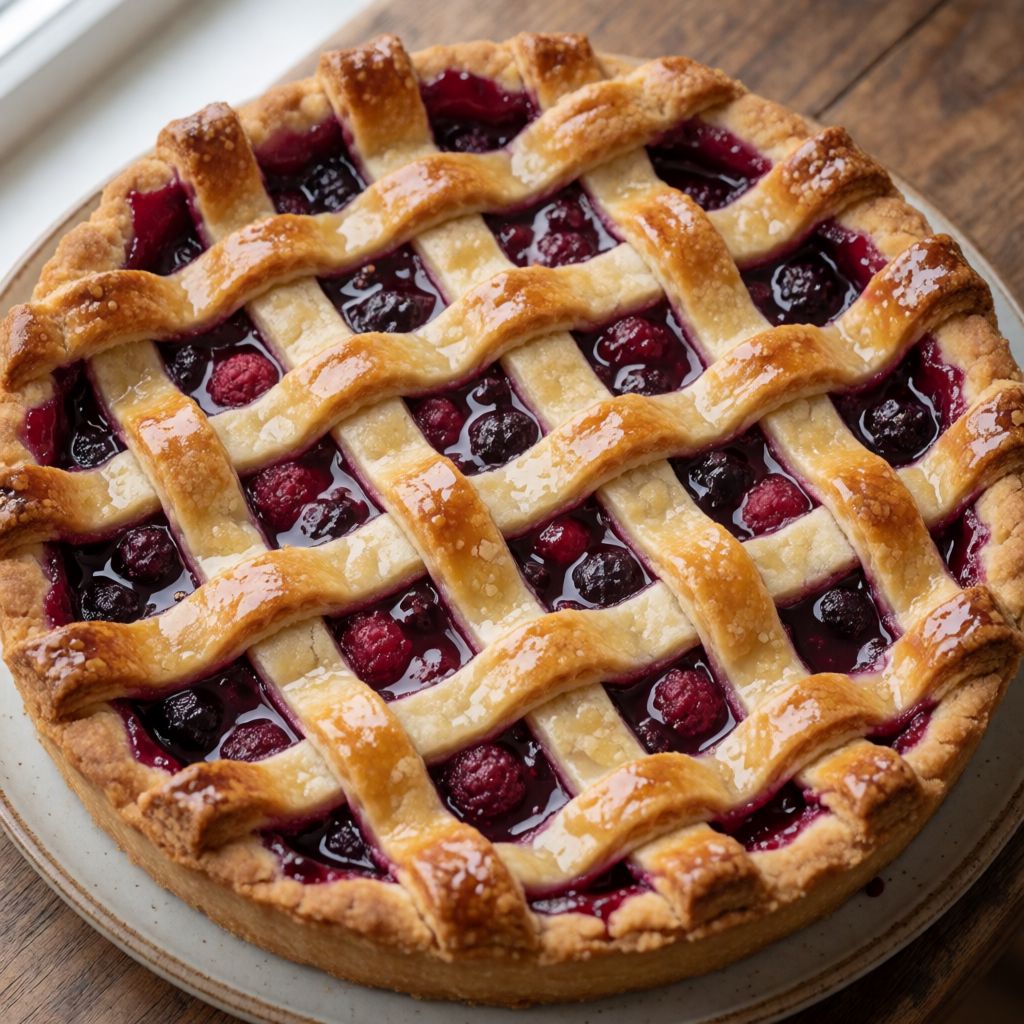
 AI photo
Mixed Berry Crostata
An Italian-style shortcrust tart filled with silky custard cream and topped with mixed berries.
Labels are worked out automatically from the ingredients and can be wrong. Check the packaging if it matters to you.
Ingredients
- 250 g Plain flour
- 100 g Butter
- 1 pcs Eggs
- 1 pcs Egg yolk
- 100 g Caster sugar
- 1 pcs Lemon zest
- 1 tsp Baking powder
- 250 ml Milk
- 2 pcs Eggs
- 75 g Caster sugar
- 1/2 pcs Lemon zest
- 20 g Cornflour
- 400 g Mixed seasonal berries
- Icing sugar to taste
- Mint a few leaves







Steps
Make the shortcrust pastry: mound the flour on a surface, add the sugar, butter cut into cubes, lemon zest, baking powder and eggs in the centre. Quickly combine the ingredients with your fingertips, then by hand, without overworking. Shape into a smooth, soft dough.
Wrap the dough in cling film and let it rest in the fridge for 30 minutes.
30 minMake the custard: in a saucepan whisk the eggs with the sugar and lemon zest, add the sifted cornflour and mix well. Pour in the milk, stirring constantly, and place over medium heat.
Keep stirring the custard until it reaches a smooth, velvety consistency, then remove from the heat.
Cover the custard with cling film, pressing it directly onto the surface, and let it cool completely.
Roll out the dough on a lightly floured surface. Transfer it to a well-buttered 24 cm tart tin.
Prick the surface with a fork, cover with a sheet of baking paper and fill with baking beans for blind baking.
Bake the base in a preheated oven at 175°C for about 20 minutes with fan assistance, or at 180°C for 20–25 minutes conventional.
23 minRemove the tin from the oven and let the base cool completely.
Once the base has cooled, fill it with the custard, spreading evenly using a piping bag or a spoon.
Top with washed and dried mixed berries. Finish by dusting with icing sugar and a few fresh mint leaves.
A crostata is really two separate acts of cooking stuck together at the last minute: a shortbread shell baked to a dry crunch, and a custard cooked on the hob to a wobbly set. Nothing about it is fried, folded or fussed over — it's a tart in the plainest sense, the kind Italian nonnas made because eggs, flour, milk and a bit of sugar were always in the house. What decides whether it works isn't the berries on top, which are decoration and acid, it's whether the base stays crisp under a wet filling and whether the custard is thick enough to hold still when you cut a slice.
The pastry here is pasta frolla, not puff and not shortcrust in the English sense — more fat and yolk than a British shortcrust, held together by just enough flour. Some say pastry needs a cold room and marble worktop to work — no, because the thing that actually matters is the butter staying solid, not the air temperature. If your kitchen's warm, work fast and chill the dough before it goes soft and the butter starts to melt into the flour rather than sit in it as flakes — that's what gives shatter instead of toughness.
Flour is just structure here — a plain flour, nothing strong or "00" needed, because you're not building gluten, you're barely tolerating it. Overwork this dough and the gluten tightens, and a tight dough shrinks and goes hard in the oven instead of staying short and sandy. That's the whole reason the recipe tells you fingertips first, then hand, briefly: warm hands and a long knead are the enemy, not the friend, of a crisp base.
Butter wants to be cold and cubed so it stays in distinct pieces through the mixing, each one melting in the oven and leaving a gap behind — that's what "short" actually means, fat blocking gluten strands from linking up into something chewy. Any firm, unsalted fat with a clean taste will do this job; a Mediterranean cook reaches for butter because dairy cattle and butter-making were local economy, not because butter has some monopoly on shortness. Margarine will get you a passable crumb and a worse flavour; it's a fallback, not an upgrade.
The egg and extra yolk in the dough are fat and binding, not leavening — the little baking powder is doing the lifting, just enough to stop the base baking into a biscuit. Lemon zest in both the pastry and the custard isn't flavour layered on top, it's there to cut the flatness of egg and milk, the way a squeeze of something sharp wakes up a Sunday roast gravy. If you've no lemon, a few drops of vanilla will stand in, though you lose that clean edge.
Blind baking with beans isn't tradition for tradition's sake — an empty pastry case left unweighted will puff and blister as trapped air and steam push the base up, so the beans (or any dried pulse, or rice, kept just for this job) are ballast, nothing more. Pricking with a fork gives steam somewhere to escape so it doesn't bubble under the surface instead. Your domestic oven will run hotter near the back and the fan will dry the surface faster than it cooks the crumb through — rotate the tin halfway if your oven has a hot side, because 24cm of pastry baking unevenly is a classic flat-dweller's problem, not a recipe fault.
Cornflour in the custard is doing a job egg yolk alone can't manage reliably on a home hob: it thickens predictably at a lower, gentler heat, so you're less likely to scramble the eggs the way you would with yolks and sugar alone over too-eager a flame. Keep the heat low enough that the custard thickens slowly and you stir the whole time — the moment it catches is the moment it catches, there's no rescuing a scorched bottom, only starting again.
Berries are the one ingredient with real freedom in it: whatever's actually in season and firm enough not to bleed into the custard the moment you cut it. Raspberries, redcurrants, small strawberries halved — anything that holds its shape under a dusting of icing sugar rather than collapsing into juice. And patience is the real sixth ingredient nobody lists: rushing the dough's rest, the base's cooling, or the custard's set is the single fastest way to turn a crisp tart into a soft, sliding mess by the time it reaches the table.